By Brian French | Florida Authority Network | October 17, 2026
Quick Answer: To open a business in Fort Lauderdale, form your entity on Sunbiz, get an EIN, apply for a City of Fort Lauderdale Business Tax Receipt through LauderBuild (zoning review included), then get a Broward County Local Business Tax Receipt. Add state licenses and tax registrations that apply to your industry. Both local receipts run October 1 through September 30.
Why Does Fort Lauderdale Licensing Feel So Complicated?
Quick Take
- Fort Lauderdale businesses answer to four layers of government: federal, state, county, and city.
- Most businesses need two separate local tax receipts, one from the city and one from Broward County.
- The order of steps matters. Doing them out of sequence is the most common cause of delay.
Fort Lauderdale is one of the most active business formation markets in Florida, and the paperwork reflects that. A new company here is dealing with the Internal Revenue Service, the Florida Department of State, the Florida Department of Revenue, the Florida Department of Business and Professional Regulation, Broward County, and the City of Fort Lauderdale, often within the same month.
None of these steps is especially hard alone. The friction comes from how they connect. The city will not issue a receipt until zoning signs off. Broward County generally wants the city receipt first. Some state licenses must be in hand before the city will finish its review. And vacation rentals reverse the usual order entirely.
This playbook walks through the sequence in the order most Fort Lauderdale businesses should follow, with the 2026 rules, fees, and deadlines that apply. It also corrects a piece of outdated advice that still circulates widely: the state’s best-known job incentive no longer exists.
The timing of this guide matters. The 2026–2027 local business tax year began on October 1, 2026. Any business that did not renew its receipt by September 30 is now delinquent, and penalties are building.
Phase 1: How Do You Legally Form a Business in Florida?
Quick Take
- Register your LLC or corporation with the Florida Division of Corporations through Sunbiz.
- Get a free federal EIN from the IRS after the state filing is accepted.
- File the Sunbiz annual report between January 1 and May 1 every year or pay a $400 late fee.
Choosing and Registering Your Entity
Every Fort Lauderdale business starts with a legal structure. Most small and mid-sized companies choose a limited liability company, while firms planning to raise outside capital often choose a corporation. Sole proprietors can operate under their own name without a state filing, but they lose the liability protection an entity provides.
Entities are registered with the Florida Department of State, Division of Corporations, through its Sunbiz portal. Sunbiz is the only authorized website for state entity filings and annual reports, and owners should be wary of third-party mailers that imitate state notices.
If you plan to operate under a name other than your legal entity name, you also need to register a fictitious name (a “DBA”) with the Division of Corporations before using it publicly.
Registered Agent Requirement
Florida requires every LLC and corporation to name a registered agent with a physical Florida street address who can accept legal papers during business hours. Owners can serve as their own agent, but many Fort Lauderdale founders use a commercial agent service to keep a home address off the public record, since Sunbiz filings are public.
Getting Your EIN
Once Sunbiz accepts your filing, apply for an Employer Identification Number from the IRS. The application is free and can be completed online. You will need the EIN to open a business bank account, register for state taxes, hire employees, and complete most local applications.
The Annual Report Trap
The most expensive mistake new Florida companies make is missing the annual report. Under Florida law, the first report is due between January 1 and May 1 of the year after formation, and every year after that.
| Entity Type | Annual Report Fee | Late Fee After May 1 |
|---|---|---|
| LLC | $138.75 | $400 |
| Profit corporation | $150 | $400 |
| Limited partnership | $500 | $400 |
| Nonprofit corporation | $61.25 | None |
The $400 late fee is set by statute and cannot be waived, even if the company never received a reminder. Entities that still have not filed by the third Friday in September face administrative dissolution, and a dissolved LLC cannot bring or defend a lawsuit in Florida court until it is reinstated and current.
Phase 2: What Local Business Tax Receipts Does Fort Lauderdale Require?
Quick Take
- Most businesses need a City of Fort Lauderdale Business Tax Receipt and a Broward County Local Business Tax Receipt.
- Apply to the city first, through the LauderBuild online portal.
- Every new city application goes through a zoning review before approval.
The Two-Receipt Rule
The City of Fort Lauderdale states plainly that most businesses need two separate local receipts: one from the city and one from Broward County. The city receipt is required under Chapter 15 of the city code and Chapter 205 of the Florida Statutes for anyone engaging in or managing a business, profession, or occupation within city limits.
In most cases, the city receipt comes first. Broward County advises applicants to check with their municipality before applying, because a city can decline an application over zoning or inspection issues, and county receipts are non-refundable.
How the City of Fort Lauderdale Application Works
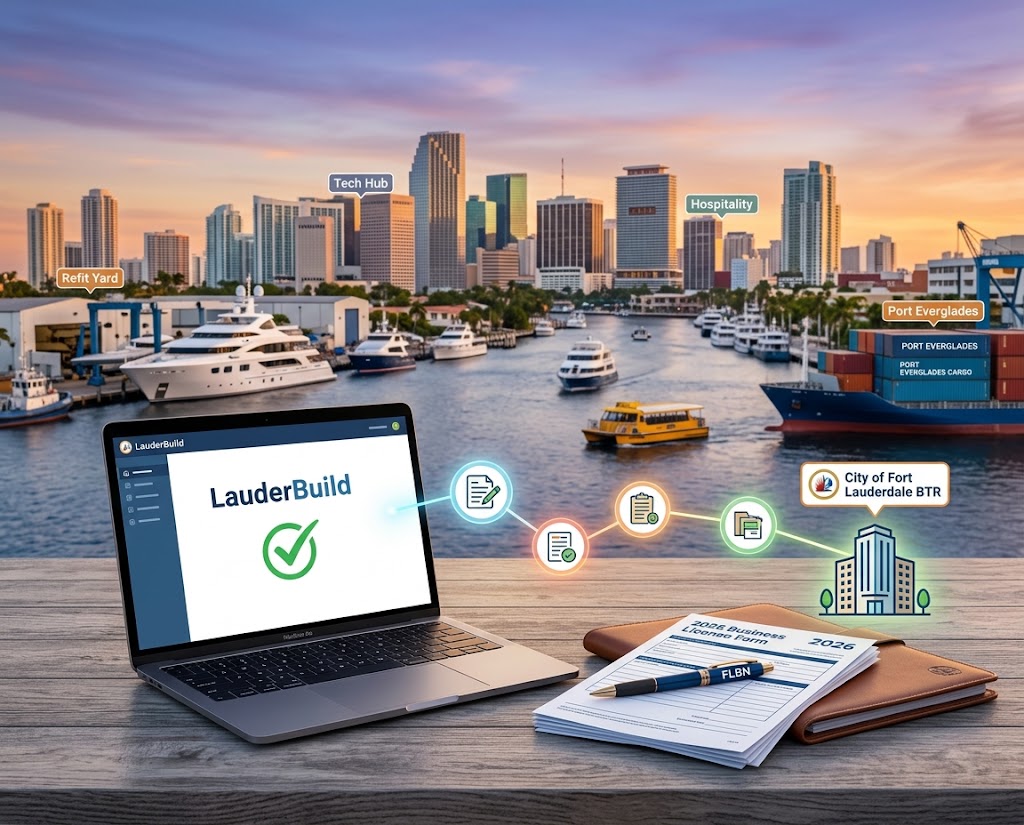
Fort Lauderdale handles business tax applications online through LauderBuild, the city’s permitting and licensing portal. The process follows a clear sequence:
- Confirm the business address is inside Fort Lauderdale city limits. Many addresses with a “Fort Lauderdale” mailing label actually sit in unincorporated Broward or a neighboring city.
- Create a LauderBuild account.
- Submit the business tax application with supporting documents.
- A Business Tax Specialist reviews the file and, if complete, requests a zoning review.
- Pay the invoice once all approvals clear.
- Receive the receipt electronically.
Supporting documents typically include entity registration records, government-issued identification, professional licenses where relevant, and a certificate of liability insurance for certain business classifications.
Why Zoning Review Matters
Zoning is where many Fort Lauderdale applications stall. The city verifies that the property allows the proposed use. If zoning or building staff determine that the business represents a change of use from the prior tenant, additional building review may be required before the receipt can be issued. A restaurant moving into a former retail shop, for example, often triggers questions about occupancy, fire safety, parking, and grease handling.
The practical lesson: confirm zoning before signing a lease. A lease on a space that cannot legally host your use is one of the costliest errors a new business can make.
State Licenses That Come First
For many regulated professions, the city will not issue a receipt until the state license is in hand. The city’s checklist names businesses that need clearance from agencies such as the Florida Department of Health, the Agency for Health Care Administration, and the Florida Department of Agriculture and Consumer Services before a receipt can be issued.
The Broward County Receipt
Broward County’s Local Business Tax applies to virtually any business or profession operating in the county, including one-person and home-based companies, unless specifically exempted. Key rules:
- A separate receipt is required for each location and each category of business conducted.
- Fees start from a base rate set by county ordinance and are adjusted by headcount at each location.
- Receipts are valid October 1 through September 30.
- Broward does not accept receipts from other counties.
- Businesses in unincorporated Broward need a Certificate of Use from the county’s permitting division before the receipt is issued.
State-certified contractors holding a receipt from their home Florida county can generally work statewide without a Broward receipt, though some Broward cities still require one before issuing construction permits.
Renewal Penalties Add Up Fast
Broward County mails renewal notices each July 1. Unpaid receipts become delinquent on October 1, with penalties that step up monthly from 10% to 25% of the tax, plus a $25 Tax Collector fee once the account runs late into the fall.
Businesses that operated without a receipt face a steeper bill. Back taxes are assessed for every year the business operated unlicensed, each with the full annual fee, a 25% penalty, and a $25 collector fee.
Exemptions
Broward exempts certain charitable, religious, and fundraising organizations, along with qualifying disabled persons, seniors, widows with minor dependents, veterans, spouses of veterans, certain service members, and low-income persons. Exempt applicants still need a receipt; they simply do not pay the tax.
How Do Home-Based Businesses Work in Fort Lauderdale?
Quick Take
- Florida law limits how cities can regulate qualifying home-based businesses.
- Home-based businesses still need the city and county business tax receipts.
- Fort Lauderdale requires a home-based business affidavit as part of the application.
Since 2021, Section 559.955 of the Florida Statutes has restricted local governments from banning or over-regulating home-based businesses. A business qualifies when it operates from a residential property and meets several conditions:
- Parking demand is no greater than a typical residence and complies with local zoning.
- Exterior changes match the neighborhood’s residential character.
- Retail transactions are not conducted in a structure other than the home itself.
- Business activity is secondary to the home’s use as a residence.
- Employee limits are observed for people working at the dwelling, though remote employees are unlimited.
A qualifying home-based business is subject only to the business taxes under Chapter 205 in its county and city. In practice, that means the city and Broward receipts still apply.
Fort Lauderdale requires applicants to sign a Home-Based Business Affidavit acknowledging these conditions, including that work must be conducted within a fully enclosed building and that the business complies with all local, state, and federal rules.
Homeowners in condominiums or HOA communities should also check their association documents. State protection against local government restrictions does not override private covenants.
Phase 3: What Industry-Specific Permits Apply in Fort Lauderdale?
Quick Take
- Restaurants, bars, vacation rentals, and marine businesses each carry state-level licensing on top of local receipts.
- Full liquor licenses in Broward County are limited by a population-based quota.
- Fort Lauderdale vacation rentals must be licensed by the state and county before applying to the city.
Marine, Maritime, and Dockside Operations
Fort Lauderdale’s marine industry is one of its economic anchors, and it carries its own licensing mix. The exact permits depend on what a company does:
| Marine Activity | Typical Licensing Layer |
|---|---|
| Yacht brokerage | State yacht and ship broker license (DBPR) |
| Charters with paying passengers | U.S. Coast Guard credential for the captain |
| Marinas and dock construction | Broward environmental and state/federal waterway permits |
| Port Everglades operations | Port authorization through Broward’s Port Everglades Department |
| Waterborne vending | City street vendor business tax classification |
Marine businesses also face the same city and county tax receipts as any other company. Firms working on or near the water should budget extra time for environmental review, which typically moves slower than standard business licensing.
Restaurants, Food Service, and Alcohol
Restaurants in Fort Lauderdale need a food service license from the Florida DBPR Division of Hotels and Restaurants, along with fire safety inspections and the local receipts. Grocery and retail food sellers are generally licensed by the Florida Department of Agriculture and Consumer Services instead.
Alcohol adds another layer. Liquor licenses are issued by the DBPR Division of Alcoholic Beverages and Tobacco (ABT), and Florida’s quota system shapes the market:
| License | What It Allows | Key Constraint |
|---|---|---|
| 2COP | Beer and wine on premises | No quota |
| 4COP-SRX | Full liquor for qualifying restaurants | Seating, size, and food sales rules |
| 4COP quota | Full liquor, typical of bars | One new license per 7,500 residents per county |
New quota licenses are created as a county grows and are awarded through an annual state drawing. Broward was among the counties with new quota licenses in the 2025 drawing. Businesses that miss the drawing usually buy an existing quota license on the private market, which can cost far more than the state fees.
The ABT application requires detailed disclosures about owners, officers, and investors, along with Florida Department of Revenue clearance. Standard applications commonly take one to three months.
Vacation Rentals and Short-Term Leasing
Fort Lauderdale reverses the usual order for vacation rentals. The city requires every vacation rental to be licensed with the state and county before applying to the city, and the city business tax account is created only after the vacation rental registration is approved.
The required sequence:
- Get a transient public lodging license from DBPR (owner-occupied homesteads renting only a room can substitute a notarized letter).
- Register with the Florida Department of Revenue for sales tax, unless every booking platform collects on your behalf.
- Register with the Broward County Tourist Development Tax Section.
- Apply for city vacation rental registration through LauderBuild.
- Pay the registration fee and the city business tax, then pass inspection.
The city’s registration fee is $880 for up to four units under one folio, including the first inspection. After a 2023 ordinance amendment, every registered rental must also have a noise detection device that alerts the owner and guests, with data kept for 180 days. Operating during a suspension can bring fines of up to $5,000 per day for repeat violations.
The tax stack is significant. Short-term rentals in Broward typically collect 6% state sales tax, 1% county surtax, and the 6% Broward Tourist Development Tax, for 13% in total.
Phase 4: What Tax Incentives Are Available in Fort Lauderdale in 2026?
Quick Take
- Florida’s Qualified Target Industry (QTI) tax refund is gone. It expired in 2020 and was repealed in 2023.
- Broward County’s local job incentives are now the main cash tools for expanding employers.
- Florida’s 2025 repeal of the commercial rent sales tax cut costs for every business that leases space.
Correcting the Record on QTI
Many startup guides still advise Fort Lauderdale businesses to apply for the “Targeted Industry Tax Refund.” That advice is out of date. The Qualified Target Industry tax refund program expired on June 30, 2020, when the Legislature did not renew it. In 2023, House Bill 5 formally repealed QTI along with Enterprise Florida and several other incentive programs.
Broward County notes that payments continue only for projects approved before the program expired. No new QTI applications are accepted. Economic development groups, including Florida TaxWatch and the Florida Economic Development Council, have pushed to restore it, but as of October 2026, no replacement program has been enacted.
The QTI definition does survive in one place. Florida’s research and development tax credit still uses the “qualified target industry business” standard to decide which companies are eligible.
Broward County’s Local Incentives
With QTI gone, Broward County built its own tools. The Greater Fort Lauderdale Alliance, Broward’s official public-private economic development partnership, helped design them.
| Incentive | Who Qualifies | Typical Award |
|---|---|---|
| Strategic Job Creation Incentive (SJCI) | Targeted industry and manufacturing employers | Up to $2,000 per job, $1M cap per company |
| Direct Cash Job Growth Incentive | High-wage job creators, county and city jointly | Up to $2,000 per job at 115%+ of county wage |
| Quick Response Training | Relocating or expanding Florida firms | Customized training grants |
| High Impact Performance Incentive | Large projects in high-impact sectors | Negotiated grants |
The SJCI was formalized in late 2023 and is performance-based: awards follow verified job creation, not promises. The Job Growth incentive requires both Broward County and the host city to participate, which means Fort Lauderdale’s commission is part of the approval.
According to the Alliance’s fiscal 2025 report, it helped 12 companies establish or expand operations in Broward that year, using the SJCI, municipal incentives, and training programs.
Companies considering a relocation or expansion should contact the Alliance before choosing a site. Incentive programs generally require that the company has not yet committed to the location.
The Commercial Rent Tax Is Gone
The most broadly felt tax change in years took effect on October 1, 2025. Under House Bill 7031, Florida repealed its sales tax on commercial rent, ending a 57-year levy that had already been reduced to 2% plus county surtax. Florida had been the only state charging sales tax on commercial leases.
For Fort Lauderdale tenants, that means no state sales tax or Broward surtax on rent for occupancy periods starting on or after October 1, 2025. Tenants should confirm that landlords removed the tax from invoices and from automatic payments, and check year-end common area reconciliations for errors.
Sales Tax and Reemployment Tax Registration
Businesses selling taxable goods or services must register with the Florida Department of Revenue before collecting tax. Broward’s combined rate is 7%: 6% state plus a 1% county surtax. Employers also register with the Department of Revenue for reemployment tax, Florida’s unemployment insurance program, once they hire.
Florida has no personal income tax, a point the Alliance highlights when recruiting executives. Corporations, however, may still owe Florida corporate income tax.
Fort Lauderdale Business Setup: Step-by-Step Reference Table
| Step | Agency | Typical Timing | Cost Notes |
|---|---|---|---|
| 1. Form entity | FL Division of Corporations (Sunbiz) | Days | State filing fee |
| 2. Get EIN | IRS | Same day online | Free |
| 3. State license (if regulated) | DBPR, DOH, FDACS, others | Weeks to months | Varies by license |
| 4. Confirm zoning | City of Fort Lauderdale | Before signing lease | Free to inquire |
| 5. City Business Tax Receipt | City of Fort Lauderdale (LauderBuild) | Weeks, with zoning review | Based on classification |
| 6. County Business Tax Receipt | Broward County Tax Collector | After city receipt | Base rate plus headcount |
| 7. Sales tax registration | FL Department of Revenue | About 3 business days online | Free online |
| 8. Reemployment tax | FL Department of Revenue | When hiring | Payroll-based |
| 9. Annual report | Sunbiz | Jan 1–May 1 yearly | $138.75 LLC |
| 10. Renew local receipts | City and county | By Sept 30 yearly | Penalties from Oct 1 |
Brian’s Take
The Fort Lauderdale licensing process is not designed to keep businesses out. It is designed by many agencies that rarely talk to each other, and the burden of coordinating them falls on the owner.
Three lessons stand out from looking at this system closely. First, zoning is the real gatekeeper. The city tax receipt itself is routine; the zoning review behind it is where the timeline is won or lost. Every founder should have zoning confirmed in writing before signing a lease.
Second, the incentive landscape has changed more than most advice reflects. Guides that still point owners to QTI are describing a program that has not accepted new applicants in six years. Broward County’s local programs are the real tools now, and they reward companies that talk to the Greater Fort Lauderdale Alliance before picking a site, not after.
Third, the quiet win for small business is the end of the commercial rent tax. It is not a headline incentive, but every tenant in every strip center and office tower in Fort Lauderdale is paying less to occupy space. For a business leasing a few thousand square feet, that is real money every month, with no application required.
Frequently Asked Questions
Do I need both a city and county business license in Fort Lauderdale?
Yes. Most businesses need a City of Fort Lauderdale Business Tax Receipt and a separate Broward County Local Business Tax Receipt. The city receipt usually comes first.
How do I apply for a Fort Lauderdale Business Tax Receipt?
Apply online through the city’s LauderBuild portal. A Business Tax Specialist reviews the application, a zoning review follows, and the receipt is issued electronically after fees are paid.
When do Fort Lauderdale business tax receipts expire?
City and Broward County receipts run from October 1 through September 30. Renewal payments are due by September 30, and unpaid Broward receipts become delinquent on October 1.
Does a home-based business in Fort Lauderdale need a license?
Yes. Qualifying home-based businesses are protected from most local restrictions under state law but still need city and county business tax receipts. Fort Lauderdale also requires a home-based business affidavit.
Is the Florida QTI tax refund still available?
No. The Qualified Target Industry tax refund expired in 2020 and was repealed in 2023. Broward County’s Strategic Job Creation Incentive and Job Growth Incentive are the main local alternatives.
What taxes do Fort Lauderdale vacation rentals collect?
Short-term rentals in Broward typically collect 6% state sales tax, a 1% county surtax, and the 6% Broward Tourist Development Tax, about 13% in total.
This guide is for general information and is not legal or tax advice. Fees, rules, and programs change; confirm current requirements with the relevant agency or a licensed professional before acting.
Sources and Further Reading
- City of Fort Lauderdale, Business Tax Receipt Information and Frequently Asked Questions
- City of Fort Lauderdale, Business Tax Application Checklist and Home-Based Business Affidavit
- City of Fort Lauderdale, Vacation Rental Program and Vacation Rental Registration
- Broward County Records, Taxes and Treasury Division, Local Business Taxes
- Broward County Tax Collector, Business Tax Receipt and Local Business Tax FAQ
- Broward County, Tourist Development Tax
- Broward County Office of Economic and Small Business Development, Business Attraction Incentives
- Greater Fort Lauderdale Alliance, Incentives and 2025 Annual Economic Development Activity Report
- Florida Senate, 2023 Bill Summary: CS/CS/HB 5, Economic Programs
- Florida Statutes, Section 559.955, Home-Based Businesses
- Florida Department of State, Division of Corporations (Sunbiz), Annual Report Filing Requirements
- Florida Department of Business and Professional Regulation, Quota Beverage License Drawing
- Florida Department of Revenue, Local Option Transient Rental Tax Rates
- Holland & Knight, Florida HB 7031 and the Repeal of the Business Rent Tax
About the Author