By Brian French | Florida Authority Network | October 23, 2026
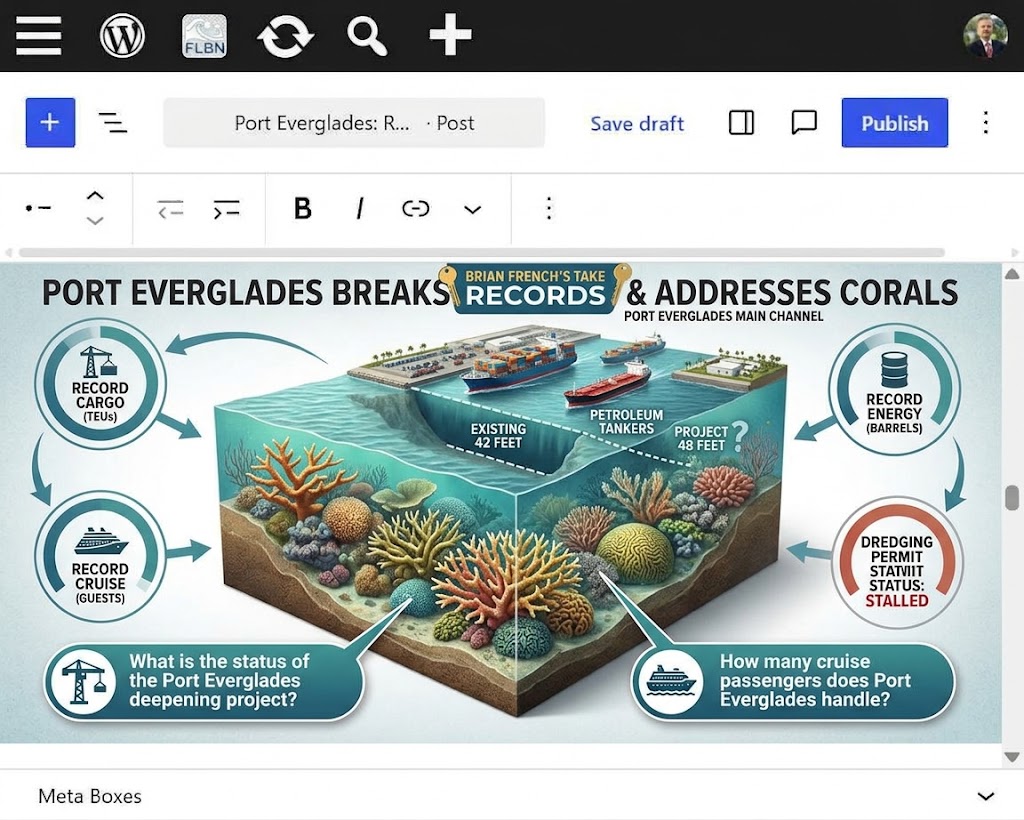
Quick Answer: Port Everglades set records in cargo, cruise, and petroleum in fiscal 2025, but its channel is still 42 feet deep. The Army Corps’ plan to deepen it to 48 feet faces coral-reef concerns, rising costs, and a 2026 permit setback. The final environmental decision was expected around November 2026, with dredging unlikely before 2028.
Why Is Port Everglades So Important to Broward County?
Quick Take
- Port Everglades is Florida’s top petroleum port, a leading container port, and the world’s third-busiest cruise homeport.
- Fiscal 2025 was the first year it set records in all three business lines at once.
- A new study puts its statewide economic activity at about $48.3 billion.
Most Broward residents know Port Everglades as the place cruise ships leave from. Fewer realize how much of South Florida’s daily life runs through it. The port supplies petroleum products to 12 Florida counties and five international airports. It moves the containers that stock regional stores. And it hosts nearly 5 million cruise passengers a year.
Fiscal year 2025, which ended September 30, 2025, was a landmark. For the first time in its modern history, the port set records in cruise, cargo, and energy simultaneously.
The port’s economic footprint grew in the latest analysis as well. A Martin Associates study for fiscal 2025 estimated that Port Everglades generates about $48.3 billion in economic activity and supports nearly 300,000 jobs across Florida, including roughly 13,139 jobs directly dependent on port activity. The jump from the prior year’s $28.1 billion figure largely reflects a change in methodology: the new study counts the full downstream impact of petroleum distribution, which earlier reports had not.
Port Everglades operates as a self-supporting enterprise fund of Broward County government. It pays for operations and capital projects through user fees rather than local property taxes.
Port Everglades by the Numbers: Fiscal Year 2025
Quick Take
- Container volume: a record 1,167,552 TEUs.
- Petroleum: a record 131.9 million barrels.
- Cruise: a record 4.77 million guests, up 16%.
| Business Line | FY2025 Result | Notes |
|---|---|---|
| Containers | 1,167,552 TEUs | All-time port record |
| Petroleum | 131,855,261 barrels | Florida’s No. 1 petroleum port |
| Cruise guests | 4,773,873 | Up 16% year over year |
| Cruise fleet | 40 ships, 9 lines | Plus a daily ferry |
| Statewide economic activity | ~$48.3 billion | Martin Associates, FY2025 |
| Direct jobs | ~13,139 | Up more than 7% |
| State and local taxes | ~$1.9 billion | Paid by port-dependent activity |
Trade Lanes
Port Everglades’ cargo business leans heavily south. In fiscal 2025, the port handled more than 266,000 TEUs of trade with the Caribbean, about 26% of that region’s U.S. port cargo, and more than 437,000 TEUs with Latin America. It also moved more than 147,000 TEUs of refrigerated cargo, an important niche for produce and perishables.
Fiscal 2026
The port’s 2026 fiscal year closed on September 30, 2026. Official full-year figures are typically released in late fall. Heading into the year, the port forecast that cruise volumes would rise again, based on the 2025–26 season schedule.
What Is the Status of the Port Everglades Deepening Project?
Quick Take
- The plan would deepen the main channel from 42 feet to 48 feet and widen key choke points.
- Surveys found roughly 10 million corals in and around the project area.
- The Army Corps withdrew a permit application in April 2026, and a final environmental decision was expected around November 2026.
What the Project Would Do
The Port Everglades Navigation Improvements Project is a U.S. Army Corps of Engineers effort to deepen the port’s main navigation channels from 42 feet to 48 feet, plus allowable overdepth to about 50 feet, and to widen the entrance channel and the tight Southport Access Channel.
The business case is straightforward. Today’s largest container ships and petroleum tankers can enter Port Everglades, but often only partly loaded. Port officials say vessels from Europe and South America already call at the port but must arrive lightly loaded, which raises shipping costs per container or barrel.
When the county signed its partnership agreement with the Corps, port officials projected the project would create nearly 1,500 permanent direct jobs from added cargo capacity, along with an estimated 2,200 construction jobs.
A Project Three Decades in the Making
The project’s history is long and its price has climbed:
| Milestone | Detail |
|---|---|
| Original Corps study | Began in the late 1990s |
| 2015 Chief’s Report | Approved with a cost estimate near $374 million |
| 2016 WIIN Act | Authorized federal participation |
| 2020 “New Start” | $29.1 million in initial federal funding |
| 2024 coverage | Estimated cost cited around $1.3 billion |
| April 3, 2026 | Corps withdrew its permit application |
| 2025 Corps fact sheet | Final EIS and decision expected November 2026 |
| Contract solicitation | Scheduled for summer 2027 |
A Port Everglades spokesperson told Sierra magazine in 2026 that the project’s cost has quadrupled over three decades and that it will be one of the most scrutinized and environmentally sensitive dredging projects in the country.
The Coral Question
The core obstacle is ecological. Scientists working with Shedd Aquarium documented roughly 10 million corals in and around the main channel, including endangered staghorn coral that has become extremely rare in Florida after recent marine heat waves.
Environmental groups point to PortMiami’s 2013 to 2015 deepening, during which sediment smothered large areas of reef. The Army Corps’ project manager for Port Everglades has said the agency does not intend to dredge the same way here, and the port has proposed what it describes as the largest coral nursery in U.S. history as part of mitigation.
Port Everglades has already completed part of its required mitigation, restoring seagrass and mangroves at West Lake Park south of the port.
A Separate Dredging Fight
Readers should not confuse the channel project with the Port Everglades Sand Bypass Project, a separate Broward County effort to move sand across the inlet to nourish beaches. That project began dredging in October 2025. In August 2026, conservation groups sued over Endangered Species Act concerns, and the Corps agreed to halt authorization for its dredging while the issue is reviewed.
What It Means for Business
As of mid-October 2026, the realistic expectation is that full channel dredging will not start before 2028, and possibly later. Shipping lines will continue to use Port Everglades with draft limits, and some cargo that would benefit from deeper water will continue to route through ports that already have it.
How Does Port Everglades Manage Cruise-Day and Cargo Congestion?
Quick Take
- Cruise days bring tens of thousands of passengers and thousands of vehicles through the same roads that serve cargo and fuel trucks.
- Gate appointment systems and digital payment tools are reducing truck queues at container terminals.
- Physical expansion at Southport added berth length and the largest low-profile cranes of their kind.
The Congestion Challenge
Port Everglades is unusual among major ports because cruise, cargo, and petroleum operations share one compact footprint near Fort Lauderdale-Hollywood International Airport and the Broward County Convention Center. On a peak cruise day, multiple ships turn around in hours, while container trucks and fuel tankers continue moving through the same corridors.
Managing that overlap is as much a scheduling problem as a construction problem.
Digital Tools in Use
Port and terminal operators rely on several types of software to keep traffic moving:
| Tool | What It Does | Who Benefits |
|---|---|---|
| Terminal operating systems (TOS) | Track container location, vessel stowage, and yard moves | Terminal operators |
| Gate appointment systems | Assign truckers time slots to reduce queues | Truckers, shippers |
| Online fee payment | Lets users pay terminal fees before arrival | Truckers, brokers |
| Vessel scheduling | Coordinates berth assignments across cruise and cargo | Port operations |
One documented example: in 2023, Port Everglades Terminal adopted Advent eModal’s community portal to run a gate appointment system and automate fee payment. Appointment systems spread truck arrivals more evenly across the day, which matters most on cruise days when road space is scarce.
Physical Capacity at Southport
Software works best with physical room. The $471 million Southport Turning Notch Extension lengthened the main cargo berth area from about 900 feet to 2,400 feet, enough for up to five additional berths. The port estimated the extension adds about 730,000 TEUs of capacity.
The project also brought six Super Post-Panamax cranes, described by the port as the world’s largest low-profile cranes of their kind. At 175 feet tall, they can reach 22 containers across a ship’s deck, compared with 16 for the port’s older cranes, which are limited by height restrictions tied to the nearby airport.
When the final cranes were commissioned in 2024, the port ranked in the top quarter of ports worldwide for operational efficiency on the World Bank’s Container Port Performance Index.
Where Should E-Commerce Brands Position Warehouses Near Port Everglades?
Quick Take
- Southeast Broward led the county in industrial absorption in mid-2026.
- Broward industrial vacancy was 6.2% in the second quarter of 2026.
- The right site depends on whether a brand imports by container, ships by truck, or serves cruise and hospitality demand.
The Industrial Market
E-commerce brands that import through Port Everglades want to minimize drayage, the short truck trip between port and warehouse. Every mile saved reduces cost and time.
CBRE’s second-quarter 2026 data showed Broward’s industrial market with 6.2% vacancy and average asking rent of $17.58 per square foot, up 6.9% year over year. Southeast Broward, the submarket closest to the port, posted the highest net absorption in the county at 164,000 square feet. About 1.2 million square feet of industrial space was under construction countywide.
Siting Guide
| Location | Advantage | Best For |
|---|---|---|
| Southeast Broward (Dania Beach, Hollywood, port-adjacent) | Shortest drayage to port | High-volume importers |
| I-595 corridor (Davie, Plantation) | Fast access to I-95, I-75, Florida’s Turnpike | Regional distribution |
| Pompano Beach and north Broward | More space, Palm Beach access | Brands serving the tri-county area |
| Southwest Broward (Miramar) | Proximity to Miami-Dade | Brands also using PortMiami |
Foreign-Trade Zone Advantages
Port Everglades is home to Foreign-Trade Zone No. 25. Companies operating within a foreign-trade zone can defer, reduce, or in some cases eliminate U.S. customs duties on imported goods until they enter U.S. commerce. Brands that re-export to Latin America or the Caribbean, which aligns with Port Everglades’ core trade lanes, should evaluate whether FTZ status fits their model.
Practical Advice
E-commerce brands should weigh three questions before signing a lease:
- Where does inventory arrive? Container imports favor port-adjacent sites; air freight favors sites near FLL.
- Where are customers? Brands serving all of South Florida may prefer the I-595 corridor’s central location.
- How time-sensitive are orders? Same-day delivery favors smaller, closer urban sites even at higher rents.
How Is Port Everglades Moving Toward Cleaner Marine Fuels?
Quick Take
- Port Everglades completed its first shore-to-ship LNG bunkering on March 26, 2026.
- LNG is now available at the port for both landside and waterside delivery.
- Cleaner fuels matter because cruise lines are ordering LNG-capable ships.
The First LNG Bunkering
On March 26, 2026, Sawgrass LNG & Power completed the first shore-to-ship liquefied natural gas bunkering operation at Port Everglades, fueling the Ritz-Carlton Yacht Collection vessel Ilma. The operation required coordination among the port, the U.S. Coast Guard Sector Miami, the Broward Sheriff’s Office, and contractor REV.
Port Everglades’ Assistant Director of Energy and Innovation, Neil Kutchera, said the port now has LNG available for both landside and waterside delivery.
Why It Matters
LNG emits less sulfur and particulate matter than traditional marine fuel oil, and cruise lines have been adding LNG-powered ships to their fleets. A homeport that can supply LNG has an advantage when lines decide where to base those ships.
The Bigger Energy Picture
Port Everglades’ energy role remains rooted in petroleum. It is South Florida’s main receiving point for gasoline, diesel, and jet fuel, and that business will not disappear soon. The near-term transition is about adding cleaner fuel options for vessels, not replacing the port’s petroleum function.
Future steps may include broader bunkering availability, emissions reporting, and other alternative fuels as international maritime standards evolve. Businesses supplying marine fuel, emissions monitoring, or related services should watch the port’s energy and innovation initiatives closely.
What Is Port Everglades Planning Next?
Quick Take
- The port’s long-term Master/Vision Plan includes more than $3 billion in capital improvements.
- Plans cover cargo, cruise, and energy capacity.
- The channel project remains the largest uncertainty.
Port Everglades’ Master/Vision Plan calls for more than $3 billion in long-term capital improvements to expand capacity, efficiency, and sustainability across its three business lines. The Southport expansion and new cranes were major completed pieces. Cruise terminal upgrades, energy infrastructure, and the navigation project are among the remaining priorities.
For businesses that depend on the port, the key variables to monitor over the next 24 months:
- The channel decision: whether the Corps issues its final environmental decision and moves toward a 2027 contract solicitation.
- Coral mitigation: the scope and cost of mitigation, which could reshape the project.
- Fiscal 2026 results: whether the port extends its record streak.
- LNG adoption: how many vessels use the port’s new bunkering capability.
- Industrial supply: whether new warehouse space near the port keeps pace with demand.
Brian’s Take
Port Everglades is doing something that sounds contradictory: setting records while its biggest infrastructure project stays stuck.
The explanation is that the port has invested in what it can control. It lengthened its berths, bought taller cranes, improved its scheduling technology, and added LNG. Those investments delivered the record year. The channel is the one piece that depends on federal agencies, environmental law, and coral biology, and it has moved slowly for three decades.
The honest read is that the channel will happen eventually, but later and at a higher cost than anyone planned. The 10 million coral finding changed the conversation, and PortMiami’s experience means regulators and courts will not accept a shortcut. Businesses should plan as if the 42-foot channel is the reality through at least 2028.
For companies in Broward, the opportunity is not waiting for the channel. It is building around what already works: Latin American and Caribbean trade, refrigerated cargo, petroleum distribution, and the world’s third-largest cruise homeport. Those are durable advantages, and they do not require another foot of water.
Frequently Asked Questions
What is the status of the Port Everglades deepening project?
The project to deepen the channel from 42 to 48 feet has been delayed by coral reef concerns and rising costs. The Army Corps withdrew a permit application in April 2026, a final environmental decision was expected around November 2026, and full dredging is not expected before 2028.
How many cruise passengers does Port Everglades handle?
Port Everglades welcomed a record 4,773,873 cruise guests in fiscal 2025, up 16% from the prior year, making it the world’s third-busiest cruise homeport.
How much cargo does Port Everglades handle?
The port handled a record 1,167,552 TEUs in fiscal 2025, with strong trade ties to the Caribbean and Latin America.
What is the economic impact of Port Everglades?
A Martin Associates study for fiscal 2025 estimated about $48.3 billion in economic activity and nearly 300,000 supported jobs statewide, including about 13,139 direct jobs.
Does Port Everglades offer LNG fuel for ships?
Yes. The port completed its first shore-to-ship LNG bunkering on March 26, 2026, and LNG is now available for both landside and waterside delivery.
Sources and Further Reading
- Port Everglades, “Port Everglades Shatters Its Own Records,” December 2025
- The Maritime Executive, “Port Everglades: A Diversified Cargo Gateway Built for Performance,” March 2026
- Port Everglades, “Port Everglades Contributes $48.3 Billion in Economic Impact”
- Container News, “Port Everglades Demonstrates Significant Economic Impact”
- Florida Ports Council, “Port Everglades Channel Deepening and Widening Project”
- Business Facilities, “Port Everglades Expansion Wins Army Corps Approval”
- AJOT, “Port Everglades Construction New Start a Major Milestone”
- Sierra Magazine, “The Financial and Ecological Risks of a Contested Florida Dredging Project,” July 2026
- Florida Bulldog, “Port Everglades Dredging Project Puts Fragile Reef System at Risk,” April 2026
- WLRN and Inside Climate News, “Ten Million Corals Are in the Path of a Federal Dredging Project in Florida”
- Local 10 News, “Port Everglades Corals Surveyed Ahead of Widening Project”
- Broward County, Port Everglades Sand Bypass Project
- Port Technology International, “Port Everglades Acquires New STS Container Gantry Cranes”
- Air Freight News, “Port Everglades Marks Commissioning of New Container Cranes”
- CBRE Research, Fort Lauderdale Industrial Figures, Q2 2026
About the Author