By Brian French | Florida Authority Network | October 24, 2026
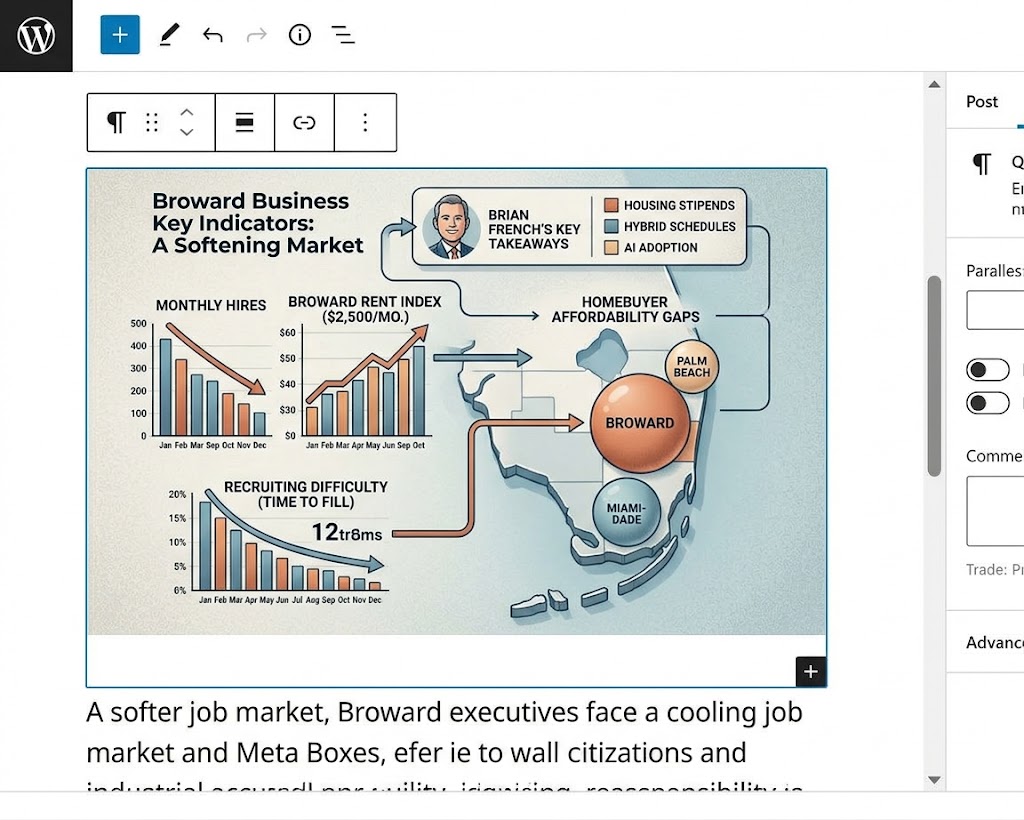
Quick Answer: Broward executives face a cooling job market and housing that still costs more than local wages support. Unemployment reached 4.6% in July 2026, up from 3.9% a year earlier. Employers retaining talent are using housing support, hybrid schedules, and targeted AI adoption, while life sciences and pharmaceutical manufacturing add high-wage jobs.
What Economic Reality Do Broward Executives Face in Late 2026?
Quick Take
- Broward’s labor market has softened: unemployment is up, total jobs are roughly flat.
- Housing costs remain far above what a median household income comfortably supports.
- Growth is shifting toward health care, construction, government, and life sciences.
For most of the early 2020s, Broward County’s challenge was finding enough workers. In late 2026, the picture is more mixed. Hiring has cooled, but the cost of living that made recruiting difficult has not come down much.
According to FloridaCommerce data released through CareerSource Broward, the county’s unemployment rate was 4.6% in July 2026, up from 3.9% a year earlier and equal to the statewide rate. Nonfarm employment in the Fort Lauderdale-Pompano Beach-Sunrise metro division was 908,200, down 400 jobs from a year earlier. The labor force shrank by about 0.8%.
The sector mix matters more than the headline:
| Sector | Direction (July 2026, year over year) |
|---|---|
| Education and Health Services | Up 2.5% |
| Construction | Up 1.9% (+1,000 jobs) |
| Government | Up 1.3% (+1,300 jobs) |
| Leisure and Hospitality | Up 600 jobs |
| Manufacturing | Up 300 jobs |
| Professional and Business Services | Down 1,600 jobs |
| Financial Activities | Down 400 jobs |
For comparison, Miami-Dade’s unemployment rate was 2.5% in July 2026 and Palm Beach County’s was 4.8%.
The practical takeaway: Broward employers have somewhat more leverage in hiring than they did two years ago, but the employees they most want to keep, skilled and mid-career workers, still face housing costs that push them to look elsewhere.
How Bad Is the Housing Affordability Gap in Broward?
Quick Take
- A typical Broward home requires an income well above the county median.
- Asking rents have climbed to roughly $2,500 a month.
- The for-sale market has cooled into buyer-friendly territory, but prices remain high.
The Numbers
Housing data for Broward varies by source and methodology, but the direction is consistent:
| Measure | Figure | Source Basis |
|---|---|---|
| Median household income | ~$74,500 | U.S. Census ACS estimates |
| Typical asking rent | ~$2,500/month | Zillow Observed Rent Index, mid-2026 |
| Fort Lauderdale median closed price | ~$460,000 | Local MLS data, August 2026 |
| Estimated income needed for median home | ~$127,000 | Mortgage, tax, insurance at 10% down |
| Listings with price cuts | ~16% | Broward county data, spring 2026 |
At those figures, a household earning the county median would spend well over a third of income on a typical rental and could not comfortably qualify for a median-priced home without substantial savings or a second income.
What Has Changed
Two developments soften the picture slightly. First, the for-sale market has cooled. Longer days on market and more price reductions give buyers more negotiating room than in 2022 or 2023. Second, Florida’s Live Local Act continues to push workforce housing into the pipeline.
Insurance and property taxes remain a wild card. For many Broward homeowners, rising insurance premiums have offset any relief from flat or softening prices.
How Are Broward Employers Fighting High Housing Costs?
Quick Take
- Employers are using direct housing stipends, down payment help, and partnerships with developers.
- Hybrid schedules let workers live farther away without long daily commutes.
- State policy is expanding where workforce housing can be built.
Employer Housing Strategies
Executives have a growing menu of tools. None is a complete answer, but combinations work.
| Strategy | How It Works | Best For |
|---|---|---|
| Monthly housing stipend | Taxable cash added to pay for rent or mortgage | Hard-to-fill roles |
| Down payment assistance | One-time grant or forgivable loan | Retaining mid-career staff |
| Master leasing | Employer leases units and sublets to staff | Hospitals, hotels, large employers |
| Developer partnerships | Reserved units in new workforce projects | Employers with predictable hiring |
| Relocation support | Moving costs and temporary housing | Recruiting from outside Florida |
| Hybrid flexibility | Fewer commute days | Office-based roles |
State Policy Tailwinds
Live Local Act 4.0. Florida’s flagship workforce housing law received its fourth update in 2026. The changes, which took effect July 1, extend Live Local’s land-use provisions to qualifying land owned by counties, municipalities, school districts, and some religious institutions. They also bar local governments from using setbacks or similar dimensional rules to reduce the building height a qualifying project is otherwise allowed.
Live Local’s central tradeoff remains: developers can exceed local height and density limits if they reserve at least 40% of a project’s units for workforce housing. Supporters say it is finally producing units at scale. Critics in Broward, including some county commissioners and the Broward Teachers Union, argue that it lets developers bypass local oversight without delivering housing that teachers and other workers can actually afford.
Homebuyer Workforce Tax Credit. During the 2026 legislative session, lawmakers advanced HB 311 and SB 1672, which would let eligible employers contribute $1,000 to $5,000 toward an employee’s down payment or closing costs and receive a 100% state tax credit. The proposal capped credits at $500,000 per employer and $5 million statewide per year. Employers should confirm the bill’s final status with a tax advisor before building a program around it. Even as proposed, it would apply only to companies that pay Florida corporate income or insurance premium taxes, which excludes nonprofits and many small businesses.
Why Hybrid Work Matters Here
In Broward, hybrid scheduling is a housing policy as much as a workplace policy. An employee who commutes three days a week instead of five can realistically live in western Broward, southern Palm Beach County, or northern Miami-Dade, where housing may be less expensive. For employers with office-based roles, clearly defined hybrid schedules widen the hiring radius without raising salaries.
How Can Broward Companies Retain Talent Beyond Pay?
Quick Take
- Retention depends on growth paths, predictability, and recognition, not salary alone.
- Local training partners lower the cost of upskilling.
- Measuring turnover by role reveals where housing pressure bites hardest.
A softer job market does not end the retention problem. It changes it. Workers who might have left for a raise two years ago now stay, but they disengage when they see no path forward.
Practical retention levers for Broward employers include:
- Defined career ladders. Clear criteria for promotion reduce the “I have to leave to move up” problem.
- Funded training. CareerSource Broward offers training programs and hiring assistance for employers in targeted industries.
- Apprenticeships. Industry-led programs, such as the Marine Industries Association of South Florida’s apprenticeship with Atlantic Technical College, show how employers can build their own skilled pipelines.
- Schedule predictability. For hourly and shift workers, stable schedules often matter as much as pay.
- Benefits that address local costs. Commuter benefits, flexible spending, and housing support signal that leadership understands the cost of living.
How Are Broward Executives Using AI in Traditional Industries?
Quick Take
- The most productive AI uses in Broward are practical: scheduling, document work, customer service, and quality control.
- Successful adopters start with narrow, measurable problems.
- Workforce communication determines whether AI improves retention or damages it.
Broward’s economy is built on service, logistics, hospitality, health care, marine, and manufacturing. These are not sectors where AI replaces the core work. They are sectors where AI can remove friction around it.
Where AI Is Paying Off
| Industry | Practical AI Use | Typical Benefit |
|---|---|---|
| Hospitality and cruise | Demand forecasting, guest messaging | Better staffing, faster response |
| Health care | Documentation, scheduling, prior authorizations | Less clinician admin time |
| Logistics and port services | Route and appointment optimization | Fewer delays, lower fuel costs |
| Marine services | Parts inventory, estimating, inspection | Faster quotes, fewer errors |
| Professional services | Drafting, research, document review | More capacity per employee |
| Manufacturing | Predictive maintenance, quality inspection | Less downtime, fewer defects |
A Disciplined Adoption Approach
- Pick one bottleneck. Choose a process with a clear cost, such as invoice processing or appointment scheduling.
- Measure before and after. Track time, cost, and error rates.
- Keep a human in the loop. Especially for customer-facing or regulated work.
- Protect data. Set rules for what information can go into AI tools.
- Tell employees what changes. Be specific about whether AI shifts tasks, changes roles, or creates new training needs.
The Talent Connection
How executives introduce AI affects retention. Employees who see AI framed as a way to remove tedious work and create new skills tend to engage. Employees who hear only about efficiency tend to update their resumes. In a market where many workers already feel housing pressure, uncertainty about job security can tip a decision to leave.
Where Is High-Wage Job Growth Happening Outside Tourism and Marine?
Quick Take
- Pharmaceutical manufacturing and life sciences are Broward’s clearest high-wage growth story.
- Education and health services are adding jobs faster than most other sectors.
- Downtown Fort Lauderdale reports strong tech job growth since 2021.
Life Sciences and Pharmaceutical Manufacturing
The Greater Fort Lauderdale Alliance has made pharmaceutical manufacturing a priority, and the pipeline shows results:
- Lupin announced a new pharmaceutical manufacturing plant in Coral Springs to anchor U.S. production of respiratory therapies, with more than 200 skilled jobs expected by 2030.
- Pherros Biosciences in Deerfield Beach is in a multi-phase expansion to produce injectable medicines.
- Broward’s existing base includes established pharmaceutical and supplement manufacturers across the county.
By its mid-year meeting in May 2026, the Alliance reported more than $272 million in new capital investment secured in fiscal 2026 across sectors including pharmaceutical manufacturing, life sciences, aviation maintenance, finance, and travel.
Health Care
Education and health services grew 2.5% year over year in July 2026, among the fastest-growing sectors in the metro area. Hospitals, outpatient providers, and health tech firms remain steady employers even as professional services soften.
Technology
The Fort Lauderdale Downtown Development Authority reports that downtown tech jobs have grown about 20% since 2021. Broward is also home to established technology companies with deep local roots. The flip side is the 2026 decline in professional and business services jobs, a reminder that white-collar hiring has slowed even as specific sectors grow.
Aviation and Logistics
Fort Lauderdale-Hollywood International Airport remains a jobs anchor. JetBlue, now the airport’s largest carrier, has said it will continue investing at FLL. Aviation maintenance, repair, and overhaul firms are expanding as well.
The Executive Blueprint for Fall and Winter 2026: Metrics to Watch
Quick Take
- Track labor, housing, cost, and demand indicators monthly.
- Compare internal turnover against local labor market trends.
- Use county data releases as an early warning system.
| Category | Metric | Why It Matters | Where to Find It |
|---|---|---|---|
| Labor | Broward unemployment rate | Signals hiring leverage | FloridaCommerce, CareerSource Broward |
| Labor | Sector job changes | Shows where competition for talent is rising | Monthly metro employment release |
| Housing | Asking rents | Drives wage and stipend pressure | Rent indexes, local MLS |
| Housing | Days on market, price cuts | Signals buyer relief | Local MLS reports |
| Costs | Insurance renewals | Major operating and employee cost | Broker reports |
| Costs | Office and industrial rents | Facility planning | CBRE, Cushman & Wakefield |
| Demand | Port and airport volumes | Regional activity indicator | Port Everglades, FLL |
| Internal | Turnover by role | Reveals housing-driven attrition | HR systems |
| Internal | Time to fill | Measures recruiting difficulty | HR systems |
Monthly county jobs data typically arrives about three weeks after the reference month, which makes it a useful early signal for headcount planning.
Strategic Recommendations for Scaling Mid-Market Broward Businesses
Quick Take
- Use today’s softer labor market to hire and train strategically.
- Treat housing as part of compensation design.
- Adopt AI to remove friction, not to cut trust.
1. Hire Selectively Now
With unemployment higher than a year ago, mid-market companies have an opening to recruit skilled workers who were hard to attract in 2023 and 2024. Focus on roles that drive growth and are expensive to fill later.
2. Build Housing Into Total Compensation
Rather than across-the-board raises, consider targeted housing stipends or down payment assistance for roles with the highest turnover. These tools can be more cost-effective than permanent salary increases.
3. Design Hybrid Work Intentionally
Define which roles need daily presence and which do not. Use hybrid schedules to widen the geographic hiring pool.
4. Partner on Workforce Development
Work with CareerSource Broward, Broward College, Atlantic Technical College, and industry associations to build talent pipelines rather than competing only for experienced hires.
5. Adopt AI Narrowly and Transparently
Start with one or two processes that have measurable costs. Communicate clearly with employees about what changes and what new skills will be valued.
6. Engage Economic Development Partners
Companies planning to expand should contact the Greater Fort Lauderdale Alliance before committing to a site. Local incentives, including the Broward County Strategic Job Creation Incentive, typically require engagement before a final decision.
7. Watch Insurance and Facility Costs
Insurance remains one of Broward’s most volatile costs. Review coverage early and model scenarios for renewal increases.
Brian’s Take
The most important number for Broward executives right now is not the unemployment rate. It is the gap between what a typical household earns and what it costs to live here. That gap is the hidden tax on every Broward business.
A softer labor market gives employers more room in hiring, and the temptation will be to treat 2026 as a reprieve. That would be a mistake. The workers who leave Broward because of housing costs are often exactly the experienced, mid-career people who are hardest to replace. When the market tightens again, companies that used this period to build loyalty will have the advantage.
The bright spot is that Broward’s economy is quietly diversifying. Pharmaceutical manufacturing, health care, aviation maintenance, and life sciences are adding the kind of high-wage, durable jobs that make a regional economy less dependent on tourism cycles. Executives should pay attention, because those employers will compete for the same skilled workers.
For mid-market leaders, the playbook is not complicated. Hire well while you can. Treat housing as a compensation issue, not someone else’s problem. Use AI to make jobs better, not just cheaper. And talk to your workforce like the people they are, because in this market, trust is a retention tool.
Frequently Asked Questions
What is the unemployment rate in Broward County?
Broward County’s unemployment rate was 4.6% in July 2026, up from 3.9% a year earlier and equal to Florida’s statewide rate, according to FloridaCommerce data.
How are Fort Lauderdale employers dealing with high housing costs?
Employers are using housing stipends, down payment assistance, master leasing, developer partnerships, relocation support, and hybrid schedules that let workers live farther from the office.
What is the Live Local Act?
Live Local is Florida’s workforce housing law, first passed in 2023. Its 2026 update, effective July 1, expanded eligible land to include certain government- and faith-owned sites and further limited local restrictions on qualifying projects.
Which Broward industries are growing in 2026?
Education and health services, construction, and government grew in mid-2026. Pharmaceutical manufacturing and life sciences are adding high-wage jobs, led by projects such as Lupin’s planned Coral Springs plant.
How should Broward businesses approach AI adoption?
Start with a single measurable bottleneck, keep humans involved in customer-facing and regulated work, protect sensitive data, and communicate clearly with employees about how roles will change.
This article is for general information and is not legal, tax, or financial advice. Confirm the status of legislation and incentive programs with qualified advisors before acting.
Sources and Further Reading
- CareerSource Broward, Broward Unemployment Release for July 2026
- CareerSource Broward, Broward County July 2026 Unemployment Data
- Greater Fort Lauderdale Alliance, “Broward County Reports a 4.6% Unemployment Rate in July 2026”
- U.S. Census Bureau, American Community Survey Estimates for Broward County
- Momentum Research, Fort Lauderdale and Broward County Market Data, 2026
- Multi-Housing News, “Florida’s Updated Live Local Act Expands the Map. Will Capital Follow?”
- Urban Land Institute, “How ULI Helped Make Florida’s Live Local Act Work”
- Tax Credit Advisor, “The Live Local Act Finds Its Footing”
- Florida Bulldog, Live Local Act Coverage, July 2026
- Bisnow South Florida, “Florida Legislature Tweaks Live Local Act to Boost Construction Lending”
- WLRN, “Could Your Boss Help You Buy a Home? A Florida Bill Aims to Make That Happen”
- Florida TaxWatch, 2026 Legislative Session Housing Summary
- Greater Fort Lauderdale Alliance, 2026 Mid-Year Meeting Announcement
- Greater Fort Lauderdale Alliance, Fiscal Year 2025 Annual Meeting Achievements
- WLRN, “Broward’s Economic Development Arm Boasts of Strong Capital Investment in 2026”
About the Author