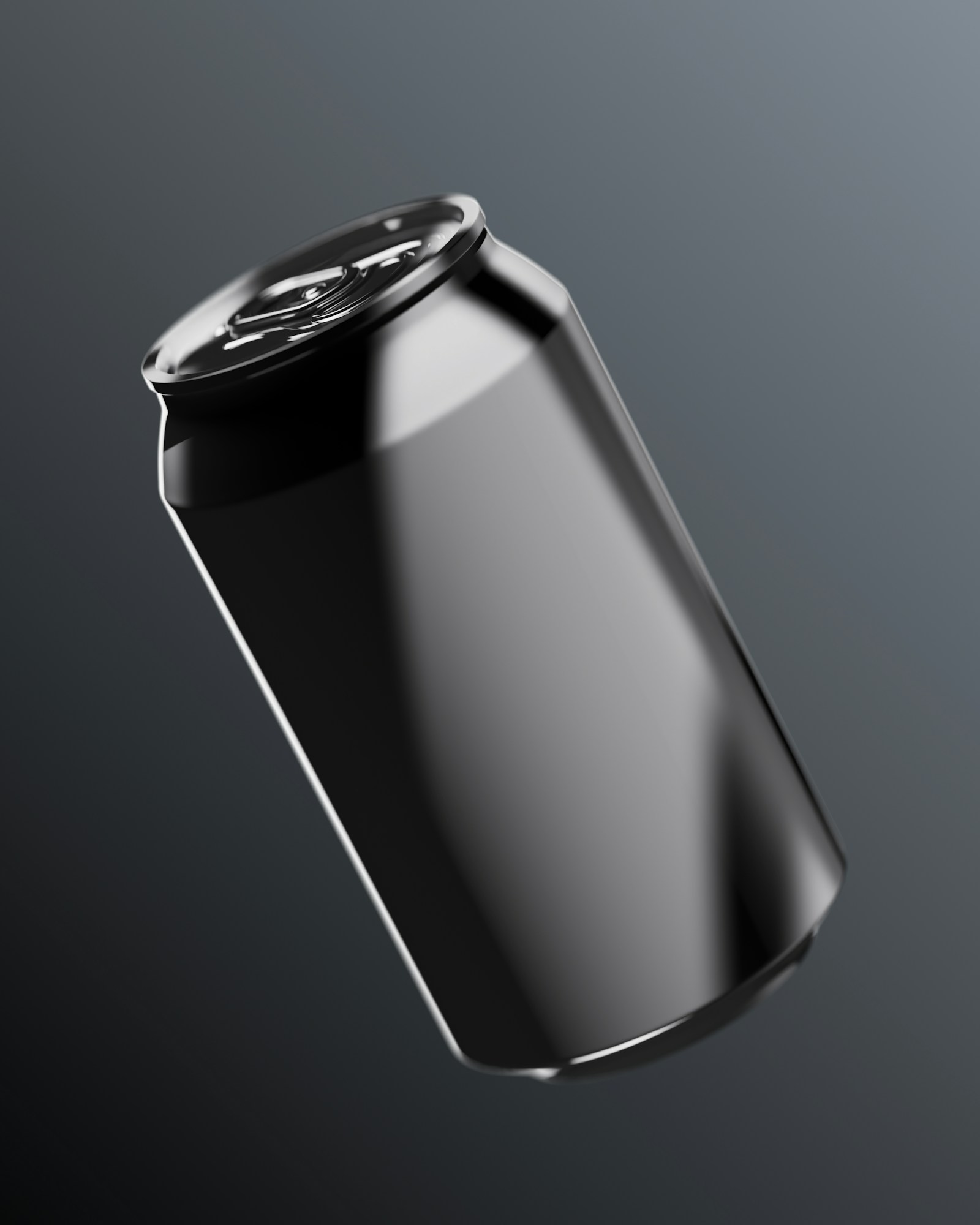
An unbranded aluminum beverage can. Photo: ObjectType RAW / Unsplash, Unsplash License.
Quick Answer: Fort Lauderdale-based National Beverage Corp. (NASDAQ: FIZZ), maker of LaCroix, Shasta and Faygo, reported first-quarter fiscal 2027 net sales of $330.7 million for the quarter ended Aug. 1, 2026, flat with a year earlier, while earnings per share fell to $0.50 from $0.60 as aluminum costs cut gross margin to 35%. For fiscal 2026, net sales were $1.18 billion, net income was $183.6 million and the company paid a $3.25-per-share special dividend worth about $304 million in July 2026.
National Beverage is a national-scale consumer staples manufacturer headquartered in Broward County, with its corporate office in Fort Lauderdale and a dozen plants spread across ten states. Its latest numbers show revenue held steady by price increases, even as case shipments fell and aluminum costs climbed.
This article covers the most recent reported quarter, the first quarter of fiscal 2027 (ended Aug. 1, 2026, reported Sept. 10, 2026), and fiscal 2026 results from the company’s Form 10-K. Second-quarter fiscal 2027 results had not been reported as of Nov. 18, 2026.
How did National Beverage perform in the first quarter of fiscal 2027?
How much revenue did National Beverage report for the quarter ended Aug. 1, 2026?
Net sales were $330.66 million, compared with $330.52 million in the quarter ended Aug. 2, 2025, a change of less than 0.1%. Underneath that flat line were two offsetting moves. Case volume fell 6.4% from the year-earlier quarter, while the average selling price per case rose 7.1%, according to a summary of the company’s quarterly filing. The release said net sales “were negatively impacted by consumer sentiment and tariffs.”
Why did profits fall if sales were flat?
Costs rose faster than prices. Gross profit fell to about $115.8 million from $125.5 million, and gross margin slipped to 35.0% from 38.0%. The company cited higher aluminum, packaging, ingredient, fuel and freight costs, and said it chose to absorb part of its tariff-related cost increases. In the release, management said, “Aluminum costs alone negatively impacted gross margin by almost 600 basis points.” That single input accounted for more than the total three-point margin decline.
Selling, general and administrative expenses rose to about $57.3 million from $54.7 million. Operating income declined to roughly $58.5 million from $70.8 million, a drop of about 17%. Net income fell 16% to $47.0 million, and earnings per share were $0.50 on both a basic and diluted basis, down from $0.60.
| Metric | Q1 FY2027 (ended Aug. 1, 2026) | Q1 FY2026 (ended Aug. 2, 2025) |
|---|---|---|
| Net sales | $330.7 million | $330.5 million |
| Case volume change | Down 6.4% | — |
| Average price per case | Up 7.1% | — |
| Gross profit | $115.8 million | $125.5 million |
| Gross margin | 35.0% | 38.0% |
| SG&A expense | $57.3 million | $54.7 million |
| Operating income | $58.5 million | $70.8 million |
| Net income | $47.0 million | $55.8 million |
| Diluted EPS | $0.50 | $0.60 |
Source: National Beverage Corp., first-quarter earnings release (Sept. 10, 2026); Quartr, Q1 2027 earnings summary.
What did management say about demand after the quarter?
The release said the company was “encouraged by the rebound in orders during August” and pointed to recent pricing actions meant to offset cost pressures. Those are statements of direction, not reported results.
On a trailing twelve-month basis through Aug. 1, 2026, the company reported net sales of $1.18 billion, net income of $174.9 million and earnings per share of $1.87.
What were National Beverage’s fiscal 2026 annual results?
How much did National Beverage earn in fiscal 2026?
Fiscal 2026 was a 52-week year that ended May 2, 2026. Fiscal 2025 had 53 weeks and ended May 3, 2025, so the comparison carries one fewer selling week. Net sales were $1,180.6 million, down 1.7% from $1,201.4 million, and the 10-K attributes the decline mainly to that missing week.
Case volume declined 6.7%, a decline the 10-K says “impacted both Power+ Brand and carbonated soft drink brands.” The average selling price per case rose 5.2%, while the average cost of sales per case rose 5.0%, mainly due to higher packaging and ingredient costs. Because price and cost per case rose at nearly the same rate, gross margin held at 37.0% for a second straight year, on gross profit of $437.3 million.
SG&A was $207.2 million, or 17.5% of net sales. Operating income was $230.1 million, down from $235.5 million. Net income was $183.6 million versus $186.8 million, and earnings per share were $1.96, compared with $2.00 basic and $1.99 diluted in fiscal 2025.
| Metric | Fiscal 2026 (52 weeks) | Fiscal 2025 (53 weeks) |
|---|---|---|
| Net sales | $1,180.6 million | $1,201.4 million |
| Gross margin | 37.0% | 37.0% |
| Operating income | $230.1 million | $235.5 million |
| Net income | $183.6 million | $186.8 million |
| Diluted EPS | $1.96 | $1.99 |
| Operating cash flow | $181.3 million | $206.7 million |
| Capital expenditures | $25.1 million | $36.3 million |
| Cash at year-end | $349.5 million | About $194 million |
Source: National Beverage Corp., 2026 Annual Report on Form 10-K and July 1, 2026 earnings release. Fiscal 2025 cash derived from the reported $156 million increase.
How much cash does National Beverage have, and how large was the special dividend?
What is the $3.25 special dividend?
On July 1, 2026, alongside its fiscal 2026 results, the board declared a special cash dividend of $3.25 per share to holders of record on July 13, 2026, paid on July 30, 2026. The payout totaled about $304.2 million. The company called it the thirteenth special cash dividend in 22 years, bringing cumulative special payouts to $19.78 per share, or more than $1.8 billion.
National Beverage does not pay a regular quarterly dividend. Its cash flow statement shows no dividends paid during fiscal 2026; the previous special dividend, also $3.25 per share and $304.1 million in total, was paid July 24, 2024, during fiscal 2025.
How did the dividend affect the balance sheet?
Cash and equivalents rose by $156 million during fiscal 2026 to $349.5 million at May 2, 2026. The company also has $150 million of unsecured revolving credit facilities with no borrowings outstanding. After the July dividend, cash stood at $107.1 million on Aug. 1, 2026. The company calls this its “fortress balance sheet.”
Capital spending is modest relative to cash generation. Capex fell to $25.1 million in fiscal 2026 from $36.3 million, and the 10-K says fiscal 2027 spending is expected to be comparable to fiscal 2026.
Who controls National Beverage Corp.?
How much of the company does Nick A. Caporella own?
National Beverage is a controlled company under Nasdaq listing standards. According to the 2026 proxy statement, founder, chairman and CEO Nick A. Caporella beneficially owned 68,494,571 shares, or 73.2% of the 93,615,302 shares outstanding on the Aug. 17, 2026 record date. That total includes 66,604,492 shares, or 71.1%, held by IBS Partners Ltd., whose general partner Caporella owns.
Multiplying the proxy share count by $3.25, the shares Caporella beneficially owns account for roughly $223 million of the July 2026 special dividend. Public shareholders own just over a quarter of the company.
What is the management agreement with Corporate Management Advisors?
The company pays Corporate Management Advisors Inc., which is owned by the chairman and CEO, an annual base fee equal to 1% of consolidated net sales. The fee was $11,805,522 for fiscal 2026, compared with $12.0 million in fiscal 2025 and $11.9 million in fiscal 2024.
What happened at the 2026 annual meeting?
Shareholders met Oct. 2, 2026, at The Ritz-Carlton Fort Lauderdale. Caporella was re-elected as a Class III director with 78,408,439 votes for and 8,071,691 withheld. The advisory vote on executive compensation passed with 74,150,169 votes for and 12,261,186 against. The five-member board consists of Nick A. Caporella, Joseph G. Caporella, Samuel C. Hathorn Jr., Stanley M. Sheridan and Glenn J. Waldman.
| Company Snapshot | Detail |
|---|---|
| Headquarters | 8050 SW Tenth Street, Fort Lauderdale, FL 33324 |
| Ticker | NASDAQ: FIZZ |
| Fiscal year-end | 52 or 53 weeks ending late April or early May |
| Production facilities | 12 plants in 10 states (10 owned; Maryland and Florida leased) |
| Employees | About 1,677 (378 under collective bargaining), May 2, 2026 |
| Key brands | LaCroix, Clear Fruit, Rip It, Everfresh, Mr. Pure, Shasta, Faygo |
| Controlling holder | Nick A. Caporella, 73.2% beneficial ownership |
| Debt | No borrowings on $150 million revolving facilities |
Source: National Beverage Corp., 2026 Annual Report on Form 10-K and 2026 Proxy Statement.
Where does National Beverage make and distribute its drinks?
How many plants does National Beverage operate?
The 10-K lists twelve production facilities in ten states. Ten are owned: two in California, two in Michigan, and one each in Georgia, Kansas, Ohio, Texas, Utah and Washington. The other two, in Maryland and Florida, are leased under agreements that expire through 2035. The 10-K calls LaCroix “our most significant brand” and says it leads the premium domestic sparkling water category.
The company had about 1,677 employees at the end of fiscal 2026, versus about 1,681 a year earlier; 378 were covered by collective bargaining agreements.
How does National Beverage get its products to stores?
The company uses a hybrid system: a warehouse distribution model in which retailers pick up or receive product at their distribution centers, and a direct-store delivery model for some accounts. It sells through take-home channels such as grocery, club, mass merchandise, drug, dollar and e-commerce, as well as convenience and food-service outlets. The 10-K warns that retail consolidation has left fewer customers with greater purchasing power.
A spread-out plant network matters for a product that is mostly water and aluminum; the first-quarter release cited higher fuel and freight costs on both inbound and outbound shipping.
What does a Broward-headquartered consumer staples company mean locally?
Most of National Beverage’s manufacturing jobs sit outside South Florida, so its local footprint is primarily a corporate one: executive leadership, finance, legal and the brand and investor relations functions that come with a public company. A Nasdaq-listed manufacturer with $1.18 billion in annual sales supports demand for local professional services, and its annual meetings have been held at oceanfront Fort Lauderdale hotels, the Conrad in 2025 and the Ritz-Carlton in 2026.
It is also a different kind of local employer from the tourism, real estate and marine businesses that dominate Broward. Staples demand tends to be steadier than discretionary spending, though the 6.7% volume decline shows the category is not immune to weak consumer sentiment, and aluminum and tariff exposure ties the headquarters directly to national trade policy.
The ownership structure also shapes where the company’s cash goes: with 73.2% beneficially owned by its founder and chairman, most of each special dividend flows to a single holder. National Beverage is a clear regional example of a mature, cash-generating, founder-controlled public company.
Brian’s Take
As a former investment manager and analyst, the number I keep coming back to is the 6.7% decline in case volume. National Beverage kept fiscal 2026 margins at 37% by raising prices about as fast as its costs rose, and that is real discipline. But a company cannot raise prices indefinitely on shrinking volume. The first quarter of fiscal 2027 showed the limit: prices up 7.1%, volume down 6.4%, and aluminum alone taking almost 600 basis points out of gross margin. The August order rebound is worth watching, but it is not a result yet.
The balance sheet is the counterweight. No borrowings, $349.5 million in cash before the dividend, capex near $25 million a year, and the ability to send $304 million to shareholders in a single July check. For Broward, that is the profile of a durable headquarters company, not a fragile one. Businesses that serve it locally are dealing with a client that has staying power.
The governance point is one every local investor and business partner should understand. This is a controlled company, with a 1%-of-sales management fee paid to an entity owned by the chairman. It is fully disclosed and shareholders approved the pay vote in October, but outside holders are along for the ride on decisions made by one person. That is the structure, and it should be read clearly.
Frequently Asked Questions
Where is National Beverage Corp. headquartered?
Its corporate office is at 8050 SW Tenth Street, Suite 4000, Fort Lauderdale, Florida 33324, in Broward County. Its twelve plants are in ten states.
What were National Beverage’s most recent quarterly results?
For the first quarter of fiscal 2027, ended Aug. 1, 2026, net sales were $330.7 million, net income was $47.0 million and diluted EPS was $0.50, versus $0.60 a year earlier. Second-quarter results had not been reported as of Nov. 18, 2026.
How much did National Beverage pay in its 2026 special dividend?
The company paid $3.25 per share on July 30, 2026, about $304.2 million in total. It was the thirteenth special dividend in 22 years, bringing cumulative special payouts to $19.78 per share, or more than $1.8 billion.
Who owns National Beverage Corp.?
Founder, chairman and CEO Nick A. Caporella beneficially owned 73.2% of the common stock as of Aug. 17, 2026, mostly through IBS Partners Ltd., which held 71.1%.
Why are National Beverage’s margins under pressure?
The company cited higher aluminum, packaging, ingredient, fuel and freight costs, plus tariff-related increases it partly absorbed. It said aluminum alone reduced first-quarter gross margin by almost 600 basis points.
Sources and Further Reading
- National Beverage Corp. Reports First Quarter Earnings (Sept. 10, 2026) — National Beverage Corp. via Business Wire
- National Beverage Q1 2027 Earnings Summary — Quartr
- National Beverage Corp. Celebrates America With Special Cash Dividend and Reports FY 2026 Results, Form 8-K Exhibit 99.1 — U.S. Securities and Exchange Commission
- National Beverage Corp. 2026 Annual Report on Form 10-K, fiscal year ended May 2, 2026 — National Beverage Corp.
- National Beverage Corp. 2026 Proxy Statement (Schedule 14A) — U.S. Securities and Exchange Commission
- National Beverage Corp. Form 8-K, 2026 Annual Meeting Results (Oct. 2, 2026) — U.S. Securities and Exchange Commission
- National Beverage Corp. Annual Report on Form 10-K, fiscal year ended May 3, 2025 — U.S. Securities and Exchange Commission
About the Author