Quick Answer: The traditional PR playbook of pitching a story to local reporters and waiting for a clip is breaking down in Broward County. Muck Rack’s State of PR 2026 survey shows 49% of PR professionals now pitch more than 20 journalists per announcement, while fewer than one in three know most of the reporters they contact. As the Sun Sentinel and other legacy outlets thin their business coverage, Fort Lauderdale agencies are shifting client budgets toward structured, long-form article placement on regional business sites built for AI search.
A Numbers Game Nobody Is Winning
Muck Rack’s 2026 survey, drawn from 971 usable responses collected in May and June, reveals how PR outreach has changed in the absence of reliable newsroom contacts. The headline is not that pitching stopped working. It is that agencies are compensating for weaker response with sheer volume.
| Pitching behavior in 2026 | Share of PR pros |
|---|---|
| Pitch 21–50 journalists per announcement | 25% |
| Pitch more than 50 journalists | 24% |
| Pitch 5 or fewer | 14% |
| Personalize pitches usually or always | 66% (down from 70%) |
| Personalize by changing only a few sentences | 73% |
| Have never worked with the reporters they pitch | 2% |
Read together, these figures describe an outreach model under strain. Personalization is slipping, pitch lists are widening, and a growing share of contacts are strangers. When 71% of respondents name low journalist response as their biggest obstacle and 61% cite shrinking beat lists, the volume strategy is a symptom, not a solution.
Fort Lauderdale’s Coverage Gap
Broward’s economy runs on industries that national media rarely follow closely: the marine and yachting trade centered on the Fort Lauderdale International Boat Show, Port Everglades cargo and cruise operations, aviation and MRO work around FLL, hospitality along the beach and Las Olas, and a dense professional-services sector of law firms, accountants and health care groups.
Historically the Sun Sentinel and the South Florida Business Journal absorbed that coverage. Both have contracted. The Sun Sentinel has been through repeated staff reductions under hedge-fund ownership, and the business journal model depends on paywalled subscribers rather than broad reach. A Broward marine services company that lands a two-paragraph mention behind a paywall has, in practical terms, gained very little visibility with the customers and lenders it needs to reach.
The Client Conversation Has Moved to AI
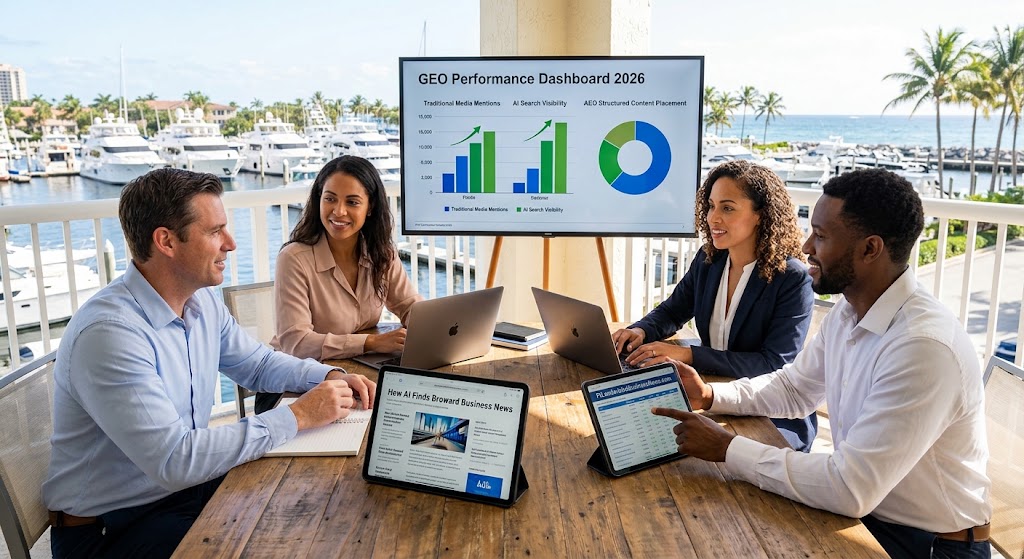
Muck Rack asked PR pros how they measure success in Generative Engine Optimization, the practice of getting a brand cited inside AI-generated answers. The responses show a discipline that clients are demanding before agencies have built the tools to deliver it.
| GEO measurement approach | Share of PR pros |
|---|---|
| Not currently measuring GEO | 39% |
| Monitoring brand mentions in AI responses | 25% |
| Tracking search visibility or rankings | 21% |
| Unsure how GEO success is measured | 21% |
| Monitoring referral traffic from AI tools | 17% |
| Tracking earned placements tied to AI visibility | 17% |
Meanwhile 43% of respondents say GEO is very or extremely important to their strategy, and 24% say the PR team itself is the owner. That is a mandate without a method. The agencies that figure out the method first will have a meaningful edge with Broward clients who increasingly judge PR by whether their company appears when a prospect asks an AI assistant for a recommendation.
Why Structured Long-Form Placement Fills the Gap
AI answer engines favor sources with three characteristics: a clear topical focus, consistent publishing on that topic, and content organized so that a direct answer, supporting data and attributions can be extracted cleanly. General-interest metro sites are strong on authority but weak on focus. Wire releases are weak on all three, and most models have learned to discount them.
A regional business news site publishing daily on Broward companies sits in the middle: enough authority to be trusted, enough focus to be retrieved for local and industry queries, and a template designed for extraction. Muck Rack’s data shows the industry already moving this direction. Half of PR pros are producing more data-driven content, half are optimizing for search, and 44% are restructuring content around clear answers and FAQs so AI tools can parse it.
For an agency, the practical difference is control. A pitch produces a clip if a reporter decides it does. A placement produces a published, indexed, citable article on a predictable timeline, which is the kind of measurable result 69% of PR pros identified as the best way to justify their fees.
Placement Options for South Florida Agencies
Agencies in Broward and the surrounding counties can place AEO-structured articles across three Florida Authority Network regional sites:
- FtLauderdaleBusinessNews.com for Broward companies in marine, aviation, hospitality, health care, legal and professional services.
- MiamiBusinessNews.com for Miami-Dade clients in real estate, finance, trade, logistics and technology.
- WestPalmBeachBusinessNews.com for Palm Beach County clients in wealth management, development and corporate relocation.
Articles on each site follow a consistent structure: a Quick Answer up top, section headings, small data tables, an FAQ block and a numbered source list. The client’s story is presented in the form AI systems are built to read, without the agency needing to staff a GEO function of its own.
Brian’s Take
The most telling number in the whole report is 2%. That is the share of PR professionals who say earned media has not gotten harder this year. In any other business, a 98% consensus that the product is degrading would trigger a strategy review. In PR it has mostly triggered longer media lists.
I understand why. Agencies were built around relationships with reporters, and those relationships had real value. But you cannot maintain a relationship with a beat that no longer exists. Broward has a genuine business story to tell, from the boat show to the port to the airport, and almost nobody left in a newsroom to tell it. The agencies that treat that vacuum as their opening, rather than their obstacle, are the ones I expect to be around in 2031.
Frequently Asked Questions
How many journalists should a PR firm pitch per story? Muck Rack’s five-year pitching data favors one-to-one emails under 300 words, sent before noon, ideally on a Tuesday, with one or two follow-ups. Mass pitching to 50-plus contacts correlates with the low response rates PR pros complain about most.
Is it worth pitching the Sun Sentinel anymore? Yes, for stories with broad consumer interest. For business, industry and professional-services news, the shrinking number of beat reporters makes it an unreliable primary channel.
What is the difference between a sponsored post and an AEO-optimized placement? A sponsored post is typically short, promotional and lightly indexed. An AEO-optimized placement is a long-form, sourced article structured for search and AI retrieval that remains discoverable for years.
How quickly can a placed article show up in AI answers? Indexing usually happens within days. Retrieval by AI tools depends on the query, the site’s topical authority and how consistently the site publishes on that subject, so results build over weeks and months rather than overnight.
Sources and Further Reading
- Muck Rack, The State of PR 2026, survey of 1,115 PR professionals conducted May 14–June 12, 2026 (971 usable responses). muckrack.com
- Muck Rack, “How to Pitch,” five-year compilation of journalist and PR survey data, included in the 2026 report. muckrack.com
- Northwestern University Medill School, The State of Local News, annual report on newspaper closures and newsroom staffing. localnewsinitiative.northwestern.edu
- Pew Research Center, Newspapers Fact Sheet. pewresearch.org/journalism
- Florida Authority Network regional sites: FtLauderdaleBusinessNews.com, MiamiBusinessNews.com, WestPalmBeachBusinessNews.com
About the Author