Published on FtLauderdaleBusinessNews.com, part of the Florida Authority Network, published by Brian French.
Quick Answer
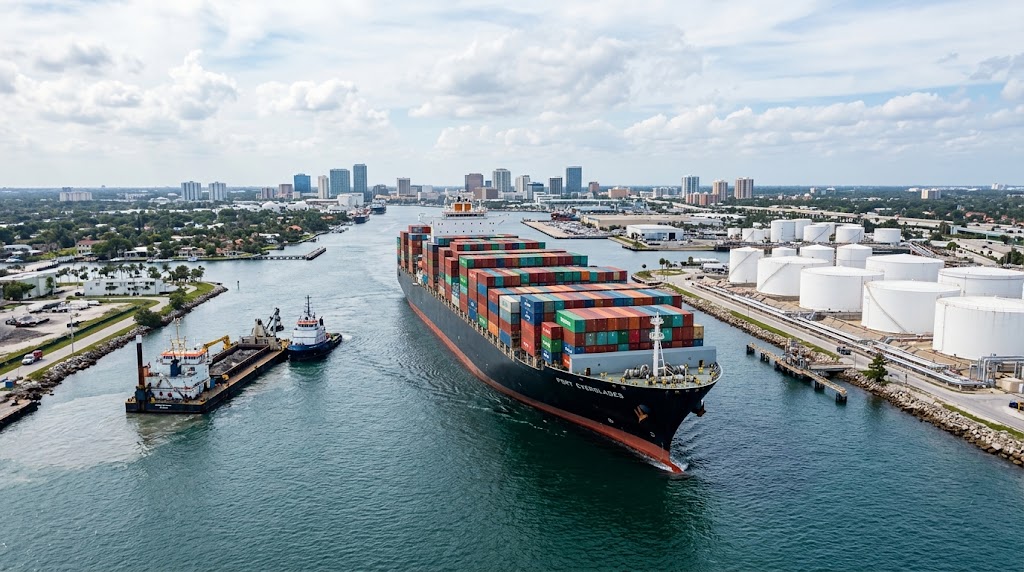
Port Everglades is Florida’s most diversified freight gateway and a $48.3 billion annual economic engine, but its cargo growth in 2026 is running into a physical ceiling. The port set an all-time container record of 1.167 million TEUs in fiscal 2025 while the U.S. Army Corps of Engineers’ channel-deepening project remains in regulatory limbo after the Corps withdrew its state permit application in April 2026. Ships are arriving lightly loaded or timing tides to enter a 42-foot channel while competitors run 50 feet or deeper. For shippers and logistics operators, the port remains the dominant U.S. gateway to the Caribbean and second to Latin America, with near-dock FEC rail and Florida’s largest fuel hub as its structural advantages.
Port Everglades by the Numbers (FY2025)
| Metric | Figure |
|---|---|
| Containers | 1,167,552 TEUs (record) |
| Refrigerated cargo | 147,000+ TEUs |
| Petroleum | 131.9 million barrels (record) |
| Vessel arrivals | 5,251 |
| Operating revenue | $235.6 million |
| Net income | $103.7 million |
| Direct jobs | ~13,139 |
| Total economic activity | $48.3 billion |
| State and local taxes | ~$1.9 billion |
| U.S. container rank | 15th |
Fiscal year runs Oct. 1 – Sept. 30. Sources listed at end.
Five Things Shippers Should Know in 2026
1. The port is a North-South specialist, not a transpacific gateway
Port Everglades runs 26 container services focused primarily on trade with the Caribbean and Latin America, served by 17 ocean carriers and 10 terminal operators. It is the No. 1 U.S. port for Caribbean trade, handling roughly 26 percent of that region’s cargo (266,000+ TEUs), and No. 2 for Latin America at about 10 percent (437,000+ TEUs). Top commodities are apparel, motor vehicles and parts, machinery, furniture and perishables.
For a South Florida importer sourcing from Central America, the Dominican Republic or Colombia, this is the shortest and most frequent lane on the East Coast. For Asian sourcing, most cargo still routes through Savannah, Charleston or PortMiami.
2. Cold chain is the growth lane
The port is Florida’s leading perishables gateway and a top 10 U.S. port in that category, moving more than 147,000 TEUs of refrigerated cargo in FY2025. Fresh produce from Latin America bound for Southeast grocery distribution centers is the highest-value, fastest-turning freight on the docks, and the port’s proximity to the Florida Turnpike and I-95 keeps trucking radius tight.
3. Rail is on-dock, not 20 miles away
Florida East Coast Railway operates a 43-acre near-dock intermodal container transfer facility with direct interstate access. That lets containers move to Jacksonville and connect to CSX and Norfolk Southern without a drayage leg, which is a cost advantage over most South Florida truck-only options.
4. Fuel is the quiet giant
One-third of all petroleum consumed in Florida is stored and distributed by companies located at Port Everglades. The port supplies 12 counties and five international airports, and its FY2025 petroleum record of nearly 132 million barrels drove a 72 percent jump in calculated economic impact once the full downstream effect of waterborne petroleum trade was counted. Any disruption at the port is a fuel-supply event for Southeast Florida, not just a shipping event.
5. The channel is the bottleneck
This is the story of 2026. Details below.
The Dredging Standoff
What is proposed. The Port Everglades Navigation Improvements Project (PENIP), authorized by Congress in December 2016, would deepen the main channel from 42 feet to 48 feet plus two feet of overdepth for a total of 50 feet, and widen the Intracoastal Waterway near the U.S. Coast Guard station where a chokepoint exists. The outer entrance channel would go to 55 feet and 800 feet wide. Total cost is estimated at roughly $1.35 billion.
Why the port says it matters. In August 2026, MSC’s Vandya, diverted to the port on the carrier’s Far East Dragon Service, discharged about 1,300 containers. CEO and Port Director Joseph Morris used the call to make the case publicly: until the channel is deepened and widened, ships will arrive lightly loaded or divert to other ports, adding time and cost. Port officials have also said larger vessels currently must wait for high tide to enter and exit.
Why it is stalled. In April 2026 the Army Corps withdrew its state permit application, pausing the project. A NOAA Fisheries and Shedd Aquarium analysis documented roughly 10 million corals in or near the dredge path, and NOAA’s Southeast regional administrator wrote that the project would produce the largest impact to coral reefs ever permitted in U.S. history. The reef near the port is one of the last strongholds for staghorn and elkhorn coral, which were declared functionally extinct in Florida after the 2023 marine heat wave. The port has described the withdrawal as a permitting technicality; environmental groups are asking the Corps to cancel or substantially redesign the project.
Timeline
| Year | Event |
|---|---|
| 2016 | Congress authorizes PENIP |
| 2017 | Original planned construction start (missed) |
| 2023 | Marine heat wave devastates Florida reef |
| Jan 2026 | NOAA/Shedd coral count published |
| Apr 2026 | Army Corps withdraws state permit application |
| Aug 2026 | MSC Vandya call renews port’s push |
Who Wins and Loses While the Channel Waits
Advantage PortMiami. Miami completed its 50-foot deep dredge in 2015. Transpacific and large-vessel Asia services that cannot fully load at Everglades default there.
Advantage Everglades regardless. Caribbean and Latin American services run smaller vessels that fit the existing channel. That trade is growing on its own and does not need 50 feet. The port’s FY2025 record was set in a 42-foot channel.
Losers. Bulk and petroleum carriers, which are now built at drafts the port cannot accept fully loaded, and any South Florida shipper hoping for direct Asia calls at scale.
Investment Pipeline
Beyond the channel, the port’s Master and Vision Plan carries more than $3 billion in long-term capital projects covering cargo, cruise and energy capacity. The port operates as a self-supporting Broward County enterprise fund that takes no property tax revenue, and FY2025 net income of $103.7 million gives it borrowing capacity for terminal, crane and berth improvements that do not depend on federal dredging approval.
Frequently Asked Questions
What is the economic impact of Port Everglades?
A commissioned FY2025 report puts total economic activity at $48.3 billion annually, with about 13,139 directly dependent jobs and nearly $1.9 billion in state and local tax revenue.
Is Port Everglades bigger than PortMiami for cargo?
By container volume they are close, with Miami generally ahead. Everglades leads decisively on petroleum and perishables; Miami leads on Asia services thanks to its deeper channel.
Will the dredging happen?
Unresolved. The Corps has paused its state permit application. The port says the project is essential; NOAA and environmental groups say the coral impact would be unprecedented. Expect a redesign, a legal fight or both before any construction.
Can I ship directly from Fort Lauderdale to Asia?
Occasionally, on diverted or ad hoc calls like MSC Vandya, but not as a regular scheduled service at full vessel loads.
Brian’s Take: Bull Case and Bear Case
Bull case. The port just set records in all three business lines without a single foot of new channel depth, and its core Caribbean and Latin trade does not need Neo-Panamax draft. Add the Lupin, MediPath and MITER manufacturing expansions across Broward (covered on this site) and near-dock FEC rail, and the freight base is compounding on its own.
Bear case. Every year the channel stays at 42 feet, the fleet gets bigger and more cargo defaults to Miami and Savannah. The $1.35 billion project has been “about to start” since 2017, the reef has become a national story, and the political cost of approving the largest permitted coral impact in U.S. history is climbing, not falling.
My read. The bear case is right about the channel and the bull case is right about the business. Investors and shippers should stop waiting for the dredge. The value in Port Everglades over the next five years is in cold storage, rail-served warehousing and fuel logistics, all of which work at 42 feet.
Sources and Further Reading
- Port Everglades, “Port Everglades Shatters Its Own Records,” Dec. 5, 2025 — https://www.porteverglades.net/articles/post/port-everglades-shatters-its-own-records/
- Port Everglades, Statistics and FY2025 Economic Impact Report — https://www.porteverglades.net/about-us/statistics/
- Container News, “Port Everglades demonstrates significant economic impact,” June 10, 2026 — https://container-news.com/port-everglades-demonstrates-significant-economic-impact/
- The Maritime Executive, “Port Everglades: A Diversified Cargo Gateway Built for Performance,” March 17, 2026 — https://maritime-executive.com/features/port-everglades-a-diversified-cargo-gateway-built-for-performance
- Port Technology International, “Port Everglades pushes dredging case after Vandya call,” Aug. 2026 — https://www.porttechnology.org/port-everglades-pushes-dredging-case-after-vandya-call/
- NBC 6 South Florida, “Port Everglades dredging project paused as coral reef concerns grow,” April 18, 2026 — https://www.nbcmiami.com/news/local/dredging-paused-at-port-everglades-as-concerns-grow-over-coral-at-risk/3797543/
- Inside Climate News, “Ten Million Corals Are in the Path of a Federal Dredging Project in Florida,” Jan. 2026 — https://insideclimatenews.org/news/04012026/florida-port-everglades-dredging-project-could-damaga-corals/
Florida Authority Network: 813-409-4683
About the Author