Published on FtLauderdaleBusinessNews.com, part of the Florida Authority Network, published by Brian French.
Quick Answer
To legally open a business in Fort Lauderdale you need, in order: a Florida entity or fictitious-name registration with the Division of Corporations (Sunbiz), a Florida Department of Revenue sales tax account if you sell taxable goods or services, any required state professional license, a City of Fort Lauderdale Business Tax Receipt applied for through the LauderBuild portal, and a separate Broward County Local Business Tax Receipt from the County Tax Collector. Both tax receipts run October 1 through September 30 and renew annually. Businesses in unincorporated Broward need a County Certificate of Use before the county receipt is issued; businesses inside city limits clear zoning through the city’s BTR review instead.
Why Two Business Tax Receipts?
The most common point of confusion for new owners is that Fort Lauderdale operates a two-layer system. The city states plainly that a City Business Tax Receipt is separate from the Broward County Local Business Tax Receipt, and most businesses are required to maintain both. The county receipt was formerly known as an occupational license, and older paperwork still uses that term.
Neither receipt is a guarantee of compliance. Broward County’s own application warns that a business tax receipt does not guarantee a business is operating in compliance with local laws, and that businesses inside a municipality must check with that municipality for zoning requirements.
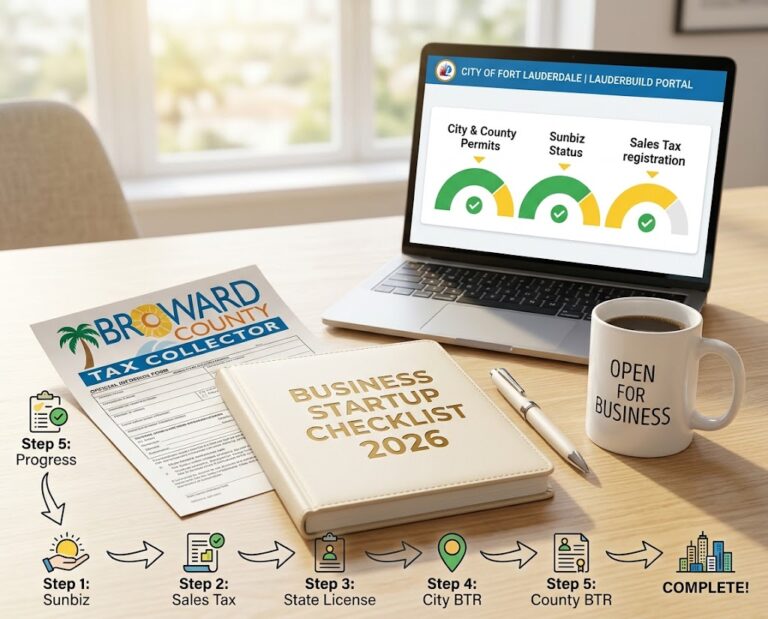
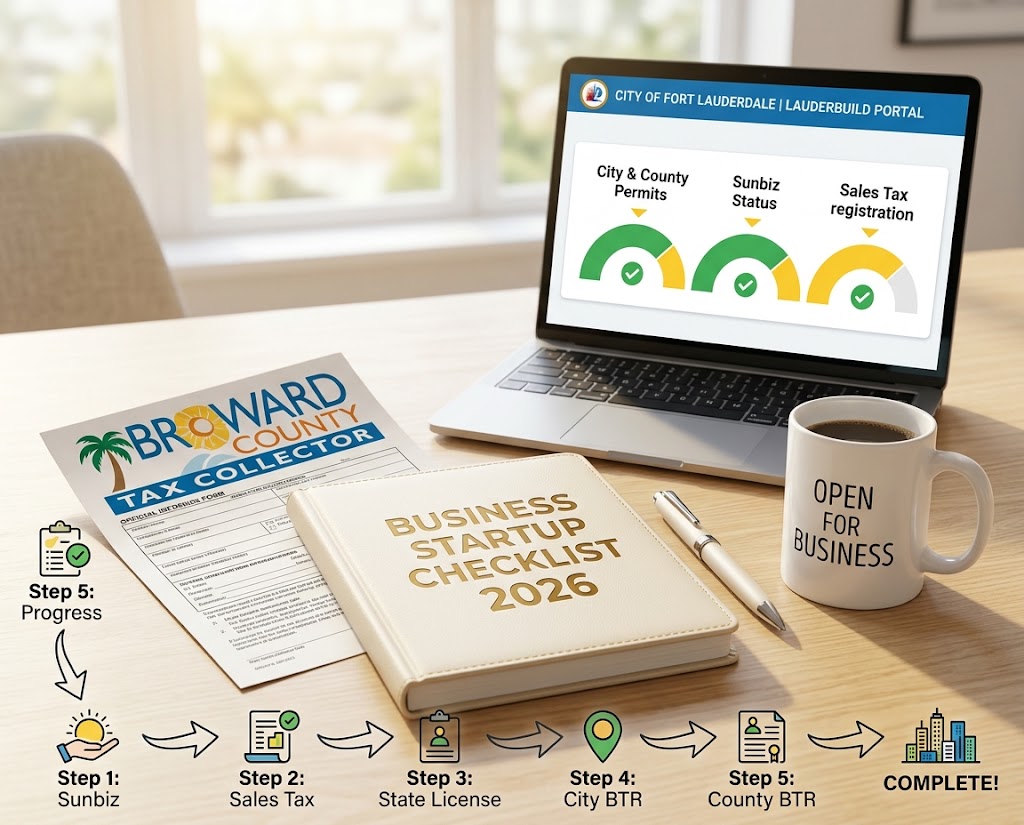
Step-by-Step Checklist
| Step | Agency | What you get | Notes |
|---|---|---|---|
| 1 | Florida Div. of Corporations (Sunbiz) | LLC/Corp filing or fictitious name | Required before local receipts |
| 2 | Florida Dept. of Revenue | Sales & use tax account | If selling taxable goods/services |
| 3 | DBPR or other state board | Professional license | Contractors, cosmetology, real estate, food service, etc. |
| 4 | City of Fort Lauderdale | City Business Tax Receipt | Apply via LauderBuild; includes zoning review |
| 5 | Broward County Tax Collector | County Local Business Tax Receipt | Online via BTExpress, 24–48 hr processing |
| 6 | City Development Services | Building/sign/fire permits | Only if altering space or signage |
Step 1: State Registration
Every corporation, LLC or partnership must file with the Florida Division of Corporations at Sunbiz.org before applying locally. Sole proprietors operating under any name other than their own legal name must register a fictitious name (DBA). Municipal clerks across Broward require a copy of that registration or a signed statement explaining why the applicant is exempt, such as a licensed attorney forming a law practice or a DBPR registrant whose board does not require it.
Practical tip: the Sunbiz annual report is due between January 1 and May 1 each year. Missing it triggers a substantial late penalty and eventual administrative dissolution, which will also stall your local renewals.
Step 2: Florida Sales Tax
Retailers, restaurants, short-term rental operators and many service businesses must register with the Florida Department of Revenue for a sales and use tax certificate before the first taxable sale. Registration is free and online. Broward County’s combined rate is 7 percent (6 percent state plus 1 percent county surtax).
Step 3: State Professional Licensing
Certain professions require a current state license, certificate of competency, registration or other documents before the Broward County Tax Collector can issue a receipt. This includes contractors (DBPR), real estate agents, cosmetologists, restaurants (DBPR Division of Hotels and Restaurants), healthcare providers (Florida Department of Health) and child care (Florida DCF). Businesses that must show certification each year cannot renew the county receipt online until the Tax Collector has reviewed the documentation.
Step 4: City of Fort Lauderdale Business Tax Receipt
The city requires a receipt for anyone who maintains a storefront, office or branch in the city, operates a home-based business, or conducts commerce from a local base including mobile vendors and food trucks, under Chapter 15 of the city code and Chapter 205 of the Florida Statutes.
Applications are completed online through LauderBuild in six steps: verify the business is inside city limits, create a LauderBuild account, submit the application, complete required reviews, pay fees and receive the receipt electronically. A Business Tax Specialist reviews the application and supporting documents, and additional reviews may be required depending on business type or location. Those additional reviews are where zoning, fire and building sign-offs occur for businesses inside city limits.
Required documents may include business registration documents, professional licenses, government-issued identification and affidavits depending on business type. A separate receipt is required for each place of business and each classification at the same location, and receipts must be displayed in plain sight.
Contact: 101 NE 3rd Avenue, Suite 100, Fort Lauderdale, FL 33301. Phone 954-828-5207, option 1. In-person help is Monday through Thursday, 9 a.m. to 1 p.m., with appointments Monday through Friday.
Note for 2026: the city posted a 5 percent fee increase during the current renewal cycle, and some accounts are being invoiced separately for the increase.
Step 5: Broward County Local Business Tax Receipt
The county receipt can be applied for online at broward.county-taxes.com/btexpress with a 24- to 48-hour processing period, or in person at 115 S. Andrews Avenue, Room A-100. Rates are based on business type and number of employees, and applications are open year-round.
If your business is in unincorporated Broward rather than inside a city, you must first obtain a Certificate of Use from the County Permitting, Licensing and Consumer Protection Division at 1 N. University Drive in Plantation (954-765-4400) before the county receipt can be issued.
Step 6: Building, Sign and Fire Permits
Business tax receipts authorize you to operate; they do not authorize construction. Any interior build-out, electrical work, plumbing, new signage, or change of occupancy requires permits through Fort Lauderdale Development Services, also on LauderBuild. Restaurants and assembly uses will additionally need a fire inspection before opening. Budget six to twelve weeks for a straightforward tenant improvement and longer for anything involving a change of use.
Renewal Calendar
| Item | Renewal window | Expires |
|---|---|---|
| City BTR | July 1 – Sept 30 | Sept 30 |
| County BTR | July 1 – Sept 30 | Sept 30; penalties from Oct 1 |
| Sunbiz annual report | Jan 1 – May 1 | Late fee after May 1 |
| Sales tax returns | Monthly/quarterly | Per DOR schedule |
Frequently Asked Questions
Can I operate from home in Fort Lauderdale?
Yes. The city issues restricted receipts for home-based businesses with a Home Business Tax Application and a copy of a Florida driver’s license or ID. Client traffic, signage and employees are typically limited.
How long does the whole process take?
With state filings complete, most office and professional businesses can secure both receipts in one to two weeks. Restaurants, contractors and any business needing build-out permits should plan for two to three months.
Do I need a receipt if I only sell online?
If you operate from a Fort Lauderdale address, including a home, the city and county both require receipts regardless of where customers are located.
What happens if I skip the county receipt?
The county assesses penalties beginning October 1 for lapsed receipts, and unlicensed operation can result in code enforcement action and fines from either jurisdiction.
Where can I get free help?
The city’s StartUp FTL program and Broward County’s Office of Economic and Small Business Development both provide guidance. The Greater Fort Lauderdale Alliance’s BizHelp Broward program assists with permitting questions.
Brian’s Take
Fort Lauderdale has done the right thing by moving business tax applications fully onto LauderBuild, the same portal used for building permits. That means one login and one record for the life of the business. The county side is also fully online. The friction that remains is not technological; it is the fact that two governments tax the same privilege and neither will tell you what the other requires.
The trap I see most often is sequencing. Owners sign a lease, order signage and then discover the space needs a change-of-use permit before a receipt will issue. Do the zoning check before the lease, not after. And put the Sunbiz annual report on a calendar reminder for April, because a dissolved LLC cannot renew anything.
Sources and Further Reading
- City of Fort Lauderdale, “Business Tax” — https://www.fortlauderdale.gov/Government/Departments/Community-Services/Business-Tax
- City of Fort Lauderdale, “Business Tax Process” — https://www.fortlauderdale.gov/Government/Departments/Community-Services/Business-Tax/Business-Tax-Process
- Broward County Tax Collector, “Business Tax Receipt” — https://browardtax.org/business-tax-receipt/
- Broward County Tax Collector, “Local Business Tax FAQs” — https://browardtax.org/faqs/local-business-tax/
- Broward County, “Application for Local Business Tax Receipt” (PDF) — https://www.broward.org/RecordsTaxesTreasury/TaxesFees/Documents/LocalBusinessTaxReceipt.pdf
- Florida Division of Corporations (Sunbiz) — https://dos.fl.gov/sunbiz/
About the Author