By Brian French | FtLauderdaleBusinessNews.com | October 3, 2026
Quick Answer
The largest superyachts are increasingly booking refits in Savannah instead of Fort Lauderdale for three reasons. Fort Lauderdale’s New River yards are close to full. Most local yards top out around 200 feet. And Savannah offers a 459-foot graving dock with no bridges in the way. Charleston takes overflow work, but mostly for smaller yachts.
The Yachting Capital Has a Capacity Problem
Fort Lauderdale still calls itself the yachting capital of the world, and the numbers back that up. The Marine Industries Association of South Florida puts Broward County’s marine economic impact at $9.9 billion, supporting about 121,000 jobs in the county. Refit and repair is a large part of that total.
The constraint is physical, not reputational. A growing share of the global superyacht fleet is now too long, too tall, or too heavy for the New River yards. A second group of yachts fits but cannot get a slot. Those yachts are not leaving Florida because of service quality. They are leaving because the dry-dock calendar is full.
This article looks at where that work goes, why, and what it costs Broward.
How Full Are Fort Lauderdale’s Yards?
Recent figures point to yards running near capacity. A 2026 workforce analysis by recruiting firm KiTalent reported that Lauderdale Marine Center ran at 94% utilization through 2025 and Derecktor Fort Lauderdale at 89%, with backlogs reaching into mid-2026 before any new contracts were signed. Those are third-party estimates, not audited yard disclosures, but they are consistent with what captains report anecdotally.
Industry press has made the same point from the other direction. Megayacht News noted that South Florida’s refit yards have strong reputations, which often means they are busy, and that a roughly 24-hour run up the coast brings yachts to Savannah’s yards.
Labor is a second bottleneck. The same KiTalent analysis found general marine labor in reasonable supply but a severe shortage of electrical, carpentry, naval architecture, and electronics integration specialists, which can stall a multimillion-dollar refit for weeks while it waits on one qualified engineer. A yard can have a free haul-out slot and still be unable to start a complex job.
The Size Ceiling on the New River
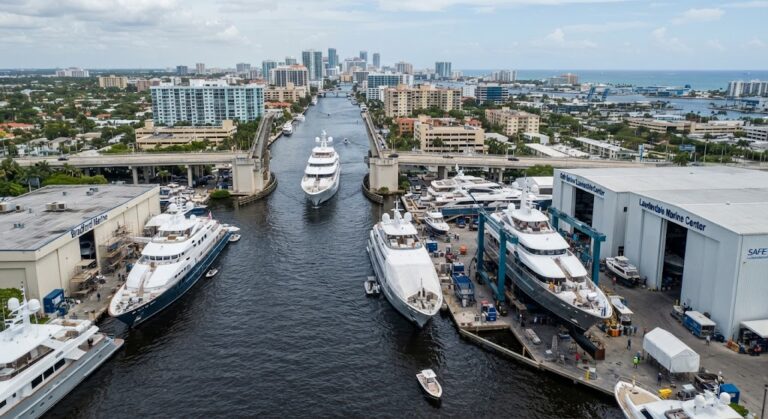
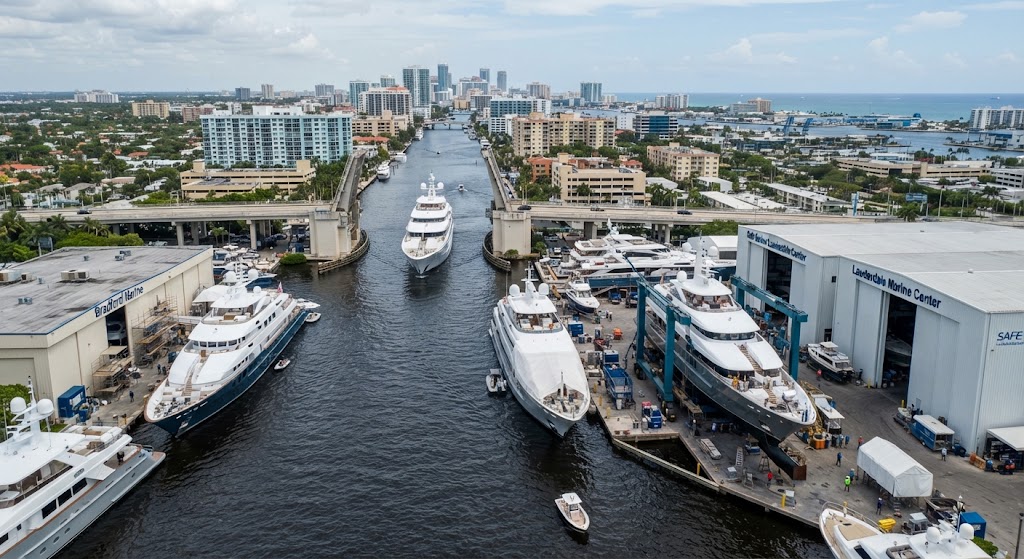
Fort Lauderdale’s refit cluster sits mostly along the New River and the Marina Mile corridor on State Road 84. That geography sets hard limits on what fits.
| Yard | Location | Practical Max Size |
|---|---|---|
| Safe Harbor Lauderdale Marine Center | New River | ~200 ft |
| Bradford Marine | New River | ~180 ft |
| Rolly Marine Service | Fort Lauderdale | ~150 ft |
| PORT 32 Fort Lauderdale | New River | 180 ft wet / ~120 ft haul-out |
| Safe Harbor Savannah Yacht Center | Savannah River, GA | ~400 ft (graving dock 459 ft) |
Lauderdale Marine Center, often described as the largest yacht repair yard in the U.S., handles yachts up to 200 feet with 19 covered sheds, 156 in-water slips, and three travel lifts rated for 330-ton haul-outs. Bradford Marine accommodates yachts up to 180 feet and offers more than 11,000 feet of covered in-water dockage.
New capacity is arriving, but at the smaller end. PORT 32 announced this week that its New River facility now combines a working boatyard, a wet basin for vessels up to 180 feet, and a 150-metric-ton Travelift that can haul yachts up to about 120 feet. That helps the 80- to 120-foot market. It does nothing for a 300-foot Lürssen.
A note on Bahia Mar: Bahia Mar is a marina and the home of the Fort Lauderdale International Boat Show, not a refit yard. Its planned $2 billion redevelopment by Related Group, Tate Capital, and Rok Acquisitions includes a marina with slips for yachts up to 350 feet. That adds berthing for very large yachts in Fort Lauderdale, but not dry-dock or haul-out capacity. Big yachts will be able to dock here and still have to leave for heavy maintenance.
Why Savannah Is Winning the Largest Yachts
Savannah’s advantage is a single piece of infrastructure Fort Lauderdale cannot easily replicate: a former Navy graving dock on a deep commercial river.
Savannah Yacht Center’s graving dock is 459 feet long with a 24-foot depth, and the yard lets American owners of yachts up to about 400 feet refit on U.S. soil. It adds a 3,240-ton shiplift, room for nine yachts on the hard, and dockage for up to eight 262-foot yachts at once.
Access matters as much as size. Because the Port of Savannah is one of the nation’s busiest, the river offers deep channels and no bridge height restrictions for superyachts. In Fort Lauderdale, the New River route to the refit district runs past bridges, tight bends, and shallow stretches that rule out the tallest and deepest hulls.
The marquee example this year was the seized superyacht Amadea. The 348-foot Lürssen left Savannah Yacht Center on April 29, 2026, after a refit of roughly four months, with AIS data showing a 109-day stay. A job that size, at a yard in Fort Lauderdale, was not physically possible.
Georgia also moved on tax policy. Georgia lawmakers passed an exemption from sales tax on purchases over $500,000 used to repair large yachts, explicitly to compete with Florida’s refit industry, and Savannah Yacht Center’s owners were among the bill’s backers.
Where Charleston Fits
Charleston is a real but smaller part of the story. Its strength is as a stopover and as a yard for mid-size yachts, not as a superyacht dry-dock.
Safe Harbor’s Charleston City Boatyard runs an 88-ton travel lift with secure outdoor storage, and many boaters time their seasonal maintenance to stop in Charleston, using the yard’s efficiency for paint and bottom work. North Charleston also hosts independent refit contractors at the former Navy base piers.
For a 120-foot yacht heading north for the summer, Charleston can absorb a paint job or a mechanical service that could not get a Fort Lauderdale slot. For a 250-foot yacht needing a dry-dock, Savannah is the realistic Atlantic alternative, along with Rybovich in West Palm Beach inside Florida.
Fort Lauderdale vs. Savannah vs. Charleston at a Glance
| Factor | Fort Lauderdale | Savannah | Charleston |
|---|---|---|---|
| Max refit size | ~200 ft | ~400 ft | Mid-size |
| Bridge limits | Yes (New River) | None on river | Varies |
| Specialist trades depth | Deepest in U.S. | Moderate | Limited |
| Repair tax break | $60K cap per repair | Exemption on large purchases | Standard SC rules |
| Best fit | 80–200 ft refits | 200–400 ft dry-dock | Stopover service |
Measuring the Economic Leakage
There is no public count of refit contracts that moved from Broward to Georgia. What can be measured is the value of each yacht that does.
A Thomas J. Murray & Associates study released by MIASF found that a median 140-foot megayacht spends more than $2 million a year and generates about $146,000 in state and local taxes. Larger yachts spend proportionally more, and a major refit of a 300-foot yacht can run well into eight figures.
Florida has tried to keep that work at home through tax policy. Under Florida Department of Revenue rules, the maximum tax on a boat repair is $60,000, applied separately to each repair job in the state. That cap equates to roughly $1 million in repairs, and the Department’s position is that splitting work across separate contracts or resubmitting the boat resets it. The cap makes Florida competitive on cost for large jobs. It cannot create dry-dock space that does not exist.
When a big refit leaves, Broward loses more than the yard invoice. It loses months of crew spending on housing, provisioning, restaurants, and car rentals, plus the subcontractor work that usually flows to local painters, joiners, and electronics firms.
Brian’s Take
The headline story is “Fort Lauderdale losing work.” The more accurate story is that Fort Lauderdale is losing work it was never built to handle, and that one company owns both sides of the trade.
Safe Harbor owns both Lauderdale Marine Center and Savannah Yacht Center. It acquired the Savannah yard in a separate deal, which means a 300-foot yacht that cannot fit on the New River can be routed north without leaving the same corporate portfolio. That is smart capacity management for Safe Harbor. For Broward County’s tax base and workforce, it is still leakage.
Three things are worth watching. First, whether any Broward or Port Everglades-adjacent site can host a deep-water dry-dock, which would be the only real fix for the largest yachts. Second, whether the specialist-trades shortage eases, since that limits throughput even at yards with open slips. Third, whether Bahia Mar and Las Olas Marina berthing for 300-foot-plus yachts creates enough demand to justify that investment.
The opportunity for Fort Lauderdale is clear: it already has the specialists, the suppliers, and the brand. What it lacks is a large enough dry-dock on a deep enough channel.
Frequently Asked Questions
Why are yachts leaving Fort Lauderdale for refits?
Mainly size and scheduling. Most New River yards top out near 200 feet, bridges limit access, and the main yards are running close to full. Yachts over about 200 feet often go to Savannah, where a 459-foot graving dock and bridge-free river can take vessels up to about 400 feet.
What are Fort Lauderdale marine yard wait times in 2026?
Yards do not publish wait times. Third-party estimates put Lauderdale Marine Center near 94% utilization through 2025 with backlogs into mid-2026. Captains should plan major haul-outs several months ahead, especially before the fall boat show and spring Mediterranean departures.
Which East Coast yards can dry-dock a superyacht over 200 feet?
On the Atlantic seaboard, the main options are Safe Harbor Savannah Yacht Center in Georgia and Safe Harbor Rybovich in West Palm Beach. Fort Lauderdale’s largest yards handle up to about 200 feet.
Is Charleston a real alternative for superyacht refits?
For mid-size yachts and stopover service, yes. Charleston’s yards handle paint, bottom work, and mechanical service well. For full dry-dock refits of large superyachts, Savannah is the stronger option.
Does Florida tax yacht refits?
Yes, but Florida caps sales tax at $60,000 per repair, which covers roughly the first $1 million of work. Separate contracts or returning the boat to the yard can each trigger a new cap, so planning the job as one repair matters.
How much economic value does one refit yacht bring Fort Lauderdale?
A median 140-foot megayacht spends more than $2 million a year, according to an MIASF-commissioned study. A major refit adds months of crew spending and local subcontractor work on top of the yard bill.
Sources and Further Reading
- KiTalent, “Fort Lauderdale’s Marine Yards Are Running Full. Their Specialist Benches Are Not.” (2026) — https://kitalent.com/article-fort-lauderdale-marine-talent-gap
- Boating Industry, “PORT 32 Fort Lauderdale Expands Yacht Service Capabilities” (Oct. 1, 2026) — https://boatingindustry.com/news/2026/10/01/port-32-fort-lauderdale-expands-yacht-service-capabilities/
- Boat International, “Largest refit yard in US to be expanded as Lauderdale Marine Center is acquired” — https://www.boatinternational.com/yachts/news/lauderdale-marine-center-is-acquired-largest-yacht-refit-yard-in-us-to-be-expanded–26825
- Southern Boating, “Best 17 Luxury Marinas and Full-Service Shipyards in the U.S.” — https://southernboating.com/featured/best-17-luxury-marinas-and-full-service-shipyards-in-the-u-s/
- Megayacht News, “Savannah Yacht Center, Servicing Some of World’s Largest Superyachts” (2025) — https://megayachtnews.com/2025/08/savannah-yacht-center/
- Megayacht News, “5 Reasons Savannah Is a Yachting Destination on the Rise” (2025) — https://megayachtnews.com/2025/06/savannah-is-a-yachting-destination-on-the-rise/
- Luxury Launches, “Amadea has left Savannah Yacht Center” (May 2026) — https://luxurylaunches.com/transport/amadea-has-left-the-savannah-ship-yard-05042026.php
- All At Sea, “Savannah, Georgia – An Ideal Destination for a Refit” — https://www.allatsea.net/savannah-georgia-ideal-destination-refit/
- Superyacht Times, “Safe Harbor Marinas acquires Savannah Yacht Center” — https://www.superyachttimes.com/yacht-news/safe-harbor-marinas-acquires-savannah-yacht-center
- Waterway Guide, “Inside Look: Safe Harbor City Boatyard in Charleston” — https://www.waterwayguide.com/knowledge-center/news-post/12688/inside-look-safe-harbor-city-boatyard-in-charleston-south-carolina
- Superyacht Services Guide, Boatyards in Georgia and South Carolina — https://www.superyachtservicesguide.com/20/9119/directory?location=2260&category=1536
- REBusinessOnline, “Joint Venture Unveils Plans for $2B Waterfront Mixed-Use Development” (Bahia Mar) — https://rebusinessonline.com/related-group-partners-unveil-plans-for-2b-waterfront-mixed-use-development-in-fort-lauderdale-florida/
- Marine Industries Association of South Florida, Economic Impact — https://www.miasf.org/
- All At Sea, “Yachts Make Mega Economic Impact in South Florida” — https://www.allatsea.net/yachts-make-mega-economic-impact-south-florida/
- Florida Department of Revenue, “Sales and Use Tax on Boats” (GT-800005) — https://floridarevenue.com/Forms_library/gt800005.pdf
- Moffa, Sutton & Donnini, “FL Sales Tax $60K Cap on Boat Repairs” — https://www.floridasalestax.com/florida-tax-law-blog/2018/december/fl-sales-tax-60k-cap-on-boat-repairs/
About the Author