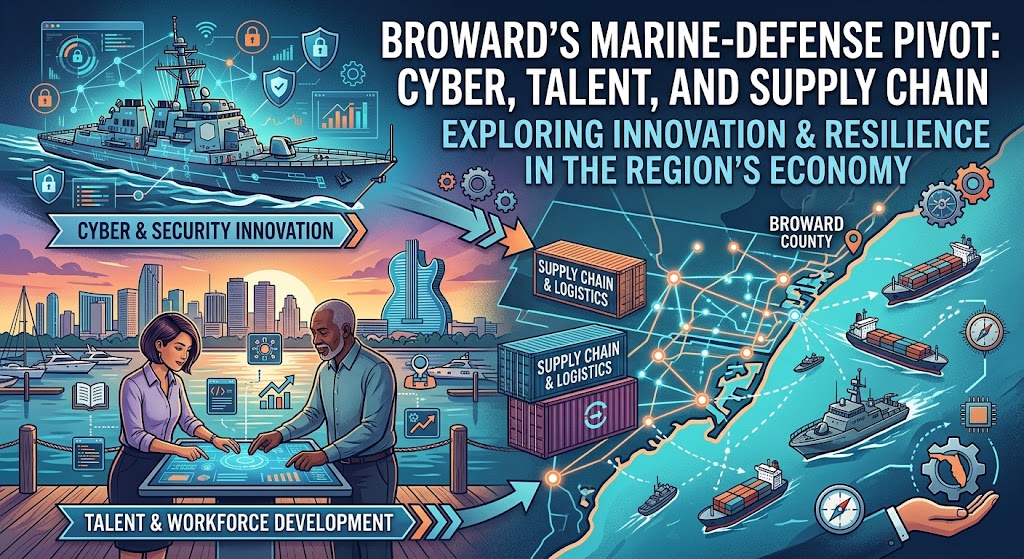
By Brian French | Florida Authority Network | October 19, 2026
Quick Answer: Fort Lauderdale marine and defense suppliers face two cyber rulebooks. Defense subcontractors handling Controlled Unclassified Information must meet NIST SP 800-171 under CMMC; third-party certification (Phase 2) was suspended in July 2026, but self-assessments still apply. Port and vessel operators under MTSA must submit Coast Guard cybersecurity plans by July 16, 2027.
Why Is Fort Lauderdale Becoming a Marine Defense Hub?
Quick Take
- Broward’s recreational “white hull” marine sector is now being mapped for Navy “gray hull” and unmanned vessel work.
- A September 2026 state grant funds the first formal study of that transition.
- Cybersecurity compliance and skilled labor are the two gates every local supplier must pass.
Fort Lauderdale has long called itself the Yachting Capital of the World, and the numbers support it. The Marine Industries Association of South Florida’s most recent regional study found the tri-county marine industry’s economic output rose from $12.0 billion in 2018 to $18.5 billion in 2022, supporting an estimated 141,860 jobs across Broward, Miami-Dade, and Palm Beach counties.
What is new in 2026 is the direction that capacity may take. The same composite shops, marine electricians, propulsion specialists, and fabrication yards that keep superyachts running are exactly the skills the U.S. Navy needs as it shifts toward smaller, modular, and unmanned vessels.
On September 8, 2026, the Greater Fort Lauderdale Alliance announced a $125,000 state Defense Reinvestment Grant, backed by $37,500 in local matching support, for the Broward Maritime Defense Readiness and Diversification Initiative. The project will study how Broward’s roughly $10 billion recreational marine and manufacturing sector can expand into Navy shipbuilding, with a focus on autonomous and unmanned vessels.
The opportunity is real. The compliance bar is also real. This guide covers both.
Does Broward Have a History of Building Military Vessels?
Quick Take
- Broward shipyards built Navy sub chasers and minesweepers during and after World War II.
- The Navy now wants to spread shipbuilding across far more locations.
- Local yards already support patrol craft, minesweepers, and auxiliary vessels.
Broward’s defense maritime story is not new. According to the Alliance, Broward Marine’s yards in Fort Lauderdale and Dania Beach produced U.S. Navy sub chasers and minesweepers during wartime and after the Cold War.
The timing of the current push reflects a federal shift. The Navy is seeking to diversify where it builds ships, with plans to move from about 10% of construction at distributed sites to roughly 50%. Its strategy calls for a “high-low mix”: advanced combatants alongside cheaper ships and unmanned systems.
That second category is where Broward fits. A region that builds and refits high-end composite yachts has much of the base needed to build small unmanned surface vessels, sensor platforms, and support craft. The Alliance points to existing local strengths in marine electronics, composites, fabrication, propulsion, software, cybersecurity, and logistics.
The initiative is led by the Alliance with two principal partners: the South Florida Defense Alliance, which brings defense-market readiness expertise, and the South Florida Regional Planning Council, which brings data and economic analysis. The Marine Industries Association of South Florida is participating as an industry stakeholder, and Port Everglades, Broward County, area cities, and educational institutions are expected to help validate findings.
What Cybersecurity Rules Apply to Fort Lauderdale Defense Suppliers?
Quick Take
- NIST SP 800-171 is the core standard for any company handling Controlled Unclassified Information (CUI).
- CMMC Phase 1 self-assessments remain in force; Phase 2 third-party certification is suspended.
- The pause changes how compliance is verified, not whether it is required.
The CMMC Framework in Plain Terms
The Cybersecurity Maturity Model Certification (CMMC) program is the Department of War’s system for verifying that contractors protect sensitive government information. It has three levels:
| Level | Data Covered | Standard | Assessment |
|---|---|---|---|
| Level 1 | Federal Contract Information (FCI) | 15 basic safeguards | Annual self-assessment |
| Level 2 | Controlled Unclassified Information (CUI) | 110 NIST SP 800-171 controls | Self or third-party (C3PAO) |
| Level 3 | Highest-priority CUI | NIST 800-171 plus 800-172 | Government (DIBCAC) |
Which level applies depends on the type of data a company handles, not company size. A small Dania Beach composite shop building parts to a Navy drawing may handle CUI as surely as a large prime contractor.
The 2026 Timeline Has Changed
The CMMC acquisition rule took effect on November 10, 2025, launching Phase 1. Under Phase 1, applicable contracts require Level 1 or Level 2 self-assessments, with scores posted in the federal Supplier Performance Risk System (SPRS).
Phase 2 was scheduled to begin November 10, 2026, making third-party certification by an accredited assessor (C3PAO) the default for most CUI contracts. That date is no longer in effect.
On July 13, 2026, the Department of War suspended Phase 2 and placed all later CMMC milestones on hold “until further notice.” Department leaders cited compliance costs for small, medium, and non-traditional contractors. The Small Business Administration noted that individual certification costs could approach $600,000 for some firms.
A CMMC Reform Task Force was given 60 days to review the program. Its request for industry input closed August 14, 2026, drawing about 1,100 responses. The task force report was expected in late September or early October 2026. As of this writing, no reformed framework has been published.
What the Pause Does Not Change
Defense law firms have been consistent on one point: the pause is not a repeal. Several obligations remain fully in place:
- DFARS 252.204-7012 still requires contractors holding covered defense information to implement NIST SP 800-171 and report cyber incidents.
- Phase 1 self-assessments remain a condition of award on applicable contracts.
- SPRS scores must still be accurate and current.
- Prime contractors can still require subcontractors to prove compliance before awarding work.
The legal exposure is real. A company that posts a self-assessment score it cannot support risks liability under the federal False Claims Act. Department officials have also declined to rule out further changes, so the requirement could return in a different form.
Practical Takeaway for Broward Suppliers
For a marine company considering its first defense subcontract, the right reading of 2026 is simple: the pause bought time, not an exemption. Firms that build their NIST 800-171 program now will be ready for whatever framework emerges. Firms that wait may find primes choosing suppliers who already have documentation in hand.
How Does the Coast Guard Cyber Rule Affect Port Everglades Businesses?
Quick Take
- The Coast Guard’s first mandatory maritime cybersecurity rule took effect July 16, 2025.
- It covers U.S.-flagged vessels and MTSA-regulated facilities, including cruise terminals.
- Cybersecurity plans and assessments are due to the Coast Guard by July 16, 2027.
A Separate Rulebook From CMMC
While CMMC governs defense contractors, a different federal rule governs the waterfront itself. The Coast Guard’s final rule, “Cybersecurity in the Marine Transportation System,” was published January 17, 2025, and took effect July 16, 2025. It is the first mandatory cybersecurity framework under the Maritime Transportation Security Act (MTSA).
The rule applies to U.S.-flagged vessels, Outer Continental Shelf facilities, and shore-based facilities required to have MTSA security plans. That includes terminals, bulk liquid transfer facilities, and facilities receiving vessels carrying more than 150 passengers. Port Everglades, one of the busiest cruise ports in the world and a major petroleum hub for South Florida, falls squarely in this category.
The Compliance Calendar
| Deadline | Requirement |
|---|---|
| July 16, 2025 | Rule effective; cyber incidents must be reported |
| January 12, 2026 | Required cybersecurity training for personnel |
| July 16, 2027 | Designate Cybersecurity Officer (CySO) |
| July 16, 2027 | Complete cybersecurity assessment |
| July 16, 2027 | Submit Cybersecurity Plan for Coast Guard approval |
Each covered entity must also maintain a Cyber Incident Response Plan. One person may serve as Cybersecurity Officer for multiple vessels or facilities, which helps smaller operators. The Coast Guard has also sought comment on extending implementation by two to five years for U.S.-flagged vessels, so vessel owners should watch for a follow-up rule.
Foreign-Flagged Yachts and Ships
Most of the superyachts refit in Fort Lauderdale fly foreign flags. They are not covered by the domestic rule, but the Coast Guard has said it will intensify Port State Control scrutiny of cybersecurity practices on foreign-flagged vessels, particularly where poor cyber hygiene affects compliance with the International Safety Management Code.
For local service yards and marine electronics firms, that creates business. Owners and captains increasingly want navigation, network, and bridge systems audited before inspection.
How Do Marine Companies Secure Autonomous Vessels and Navigation Software?
Quick Take
- Unmanned vessels depend entirely on software, sensors, and communications links.
- Operational technology on vessels is harder to patch than office IT.
- FAU’s SeaTech campus in Dania Beach is a regional anchor for autonomous vessel research.
An unmanned vessel has no crew to notice a spoofed GPS signal or an unauthorized command. Its safety depends on the integrity of its navigation software, sensor data, and communication links. That makes cybersecurity a design requirement, not an add-on.
Key risk areas for Broward builders and integrators include:
- Navigation integrity: Protecting GPS and positioning inputs against spoofing and jamming.
- Command links: Encrypting and authenticating remote control and telemetry channels.
- Software supply chain: Verifying the source and integrity of firmware and third-party code.
- Operational technology: Securing engine controls, power management, and bridge systems that were never designed for internet exposure.
- Shore-side systems: Protecting the port logistics, scheduling, and fleet management platforms that vessels connect to.
Broward already has research depth in this area. Florida Atlantic University’s SeaTech Institute for Ocean and Systems Engineering, established in 1997, sits on eight acres between the ocean and the Intracoastal Waterway in Dania Beach, about 2.5 miles south of Port Everglades. It runs laboratories dedicated to autonomous underwater and surface vehicles and has received Office of Naval Research funding for unmanned “mothership” systems that deploy underwater vehicles and aerial drones.
SeaTech also maintains a long-term partnership with the Naval Surface Warfare Center Carderock Division, whose South Florida Ocean Measurement Facility extends offshore south of Port Everglades. Few regions can offer a defense ocean test range, a research university lab, and a deep marine trades base within a few miles of one another.
How Is Broward Addressing the Marine Tech Talent Gap?
Quick Take
- South Florida’s skilled marine workforce is aging, and replacements are hard to recruit.
- MIASF’s Yacht Service Technician Apprenticeship Program now involves more than two dozen employers.
- Defense work will add demand for credentialed welders, electricians, and cyber-literate technicians.
An Aging Workforce
South Florida is home to one of the largest concentrations of skilled marine tradespeople in the world, but industry leaders have warned that the workforce is aging and will not be easily replaced. Defense expansion would sharpen that problem, because Navy work requires the same trades plus security clearances, documented quality systems, and familiarity with cyber controls.
The Apprenticeship Model
The region’s best-known pipeline is the Yacht Service Technician Apprenticeship Program, a two-year partnership between the Marine Industries Association of South Florida, the Florida Department of Education, and Atlantic Technical College, part of Broward County Public Schools. Apprentices work full time while attending evening classes, earning training in rigging, crane operation, pipefitting, welding, fabrication, carpentry, and painting.
The program has grown steadily since launching in 2020, and by its fifth year had 26 participating companies. Graduates earn a nationally recognized credential.
College and Early Pathways
- Broward College runs a Marine Engineering program that feeds yards such as Derecktor in Dania Beach, which has hired graduates and rotated them through welding and plumbing departments.
- FAU’s Ocean and Mechanical Engineering department offers graduate research at SeaTech and summer ocean engineering workshops for students aged 14 to 17.
- CareerSource Broward offers training funds and hiring assistance for aviation, aerospace, and related employers.
What Is Missing
The pipeline is strong in traditional trades and research, but thinner in the middle: technicians who can install and maintain networked vessel systems while documenting work to a cyber standard. That hybrid role, part marine electrician and part IT security technician, is likely to be the hardest position to fill as defense work grows.
Where Are Marine and Defense Tech Firms Clustering?
Quick Take
- Heavy marine work concentrates along the New River, State Road 84, and Dania Beach waterfront.
- Port Everglades anchors logistics, fuel, and the Navy-linked ocean test range.
- Aviation and aerospace defense suppliers cluster near Fort Lauderdale’s airports and in Miramar.
Broward’s marine-defense economy is not one district. It is a corridor:
| Area | Primary Activity | Defense Relevance |
|---|---|---|
| New River and SR 84 marine corridor | Yacht repair, refit, haul-out | Fabrication, propulsion, composites |
| Dania Beach waterfront | Shipyards, FAU SeaTech | Vessel builds, autonomy research |
| Port Everglades | Cargo, cruise, fuel | MTSA facilities, ocean test range access |
| FLL and Executive Airport area | Aviation MRO and parts | Aerospace defense supply chain |
| Miramar and southwest Broward | Aerospace distribution | Defense logistics |
| Flagler Village and downtown | Software, startups | Navigation, data, cyber services |
The aerospace side of Broward’s defense base is already established. Kellstrom Defense Aerospace expanded in Miramar with Alliance support, and the region hosts MRO and parts firms that serve both commercial and military aviation.
The biggest constraint is land. Working waterfront in Broward is expensive and under steady pressure from residential development, a concern MIASF has raised for two decades. Any meaningful Navy work will require yards to protect, and possibly expand, industrial waterfront that the market would otherwise convert to housing.
What Are Regional Leaders Saying About the Opportunity?
Quick Take
- The Alliance sees the grant as validation of Broward’s maritime adaptability.
- The South Florida Defense Alliance says much local capacity has never been mapped to defense demand.
- The study is designed as a model other Florida communities could use.
David Coddington, Senior Vice President of Business Development at the Greater Fort Lauderdale Alliance, described the grant as validating both the strength and adaptability of Broward’s maritime ecosystem, and said the initiative aims to create more local high-skill jobs and investment.
Rick Miller, Executive Director of the South Florida Defense Alliance, made a sharper point: Broward has one of the country’s most sophisticated maritime, port, logistics, manufacturing, and technology ecosystems, but much of that capacity has not been measured against defense and dual-use demand. The study, he said, will identify where Broward companies can support the Navy, Coast Guard, homeland security, unmanned systems, sustainment, and repair.
The broader market backdrop is large. The Alliance cites an outside market forecast projecting the U.S. naval defense market to grow from $131 billion to $233 billion by 2032.
Actionable Compliance Checklist for Broward Defense Subcontractors
Quick Take
- Start by identifying exactly what data you handle.
- Build your NIST 800-171 documentation now, regardless of the CMMC pause.
- Keep self-assessment scores honest; overstated scores create legal risk.
Use this checklist to audit your current posture:
- Classify your data. Determine whether your contracts involve Federal Contract Information only, or Controlled Unclassified Information. Contracts containing DFARS clause 252.204-7012 almost always involve CUI.
- Define your scope. Map which people, systems, devices, and facilities touch covered data. A smaller, well-isolated environment is cheaper to secure and assess.
- Write your System Security Plan. Document how each of the 110 NIST SP 800-171 controls is implemented.
- Build a Plan of Action and Milestones. List every gap, an owner, and a target date to close it.
- Score and post honestly. Complete the DoD assessment methodology and post your score in SPRS. Do not claim controls you have not implemented.
- Check your cloud and email. Services that store CUI generally must meet FedRAMP Moderate or equivalent standards.
- Prepare for incident reporting. DFARS requires reporting cyber incidents within 72 hours. Know who makes the call.
- Flow down requirements. If you use sub-tier suppliers that touch CUI, your contracts must pass the requirements down.
- If you operate on the water, check MTSA. Facilities and U.S.-flagged vessels with security plans need a Cybersecurity Officer, assessment, and plan by July 16, 2027.
- Train your people. Most breaches still begin with a phishing email or a reused password.
- Watch for the task force outcome. Monitor Department of War announcements and solicitations for revised CMMC requirements.
- Engage local partners. The Greater Fort Lauderdale Alliance and the South Florida Defense Alliance are building the region’s defense-readiness roadmap and want supplier input.
Brian’s Take
The Broward marine industry has spent decades getting very good at one thing: building, fixing, and maintaining sophisticated boats for people with high expectations. That is an excellent foundation for defense work, but it is not the same business.
The hard part of defense contracting is rarely the welding. It is the paperwork, the data handling, and the documentation that proves the welding was done to standard and the drawings never leaked. That is where many capable South Florida shops will struggle, and it is why cybersecurity sits at the center of this story.
The CMMC pause creates a tempting misreading. Some owners will hear “suspended” and shelve their compliance work. The smarter read is that the government is rethinking how it verifies compliance, while the underlying NIST requirement has not moved. Firms that use the pause to build real programs will be positioned when primes start choosing local suppliers for unmanned vessel work.
The other variable is land. Broward cannot become a meaningful node in Navy shipbuilding if its industrial waterfront keeps turning into condominiums. The Alliance study will be most valuable if it puts a number on what that waterfront is worth to the regional economy, so local governments can weigh it honestly against the next residential proposal.
Frequently Asked Questions
Is CMMC still required for Fort Lauderdale defense contractors?
Yes, in part. Phase 1 self-assessments and NIST SP 800-171 obligations remain in force. The Phase 2 requirement for third-party certification, set for November 10, 2026, was suspended on July 13, 2026, pending a reform review.
What is the deadline for the Coast Guard maritime cybersecurity rule?
Covered U.S.-flagged vessels and MTSA-regulated facilities must designate a Cybersecurity Officer, complete a cybersecurity assessment, and submit a Cybersecurity Plan by July 16, 2027.
What is the Broward Maritime Defense Readiness and Diversification Initiative?
It is a Greater Fort Lauderdale Alliance study, funded by a $125,000 state Defense Reinvestment Grant announced in September 2026, to map how Broward’s marine industry can serve Navy, Coast Guard, and unmanned vessel markets.
How big is the South Florida marine industry?
The Marine Industries Association of South Florida reported $18.5 billion in regional economic output in 2022, supporting an estimated 141,860 jobs across Broward, Miami-Dade, and Palm Beach counties.
Where can people train for marine industry jobs in Broward County?
Main pathways include the MIASF Yacht Service Technician Apprenticeship Program at Atlantic Technical College, Broward College’s Marine Engineering program, and FAU’s Ocean and Mechanical Engineering programs at SeaTech in Dania Beach.
This article is for general information and is not legal or compliance advice. Federal cybersecurity requirements are changing; confirm current obligations with contracting officers, the Coast Guard, or qualified counsel.
Sources and Further Reading
- Greater Fort Lauderdale Alliance, “Alliance Awarded Defense Research Grant,” September 8, 2026
- Executive Office of the Governor of Florida, Defense Reinvestment Grant Program Awards
- Marine Industries Association of South Florida, Economic Impact of the Recreational Marine Industry in Broward, Miami-Dade, and Palm Beach Counties
- Boating Industry, “MIASF Reports New Data From Industry Impact Study”
- Jenner & Block, “Department of War Suspends CMMC Phase II—But Compliance Obligations Remain”
- Wiley Rein, “DOD Pauses CMMC 2.0 Implementation: A Big Deal with Little Immediate Impact”
- Skadden, “DOW Suspends CMMC Phase II: What the Pause Means for Contractors Right Now”
- U.S. Small Business Administration Office of Advocacy, DoW Request for Information for CMMC Reform Task Force
- Foley & Lardner, “The CMMC Contract Clause Is Here: What Defense Contractors Need to Know”
- National Law Review, “Coast Guard Issues Final Maritime Cybersecurity Rule: Key Requirements and Implementation Timeline”
- Dark Reading, “Coast Guard Issues Cybersecurity Rule for Maritime Transport Safety”
- Florida Atlantic University, SeaTech Institute for Ocean and Systems Engineering
- Florida Atlantic University, “FAU Awarded $1.25 Million by U.S. Navy for Research in Support of Unmanned Marine Vehicle Platforms”
About the Author