Quick Answer
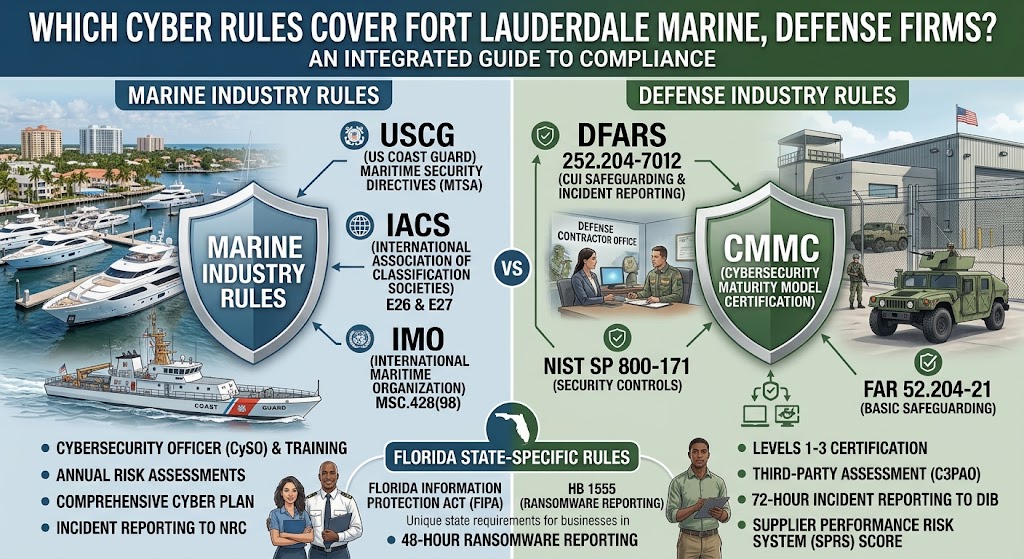
Fort Lauderdale marine and defense contractors may face five sets of cybersecurity rules:
- U.S. Coast Guard maritime cyber rule: applies to vessels and port facilities with federal security plans.
- DFARS 252.204-7012 and NIST SP 800-171: apply to Pentagon contractors handling Controlled Unclassified Information (CUI).
- CMMC self-assessments: Phase 1 is in force; third-party certification is suspended.
- ITAR and EAR export controls: apply to defense technical data.
- Florida’s breach notification law: applies to any company holding Floridians’ personal information.
Why Fort Lauderdale Contractors Face Overlapping Rules
Fort Lauderdale sits where two regulated industries meet:
- Marine: South Florida’s recreational marine industry generated $18.5 billion in economic output in 2022, up from $12.0 billion in 2018. It supports an estimated 141,860 regional jobs, with Broward County as its center.
- Defense and maritime security: Port Everglades, nearby Coast Guard operations and Navy and defense supply chains bring federal contracts to local shipyards, engineering firms, electronics suppliers and IT providers.
A refit yard, marine electronics installer or engineering firm can face Coast Guard rules through a port client, DFARS rules through a Navy subcontract, and export controls through technical drawings, all at once.
Which Rules Apply to Your Company?
| If Your Company… | Rules That Likely Apply |
|---|---|
| Operates a U.S.-flagged vessel or MTSA-regulated facility | Coast Guard cyber rule (33 CFR Part 101) |
| Serves a regulated port facility or vessel operator | Coast Guard requirements passed down by contract |
| Holds or bids on DoD contracts with CUI | DFARS 7012, NIST SP 800-171, CMMC |
| Holds only Federal Contract Information (FCI) | CMMC Level 1 basic safeguarding |
| Handles defense technical data | ITAR or EAR export controls |
| Works on civilian agency contracts with CUI | Proposed FAR CUI rule (not final) |
| Manages commercial yachts over 500 gross tons | IMO cyber risk management in the safety management system |
| Holds Floridians’ personal data | Florida Information Protection Act |
1. Coast Guard Maritime Cybersecurity Rule
The Coast Guard’s rule, “Cybersecurity in the Marine Transportation System,” is the first mandatory federal cybersecurity framework for the maritime sector.
Who It Covers
It applies to owners and operators of:
- U.S.-flagged vessels,
- Outer Continental Shelf facilities, and
- facilities regulated under the Maritime Transportation Security Act (MTSA), such as terminals at Port Everglades.
Any vessel or facility required to have a security plan must now build cybersecurity into it.
Most Fort Lauderdale boatyards and refit shops aren’t MTSA-regulated themselves. But contractors whose technicians or systems touch a regulated facility’s networks should expect the facility’s cyber obligations to show up in their contracts.
Key Deadlines
| Requirement | Deadline |
|---|---|
| Report cyber incidents to the National Response Center | In effect since July 16, 2025 |
| Cybersecurity training for personnel | January 12, 2026, then annually |
| Designate a Cybersecurity Officer (CySO) | July 16, 2027 |
| Complete a Cybersecurity Assessment | July 16, 2027 |
| Submit a Cybersecurity Plan for approval | July 16, 2027 |
What the Plan Must Cover
- Assessment: A cybersecurity assessment scaled to each operator’s IT and operational technology (OT).
- Segmentation: Separation between business IT networks and operational systems such as engine controls, navigation and cargo handling. Analysts consider this the hardest requirement to meet.
- Incident response: A cyber incident response plan.
- Annual review: Yearly assessments and Coast Guard audits after approval.
The Coast Guard asked for comments on giving U.S.-flagged vessels more time to comply. Operators should confirm whether a vessel extension applies before planning to the 2027 date.
2. Defense Contractor Requirements: DFARS and NIST SP 800-171
Defense contractors handling CUI have been bound by DFARS clause 252.204-7012 since 2017. It requires:
- NIST SP 800-171 controls: The 110 security requirements for CUI on contractor systems. The DFARS clause currently references Revision 2.
- 72-hour incident reporting: Report cyber incidents to the Pentagon within 72 hours of discovery.
- Flow-down: Pass the clause to subcontractors that handle CUI.
- SPRS score: Post a self-assessment score in the Supplier Performance Risk System (SPRS).
3. CMMC: What’s In Effect and What’s Paused
The Cybersecurity Maturity Model Certification (CMMC) adds verification on top of DFARS 7012. Its status changed sharply in 2026:
- November 10, 2025: The DFARS rule took effect, and contracting officers began adding CMMC requirements (Phase 1 self-assessments) to new solicitations.
- July 13, 2026: The Department of War suspended Phase 2, which would have required third-party Level 2 certification starting November 10, 2026. A CMMC Reform Task Force began a 60-day review.
- September 3, 2026: A class deviation directed contracting officers to remove third-party assessment requirements from contracts, making the pause binding.
What Still Applies
Phase 1 self-assessments, DFARS 252.204-7012 obligations and annual SPRS affirmations remain fully in effect. Prime contractors may still require certification from their subcontractors through their own contract terms, even during the pause.
Bottom line for local firms: The pause delays outside audits. It doesn’t change the underlying security requirements. Firms that stop work on NIST 800-171 risk failing self-assessments and losing contracts when certification resumes.
4. Proposed FAR CUI Rule for All Federal Contractors
On June 23, 2026, the FAR Council proposed a government-wide rule for protecting CUI. It would extend safeguarding requirements to civilian agency contractors, including those working for the Coast Guard, Homeland Security and NOAA.
Key terms of the proposal:
- Revision 3 baseline: Contractor systems handling CUI would have to meet NIST SP 800-171 Revision 3.
- 72-hour reporting: Suspected or confirmed CUI incidents would have to be reported within 72 hours.
- Record retention: Incident-related information would have to be kept for at least 90 days.
- Extra controls for critical programs: Agencies could add NIST SP 800-172 controls for critical programs or high-value assets.
The comment period closed July 23, 2026. The rule isn’t final, but firms should plan for the move from Revision 2 to Revision 3.
5. Export Controls: ITAR and EAR
Many Fort Lauderdale defense and marine engineering firms handle export-controlled data, such as naval vessel designs, sonar and communications systems, or military-specification components.
- ITAR (State Department): Covers defense articles and technical data on the U.S. Munitions List.
- EAR (Commerce Department): Covers dual-use items and technology.
Cyber implications:
- Restrict system access to authorized U.S. persons where required.
- Use compliant cloud environments for controlled data.
- Treat unauthorized access or foreign-person exposure as a possible export violation, not just an IT incident.
6. Yachts and International Vessels
Fort Lauderdale’s large yacht service sector also faces international rules. Under the International Maritime Organization’s resolution MSC.428(98), cyber risks must be addressed in a vessel’s safety management system. This affects managers and crews of commercial yachts and other vessels subject to the International Safety Management (ISM) Code.
Refit yards and IT installers working on these vessels are increasingly asked to document network changes, remote-access controls and software updates.
7. Florida Breach Notification Law
Every Florida business that holds personal information must follow the Florida Information Protection Act:
- Individuals: Notify affected people within 30 days of determining a breach.
- State: Notify the Florida Department of Legal Affairs if 500 or more Floridians are affected.
- Vendors: Third-party vendors must notify their client within 10 days.
Compliance Roadmap for Fort Lauderdale Marine and Defense Contractors
- Map your contracts. Identify DFARS, FAR, Coast Guard, ITAR and state clauses in every prime contract and subcontract.
- Classify your data. Separate CUI, FCI, export-controlled data and personal information.
- Do a NIST SP 800-171 gap assessment. Score yourself honestly and post the score in SPRS.
- Plan for Revision 3. Prepare for the FAR rule and an eventual DFARS update.
- Segment IT from OT. Separate business systems from shipyard, vessel and industrial control systems.
- Write a 72-hour incident response plan. Include reporting paths to the Pentagon, the Coast Guard’s National Response Center and your clients.
- Train everyone. Coast Guard-regulated operators need annual training, and DFARS contractors need documented awareness training.
- Lock down remote access. Vendor and technician access to vessel and facility systems is a frequent attack path.
- Review cloud and email. Make sure CUI and ITAR data sit only in compliant environments.
- Track CMMC. Watch for the task force’s findings and any new Phase 2 date.
Frequently Asked Questions
What cybersecurity compliance requirements do Fort Lauderdale marine and defense contractors need to meet?
Depending on their work, contractors may need to meet:
- the Coast Guard’s maritime cyber rule (for vessels and port facilities)
- DFARS 252.204-7012 and NIST SP 800-171 (for Defense contracts involving CUI)
- CMMC self-assessments
- ITAR or EAR export controls
- Florida’s breach notification law
Is CMMC still required in 2026?
Partly. Phase 1 self-assessments remain in effect. Phase 2 third-party certification was suspended on July 13, 2026, and made binding on contracting officers through a September 3, 2026, class deviation.
When are Coast Guard maritime cybersecurity plans due?
Owners and operators of U.S.-flagged vessels and MTSA-regulated facilities must designate a Cybersecurity Officer, complete an assessment and submit a Cybersecurity Plan by July 16, 2027. Incident reporting has been required since July 16, 2025.
Does the Coast Guard cyber rule apply to boatyards and marine contractors?
It applies directly to U.S.-flagged vessels, Outer Continental Shelf facilities and MTSA-regulated facilities. Many boatyards and marine contractors aren’t directly covered, but they may face the requirements through contracts with regulated clients.
What is the difference between NIST SP 800-171 Revision 2 and Revision 3?
The DFARS clause for defense contractors currently references Revision 2. The proposed FAR CUI rule would make Revision 3 the baseline for civilian contracts, and the Pentagon’s rules could later shift to match.
How fast must a defense contractor report a cyber incident?
DFARS 252.204-7012 requires reporting to the Pentagon within 72 hours of discovery. The proposed FAR CUI rule would apply the same 72-hour window to civilian contracts.
Sources and Further Reading
- Blank Rome, “Coast Guard Cybersecurity Rule 2025: Key Legal Issues, Deadlines and FAQs”
- UK P&I Club, USCG Cyber Regulations Fact Sheet
- Guice Offshore, “Coast Guard Cybersecurity in the Marine Transportation System Final Rule Effective As of July 16, 2025”
- Maritime Executive, “Understanding the Coast Guard’s Cybersecurity Rule”
- Dark Reading, “Coast Guard’s New Cybersecurity Rules Offer Lessons for CISOs,” 2026
- U.S. Department of War, “Department of War Suspends CMMC Phase II Requirements,” July 13, 2026
- WilmerHale, “Pentagon Suspends CMMC Phase 2 Requirements and Launches Review of Cybersecurity Certification Program,” July 20, 2026
- Crowell & Moring, “Department of War Immediately Suspends CMMC Phase II Requirements, Launches 60-Day Reform Review,” 2026
- Nextgov/FCW, “CMMC’s Phase 2 suspension locked in with binding regulation,” September 2026
- Pegasus Technologies, “Is CMMC Paused? What You Still Owe in 2026”
- Cooley, “DoD Releases Long-Awaited Final Rule Implementing CMMC Contract Clause,” September 2025
- Mayer Brown, “FAR Council Proposes Revised CUI Safeguarding and Incident Reporting Framework While DoW Pauses CMMC Implementation,” July 2026
About the Author