By Brian French | Florida Authority Network | October 20, 2026
Quick Answer: Fort Lauderdale’s refit yards are tight because yachts keep getting bigger while working waterfront keeps shrinking. The largest vessels often exceed local lift limits and head to Palm Beach County or overseas. Expansion is moving north to Riviera Beach, Fort Pierce, and Martin County, while Broward yards upgrade lifts and berths in place.
Why Is Superyacht Refit Capacity So Tight in Fort Lauderdale?
Quick Take
- The global superyacht fleet is growing in both number and size, and refit demand is growing with it.
- Fort Lauderdale’s yards are boxed in by residential development, permitting, and river depth.
- Skilled labor, not just dock space, is now a limiting factor during peak season.
Every October, the superyacht fleet migrates toward Fort Lauderdale. Owners want work completed before the Fort Lauderdale International Boat Show and before the Caribbean charter season. The 67th edition of the show runs October 28 through November 1, 2026, which means local yards are in their most compressed weeks of the year right now.
The show itself is an economic engine. Organizers estimate about $1.79 billion in annual economic impact and more than 100,000 jobs supported across the region. But the boats in the water at the show are only part of the story. The larger and steadier business is the refit, repair, and maintenance work that keeps those vessels running the other 360 days of the year.
That work is under strain. Industry interviews published by The Superyacht Report in 2026 describe capacity bottlenecks in major refit hubs during peak seasons, affecting not only labor but also supervision, quality control, and realistic scheduling. South Florida is one of the most visible examples.
What Are the Root Causes of the Refit Bottleneck?
Quick Take
- Yachts are outgrowing the lifts, berths, and channels built for an earlier generation.
- Waterfront industrial land is steadily lost to residential and resort projects.
- Labor shortages hit the most specialized trades hardest.
1. Vessels Are Getting Bigger
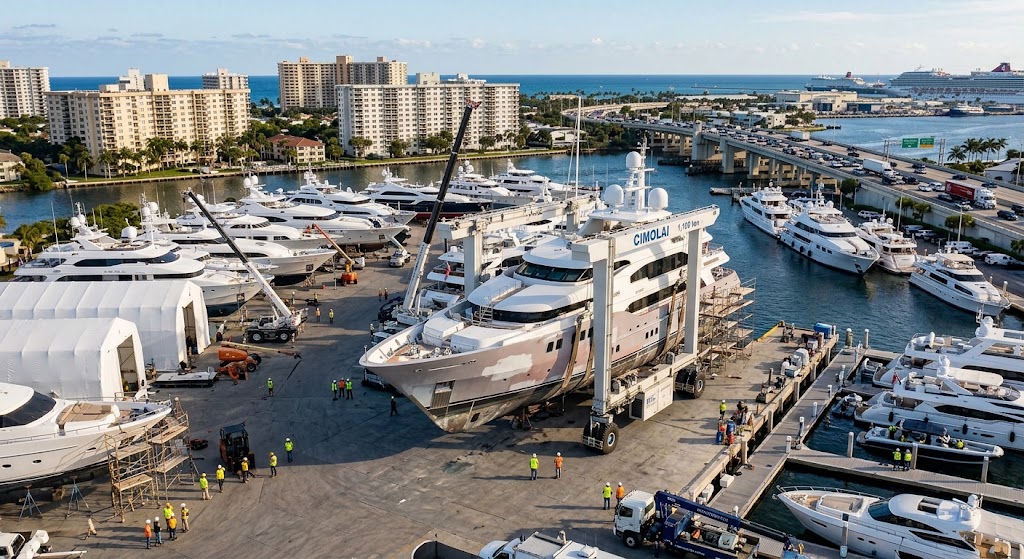
A yard built for 150-foot yachts cannot simply absorb 250-foot yachts. Hauling a large vessel out of the water requires a lift with enough tonnage, a pier long and wide enough to carry it, and enough hardstand to block it ashore safely. Each step is a capital project.
Broward yards have spent the last decade chasing that curve. Derecktor’s Dania Beach yard installed what was then the largest mobile yacht lift in the country in 2012, a 900-ton Cimolai hoist. A later pier extension allowed it to routinely lift yachts of 200 feet, and occasionally up to 220 feet in overall length. That is impressive capacity, but a growing share of new superyachts exceed it.
2. Waterfront Land Is Disappearing
Marine industry leaders have warned about this for two decades. In 2006, the Marine Industries Association of South Florida reported that Broward had lost several boatyards in five years, and that most of the survivors had received offers from residential developers.
The economics have not changed. A waterfront acre is usually worth more as condominiums than as a working boatyard, and once a yard is converted, it rarely comes back. Every new tower on the New River or the Intracoastal is one less potential site for hauling and refitting.
3. Permitting and Environmental Limits
Expanding a yard means working in and over water. That brings in state submerged land rules, federal waterway permits, and county environmental review. Dredging a channel deep enough for large yachts is slow, expensive, and sometimes surprising. When the Dania Cut-off Canal was dredged to 17 feet to give megayachts better access from Port Everglades, crews hit a hard limestone slab that required new equipment to break through.
4. Skilled Labor Is the New Ceiling
Even where space exists, the people to do the work may not. Painters, marine electricians, fabricators, and project managers with superyacht experience are hard to find, and much of the existing workforce is nearing retirement. Paint sector leaders interviewed by The Superyacht Report said pressure on skilled capacity is currently a limiting factor, and that the need for more infrastructure and workforce is increasingly clear.
Why Do Superyachts Leave Fort Lauderdale for Refits?
Quick Take
- The largest yachts may exceed the lift or dry-dock capacity of Broward yards.
- Peak-season scheduling conflicts push some owners to book elsewhere.
- European yards compete aggressively on large, long refit projects.
There is no single reason a yacht leaves Fort Lauderdale for work, but the patterns are consistent:
| Reason | What It Means for Owners |
|---|---|
| Size beyond local lifts | Vessel cannot be hauled at most Broward yards |
| Peak-season congestion | Preferred dates and trades are already booked |
| Long, complex refits | Multi-month projects often go to large European yards |
| Dry-dock needs | Some work requires a floating dock rather than a lift |
| Owner itinerary | Mediterranean summer season favors European yards |
For the very largest yachts, the alternatives are limited. Within Florida, the main options are the Palm Beach County and Treasure Coast yards discussed below. Outside Florida, owners frequently turn to major refit yards in Northern Europe and the Mediterranean, timed with summer cruising.
The loss is not just the yard bill. When a yacht refits elsewhere, Fort Lauderdale also loses the subcontractors, crew spending, hotel nights, and supplier orders that travel with the project. Derecktor’s business development leadership has noted that roughly 600 marine-related businesses operate within five miles of its Dania Beach yard, all of them dependent on vessels being hauled there.
Where Is Broward Expanding Capacity in Place?
Quick Take
- Lauderdale Marine Center on the New River remains the nation’s largest yacht repair facility by volume.
- The Dania Cut peninsula has been reorganized to handle more large yachts.
- New marinas such as Port 32 add berths but not haul-out capacity.
Lauderdale Marine Center
Lauderdale Marine Center, at the entrance to the Marina Mile corridor on State Road 84, is widely described as the largest yacht repair facility in the United States by the number of large vessels it can haul and service. It sits on roughly 50 acres along the South Fork of the New River, with about 60 independent contractors working on-site.
Its model is unusual. Rather than performing all work itself, LMC leases space and lets each yacht’s captain or manager choose contractors. In 2017, it became the first marine Foreign Trade Zone in the United States, a designation that helps with foreign-flagged yachts and international parts.
The facility has changed hands as institutional capital has moved into marine infrastructure. The Carlyle Group bought it in 2015 and invested more than $35 million, including absorbing the adjacent Riverbend property. Safe Harbor Marinas later acquired it, making the same company the owner of both LMC and Rybovich in Palm Beach County.
The Dania Cut Peninsula
The Dania Cut peninsula, just south of Port Everglades, hosts Derecktor Dania, Broward Shipyard, and Dania Cut Super Yacht. A reorganization of dockage there was designed to let the cluster collectively handle up to 55 yachts over 100 feet, with about two-thirds on the hard and one-third in the water.
Derecktor has also changed how it sells refit work. In 2025, it installed an integrated enterprise resource planning system across its three yards and launched “Derecktor One,” a refit program offering a single contract for estimating, project management, and delivery at its Dania Beach and Fort Pierce yards.
New Marina Berths
Fort Lauderdale has added berths even where it has not added haul-out space. Port 32 Fort Lauderdale opened on the Marina Mile in 2023 with room for 32 large yachts in a three-acre basin, plus hurricane-rated dockage. Pier 66 expanded its superyacht slips in a multimillion-dollar marina upgrade.
Berths matter for in-water service and for keeping yachts in the area, but they do not solve the haul-out problem. A yacht that needs its bottom painted or running gear serviced still needs a lift and hardstand.
How Is Bahia Mar’s Redevelopment Changing the Picture?
Quick Take
- Bahia Mar is being redeveloped into a $2 billion luxury resort, residential, and marina project.
- The plan includes slips for yachts up to 350 feet and a permanent home for the boat show.
- It adds high-end berthing, not industrial refit capacity.
Bahia Mar, the longtime heart of the Fort Lauderdale International Boat Show, is in the middle of a transformation. Related Group, Tate Capital, and Rok Acquisitions announced a $2 billion St. Regis-branded resort and residential project on the roughly 40-acre site. The marina is planned for yachts as long as 350 feet, alongside about 88,000 square feet of waterfront retail and a public park.
Developers said they expected to break ground in early 2026, with opening targeted for late 2029. The plan preserves dedicated waterfront space for the boat show, which has been held at Bahia Mar since 1976.
The project captures a broader trend. Fort Lauderdale’s waterfront is moving upmarket. That is good for owners who want to keep large yachts in town, and good for hospitality and brokerage. It does little for the shipyards, and it reinforces the land-value pressure that makes industrial waterfront so hard to protect.
Why Is Refit Work Moving North to Palm Beach County?
Quick Take
- Safe Harbor Rybovich is consolidating its heavy repair work in Riviera Beach.
- Riviera Beach approved a scaled-back expansion in February 2025 after an earlier rejection.
- The Riviera Beach site supports some of the largest haul-out and dry-dock equipment in the region.
The Rybovich Move
Rybovich, a West Palm Beach institution for generations, pioneered the integrated superyacht marina and refit model. Safe Harbor Marinas bought the West Palm Beach yard and a smaller Riviera Beach yard in late 2020 for $369 million. Its plan is to move repair operations north to Riviera Beach while redeveloping the West Palm Beach site with residential towers and commercial space.
The Riviera Beach site is designed for scale. Plans call for a 1,100-ton Travelift to complement a 2,500-ton floating dry dock, giving Palm Beach County haul-out and dry-dock capability that very few East Coast yards can match. Safe Harbor’s representatives have pitched it as potentially the largest superyacht repair facility in the country.
A Hard-Won Approval
The expansion was not easy. In 2023, the Riviera Beach City Council rejected the required rezoning after neighborhood opposition. In February 2025, the council unanimously approved a significantly reduced project, with the company stopping development at 22nd Street and leaving land to the north undeveloped. Neighbors who had opposed the earlier plan supported the revised version.
That sequence is a useful lesson for every South Florida yard. Expansion is possible, but only with buffers, design concessions, and early engagement with the people who live next door.
The Wider Palm Beach Cluster
Riviera Beach’s working waterfront also hosts Viking Yachts operations and sits near the Port of Palm Beach. Advocates for the Rybovich project argued that the combination sends a signal to the entire marine industry that Palm Beach County is open for heavy marine business.
What Is Happening on the Treasure Coast?
Quick Take
- Derecktor opened a superyacht yard in Fort Pierce with one of the world’s largest mobile boat hoists.
- Martin County approved major builder and service expansions in Stuart and Indiantown.
- Lower land costs and available acreage are pulling investment north.
Fort Pierce
Derecktor took delivery of what was then the world’s largest mobile boat hoist at its new Fort Pierce yard in January 2021. The yard converted a century-old port site into a full-service superyacht repair and refit facility, giving Derecktor two Florida locations that can share work: Dania Beach for proximity to Port Everglades and Fort Lauderdale’s supplier base, and Fort Pierce for the largest hauls.
Martin County
Martin County has seen a cluster of marine investments:
| Project | Location | What It Adds |
|---|---|---|
| Willis Custom Yachts | Stuart area | ~101,000 sq ft manufacturing, 40,000 sq ft trades building |
| Hinckley Yacht Services | Manatee Pocket, Stuart | 43,000 sq ft Category 5-rated storage for up to 60 vessels |
| Indiantown Marine Center | Village of Indiantown | 33-acre site for large builders and service |
| MarineMax Stuart Marina | Stuart | New marina with retail and service operations |
The Martin County Board of County Commissioners unanimously approved the Willis Custom Yachts master plan and first phase, which covers a roughly 66-acre site on the St. Lucie River. Hinckley described its Stuart storm-rated building as the first step in a multi-phase plan to make the location a best-in-class service destination.
Most of the Treasure Coast growth is in builders and mid-size yacht service rather than the largest superyachts. But it matters for Fort Lauderdale: it pulls trades, suppliers, and sometimes whole companies north where land is available.
How Are Fort Lauderdale Marine Businesses Adapting?
Quick Take
- Contractors are increasingly mobile, following yachts to whichever yard has space.
- Yards are selling bundled, single-contract refit programs.
- Storm-rated storage and in-water service are growing niches.
Fort Lauderdale’s marine businesses are not standing still while capacity moves. Several adaptations are visible:
Mobile service teams. Painters, electricians, carpenters, and systems integrators increasingly travel to the yacht rather than requiring it to come to them. A Fort Lauderdale firm might work at LMC one month, Rybovich the next, and Fort Pierce after that. The supplier base stays anchored in Broward even as the hauling happens elsewhere.
Single-contract refits. Owners have grown frustrated with cost overruns and unclear responsibility on large refits. Programs such as Derecktor One respond by putting estimating, management, and delivery under one contract.
In-water specialization. Without more haul-out space, more work is being done with the yacht afloat: interiors, electronics, audiovisual systems, and some mechanical overhauls. New superyacht berths at Port 32, Pier 66, and eventually Bahia Mar support that model.
Storm resilience. Recent hurricanes have made storm-rated storage a selling point. Hinckley’s Stuart building and Port 32’s hurricane dockage are examples of a growing service category.
Workforce investment. Yards such as Derecktor partner with the Marine Industries Association of South Florida, Atlantic Technical College, and Broward College to train apprentices and rotate them through welding, plumbing, and other departments.
What Does the Next Five Years Look Like for South Florida Refit?
Quick Take
- Demand should stay strong as the fleet grows and older yachts need major work.
- Heavy haul-out capacity will keep shifting north toward Palm Beach and the Treasure Coast.
- Fort Lauderdale’s edge will depend on keeping its supplier base and protecting remaining industrial waterfront.
Forecasting the marine economy is uncertain, but several trends appear durable through about 2031:
Demand stays high. The fleet keeps growing, and yachts built in the last boom will need major mid-life refits. Regulatory changes on emissions, safety, and cybersecurity also create work owners cannot defer.
Capacity keeps shifting north. The largest new haul-out and dry-dock capacity in the region is being built in Riviera Beach and Fort Pierce, not Broward. Unless Broward finds new industrial waterfront, its share of the very largest refits is likely to shrink.
Fort Lauderdale remains the hub. Even so, Fort Lauderdale is unlikely to lose its central role. It has the boat show, the brokerage community, the largest concentration of marine suppliers, Port Everglades, and an international airport. The region will likely operate as a corridor, with Fort Lauderdale as the commercial center and northern yards providing the heavy lift.
Real estate is the swing factor. The biggest risk to Broward’s marine economy is not competition from Palm Beach. It is the steady conversion of working waterfront to residential use. Local land-use decisions over the next five years will determine how much refit work stays in the county.
Brian’s Take
The refit bottleneck is a good problem in one sense: it exists because demand is strong. Owners want to bring their yachts to South Florida. The question is whether the region can physically handle them.
What stands out is that the expansion map is being drawn by real estate economics, not by the marine industry’s preferences. Rybovich is moving north partly because its West Palm Beach land is worth more as towers. Bahia Mar is becoming a luxury resort. Each of these decisions makes sense for the property owner. Added together, they push heavy marine work farther from the urban core.
For Fort Lauderdale, that is not necessarily a crisis, as long as the supplier base stays. The money in refit is not only in the lift; it is in the hundreds of specialty firms that do the actual work. If those firms remain headquartered in Broward and travel to wherever the yacht is hauled, Fort Lauderdale keeps much of the economic value.
The risk is the tipping point. Once enough haul-out capacity moves north, suppliers follow, then workers, then the training programs. Broward still has time to protect the industrial waterfront it has left. It should treat that land the way other cities treat a port or an airport: as infrastructure, not as a future condo site.
Frequently Asked Questions
Why are superyachts leaving Fort Lauderdale for refits?
The largest yachts can exceed the lift and berth capacity of most Broward yards, and peak-season congestion fills schedules. Owners often turn to Palm Beach County, Fort Pierce, or large European yards for major projects.
What is the largest yacht repair facility in the United States?
Lauderdale Marine Center on the New River in Fort Lauderdale is widely described as the nation’s largest yacht repair facility by the number of large vessels it can haul and service.
Where are South Florida marine companies expanding?
The main expansion areas are Riviera Beach in Palm Beach County, Fort Pierce in St. Lucie County, and Stuart and Indiantown in Martin County, with Broward yards upgrading lifts and berths in place.
When is the 2026 Fort Lauderdale International Boat Show?
The 67th Fort Lauderdale International Boat Show runs October 28 through November 1, 2026, across multiple waterfront venues centered on Bahia Mar.
What is happening to Bahia Mar in Fort Lauderdale?
Developers are pursuing a $2 billion St. Regis-branded resort, residential, and marina project with slips for yachts up to 350 feet, while keeping space for the boat show. Opening has been targeted for late 2029.
Sources and Further Reading
- Yacht Charter Fleet, “Fort Lauderdale International Boat Show Announces Show Updates as Ticket Sales Open for 2026 Edition”
- Denison Yachting, Fort Lauderdale International Boat Show 2026
- The Superyacht Report and SuperyachtNews, “Is There a Labour Bottleneck?”
- SuperyachtNews, “Dania Cut River Peninsula to Improve Superyacht Services”
- Superyachts.com, “Derecktor Shipyard on Catering for Bigger Builds”
- Derecktor, “Derecktor Dania Extends Lift Piers, Increases Lifting Capacity to 220′ LOA”
- MarineLink Shipyards, Derecktor One and Florida Yard Updates
- The Carlyle Group, “The Carlyle Group Acquires Lauderdale Marine Center”
- Marina Dockage, “Safe Harbor Marinas Purchases Lauderdale Marine Center”
- Stet News, “Safe for Safe Harbor” (Riviera Beach approval, February 2025)
- Stet News, “Superyacht Boatyard Promises Riviera Beach $300 Million Infusion”
- Bellingham Marine, Rybovich Project Profile
- Bisnow South Florida, “Developers Launch $2B Monaco-Inspired Bahia Mar Redevelopment”
- Business Development Board of Martin County, Willis Custom Yachts and Hinckley Yacht Services Announcements
About the Author