Capital, Concrete, and Cost of Capital: The 2026 Fort Lauderdale Commercial Real Estate Paradigm
For decades, the national narrative surrounding Fort Lauderdale cast the city as a secondary, leisure-driven market—a sun-drenched relative to Miami’s international banking hub. That narrative is officially obsolete.
Fort Lauderdale has stepped into its own era of high-velocity corporate expansion, institutional capital migration, and sweeping urban modernization. The downtown skyline, long anchored by legacy finance and legal towers, is being entirely redrawn by multi-billion-dollar mixed-use developments, corporate relocations, and luxury residential projects.
However, the current market dynamics are completely different from the hyper-growth explosion of the early 2020s. Today, the Fort Lauderdale marketplace is navigating a complex macroeconomic transition. The combination of sustained out-of-state corporate inflows, massive structural infrastructure transformations, and elevated interest rates has created a distinct environment where cap rates have plateaued, developers are leaning on legislative tools like the Live Local Act, and inventory pipelines are tightening.
1. The Corporate Migration Wave: Out-of-State Capital Deepens Its Roots
The migration of corporate capital into Broward County has evolved from a pandemic-era trend into a permanent structural reality. While initial waves of business relocation were heavily driven by individual executives seeking tax advantages, the current wave consists of institutional entities permanently establishing major corporate headquarters, regional offices, and logistical hubs.
According to Q1 2026 commercial leasing analytics from CBRE, office-using roles account for roughly half of all new positions created in the metro area. White-collar hiring within the professional services, legal, technology, and financial sectors remains remarkably resilient. This specialized job creation is fueling a sustained flight-to-quality, keeping demand for premium, highly amenitized Class A office assets insulated from broader national office market contractions.
This influx of corporate capital has transformed key regional submarkets into distinct economic powerhouses:
- Downtown Fort Lauderdale & Las Olas Boulevard: This core business district has cemented itself as a major center for asset management firms, corporate advisory groups, and specialized legal practices. The demand for modern, collaborative office environments here has driven landlords to launch significant capital improvement programs across legacy institutional properties. A prime example is the newly renovated Broward Financial Centre, which was recently tapped for a major leasing push to capture regional corporate expansions.
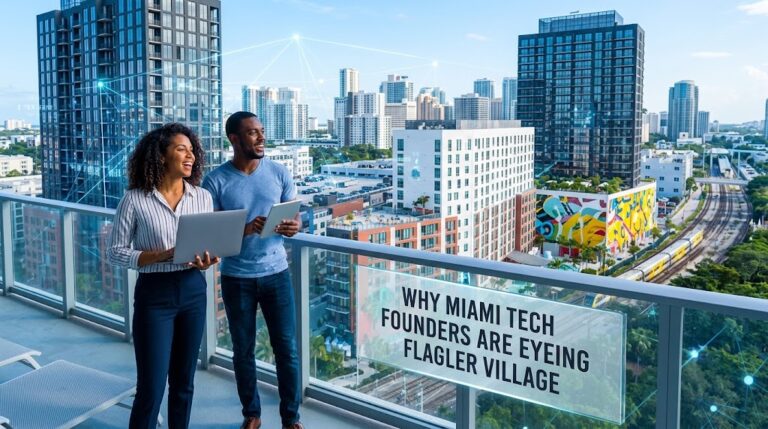
- Flagler Village: Once an industrial warehouse zone, Flagler Village has evolved into Fort Lauderdale’s premier creative and technological hub. It attracts startups, digital service providers, software firms, and entrepreneurial ventures looking for highly walkable, urban ecosystems that appeal to younger tech talent.
- Suburban Corridors (Plantation, Sunrise, Cypress Creek): Inbound capital isn’t restricted to the downtown core. Decentralized office nodes are capturing significant middle-market corporate office footprints. Deals like the $8 million sale of the Plantation Executive Building in early 2026 underscore continuous investor appetite for stabilized suburban commercial spaces that offer seamless regional connectivity via major highway systems.
2. Megaprojects Reshaping the Urban Core
The visual evidence of Fort Lauderdale’s commercial transformation is found in its massive construction pipeline. The city is currently playing host to some of the most ambitious mixed-use, master-planned redevelopments in the southeastern United States.
These projects represent a shift away from single-purpose real estate, favoring dense, vertical, integrated ecosystems where residents can live, work, and socialize without relying on extensive commutes.
The Galleria Redevelopment: A $73 Million Catalyst Turn
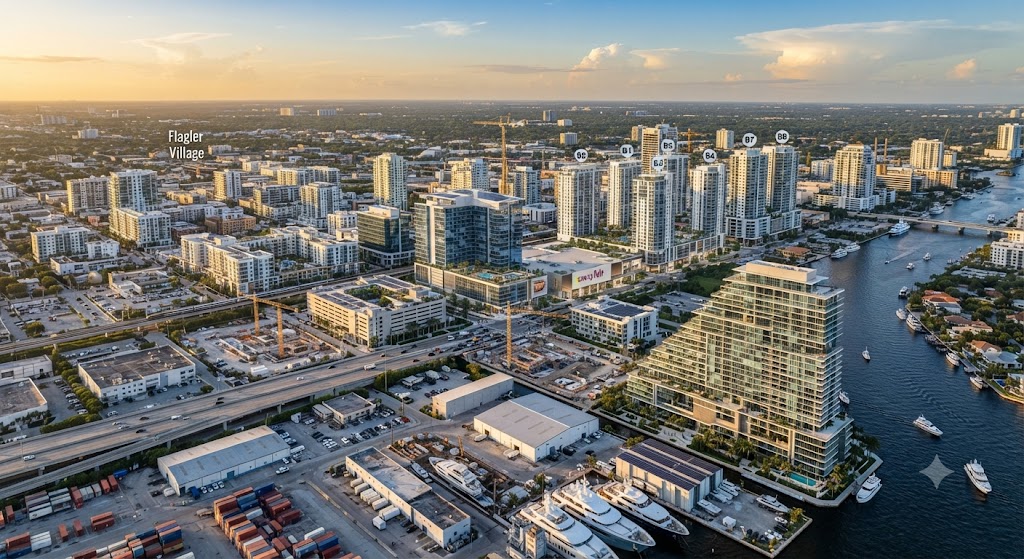
The most significant and highly watched urban intervention currently moving through the regulatory pipeline is the comprehensive redevelopment of The Galleria at Fort Lauderdale. Historically an underutilized retail mall, the property was acquired in 2025 by a powerful joint-venture coalition including GFO Investments, InSite Group, Atlas Hill Real Estate, and Prime Finance for a reported $73 million.
In May 2026, the project cleared a monumental regulatory hurdle when the Federal Aviation Administration (FAA) issued official determinations for eight 342-foot-tall high-rise towers associated with the master plan. Rising approximately 30 stories above ground level, these structures (labeled B1 through B8) will completely redefine the Sunrise Boulevard corridor.
The scale of this master plan highlights how developers are converting obsolete retail footprints into highly productive mixed-use hubs. Additionally, retail anchors are adapting to this new density; digital-native giant Wayfair announced it will debut its first large-format Florida retail store at the Galleria, spanning 94,000 square feet across two levels, scheduled for a late 2027 delivery.
Branded Luxury and Waterfront Monopolies
Simultaneously, the ultra-luxury residential and hospitality market is pushing further down the waterfront corridors. In early 2026, developers launched active sales for the highly anticipated Ritz-Carlton Branded Residences in Fort Lauderdale, aiming for a delivery window between late 2027 and 2028.
Market indicators show that branded residential products continue to command significant price premiums in South Florida. By coupling a globally recognized hospitality name with boutique-scale, high-end design, and a strong waterfront footprint, institutional developers are capturing a substantial share of affluent out-of-state capital that remains unbothered by local financing pressures.
3. The Multifamily Paradox: Shifting Interest Rates & Capital Markets
While the long-term economic thesis for Fort Lauderdale remains incredibly strong, the immediate multifamily sector is operating within a unique macroeconomic paradox. The continuous arrival of new residents creates sustained, high-level demand for housing. However, the capital market environment has fundamentally altered how these projects are financed, built, and operated.
Interest Rate Volatility and Cap Rate Stabilization
The capital markets in early 2026 have been defined by a fierce financial tug-of-war. During January and February, a brief dip in long-term treasury yields and commercial mortgage rates triggered a sudden wave of optimism, resulting in improved internal rates of return (IRR) and cash-on-cash projections for active buyers. However, geopolitical disruptions in late February instantly reversed that downward momentum, sending interest rates back up and locking capital markets into an elevated, defensive position.
Fort Lauderdale Metro Cap Rates (Q1 2026)
- Luxury Metro Class A: 5.18%
- Luxury Metro Class B: 5.21%
- Luxury Metro Class C: 5.80%
- Suburban Class A: 5.25%
- Suburban Class B: 5.38%
- Value-Added Acquisition: 6.77%
Following a noticeable 9% upward curve throughout 2025, commercial appraisal data indicates that multifamily cap rates flattened in Q1 2026, averaging 5.60% across all combined asset classes.
The Financing Environment: Debt Service Constraints
With apartment loan programs presently ranging from 5.55% to 6.65% for fixed-rate permanent debt, and shorter-term bridge or rehabilitation financing hovering between 8.75% and 13.00%, the cost of capital remains historically high. This reality has put immense downward pressure on debt-service coverage ratios (DSCR), forcing institutional underwriting to become exceptionally conservative.
Because the cost of financing matches or exceeds prevailing cap rates—a phenomenon known as neutral or negative leverage—developers can no longer rely on quick, short-term flips to manufacture returns. Instead, institutional capital has shifted completely toward a long-term hold strategy (typically 6 to 10 years), focusing heavily on operational efficiency, finding properties with below-market rents, and optimizing asset management to drive cash flow over time.
4. Operational Dynamics: Inventory, Vacancies, and the Rent Ceiling
As capital market realities adjust, the actual physical supply and demand dynamics on the ground are hitting a critical equilibrium point. The massive wave of construction deliveries that defined the 2023–2025 period is finally winding down, shifting bargaining leverage back toward property owners in core submarkets.
The Inventory Slowdown
According to the 2026 Investment Forecast issued by Marcus & Millichap, multifamily inventory growth across the Fort Lauderdale metro will slow down significantly this year. Total projected deliveries are expected to reach just 3,300 units for the entirety of 2026—representing the smallest annual pipeline addition since 2022.
At a localized inventory growth rate of just 1.6%, Fort Lauderdale is tied with Miami for the lowest rate of new apartment additions among Florida’s major metropolitan areas. This sharp drop-off in deliveries provides a needed buffer for the market, allowing the existing pool of unabsorbed inventory to be systematically digested by the region’s continuous white-collar job creation.
The Rent Growth Ceiling and Tenant Concessions
Despite a tightening supply chain, property managers are running headfirst into a hard consumer rent ceiling. High baseline living expenses and local inflation mean that the average renter simply cannot absorb further aggressive rent increases. To combat this, the overarching asset management objective across Broward County has shifted from maximizing rent hikes to prioritizing occupancy.
Metrowide vacancy rates currently hover around 4.8% and are projected by Fannie Mae to edge slightly upward to 5.1% by the fourth quarter of 2026. Because of this, operators are deploying targeted rental concessions (such as one month free on a 13-month lease) to stabilize their tenant bases.
Interestingly, the market is splitting along geographic lines:
- Central Downtown Core: Driven by professional service hiring, downtown vacancy continues to contract. Class A operators in this submarket began successfully achieving modest rent increases on new leases again, marking a stark contrast to the flat operational environment of the previous two years.
- Outlying Submarkets: Regions like Hollywood face an elevated construction pipeline that is placing temporary pressure on localized vacancies, though its affluent tenant base is expected to steadily absorb those luxury units. Conversely, suburban areas like Pembroke Pines, Plantation, and Coral Springs are seeing almost zero new supply additions, heavily insulating them from vacancy risk even as broader household formation slows down.
5. The Live Local Act: A New Playbook for Density and Capital Stack Structuring
Faced with steep financing rates and high construction costs, developers are turning to state legislation to unlock project viability. Florida’s Live Local Act (LLA) has emerged as one of the most powerful and disruptive mechanisms in the state’s commercial real estate history, completely altering how developers underwrite multi-family capital stacks in Broward County.
The Live Local Act Core Mechanics: By designating a minimum of 40% of a residential project’s total units as workforce housing (targeted to households earning up to 120% of the local Area Median Income) for a duration of 30 years, developers can legally bypass local municipal zoning restrictions regarding density and building height, moving straight to the maximum allowable limits within the county.
Unlocking Feasibility Through Tax Exemptions
The true brilliance of the Live Local Act in a high-interest-rate environment lies in its profound operational cost-saving measures. Projects that qualify under the LLA gain access to substantial property tax exemptions and specialized financing streams, including State Apartment Incentive Loan (SAIL) funding programs managed by the Florida Housing Finance Corporation.
For massive urban redevelopments like the Galleria master plan, utilizing the Live Local Act is a deliberate financial strategy. By incorporating 1,273 workforce housing units into their 3,144-apartment layout, the development team successfully unlocked unprecedented vertical density. The resulting property tax breaks directly lower the asset’s operating expenses, offsetting high debt-service costs and making an otherwise impossible capital stack highly feasible.
While this legislative strategy has drawn criticism from local communities concerned about rapid urban density and straining municipal infrastructure (particularly along primary thoroughfares like Sunrise Boulevard), it remains the premier tool for institutional developers looking to jump-start major projects without waiting for interest rates to drop.
6. Industrial and Marine Logistics: The Supply-Constrained Super-Class
While multifamily and office real estate command the majority of public headlines, Fort Lauderdale’s industrial real estate sector is quietly operating as one of the strongest, most resilient asset classes in the entire southeastern United States.
The Geography of Scarcity
Unlike interior Sun Belt development markets like Phoenix, Dallas, or Nashville—where developers can build warehouses out across endless miles of low-cost land—Fort Lauderdale and the broader Broward County region are bound by immovable geographic constraints. With the Atlantic Ocean to the east and the protected Florida Everglades directly to the west, the local market suffers from a permanent, severe scarcity of developable industrial land.
On the demand side, e-commerce fulfillment centers, last-mile logistics networks, and regional cold-storage operations are continuously competing for space to service a rapidly expanding population. This structural imbalance has kept vacancy rates exceptionally low and empowered landlords with massive pricing leverage.
Premium Lease Rates and the Maritime Multiplier
Current industrial lease rates in Broward County highlight the premium value placed on these logistics nodes:
- Small Bay Flex Space (Under 3,000 Sq. Ft.): $18.00 to $30.00 per Sq. Ft. NNN
- Mid-Size Warehouse (3,000–10,000 Sq. Ft.): $14.00 to $22.00 per Sq. Ft. NNN
- Large Distribution Logistics (10,000–50,000+ Sq. Ft.): $10.00 to $16.00 per Sq. Ft. NNN
Note: Base rent figures exclude triple net (NNN) charges, which typically add an extra $2.00 to $5.00 per square foot in local occupancy costs.
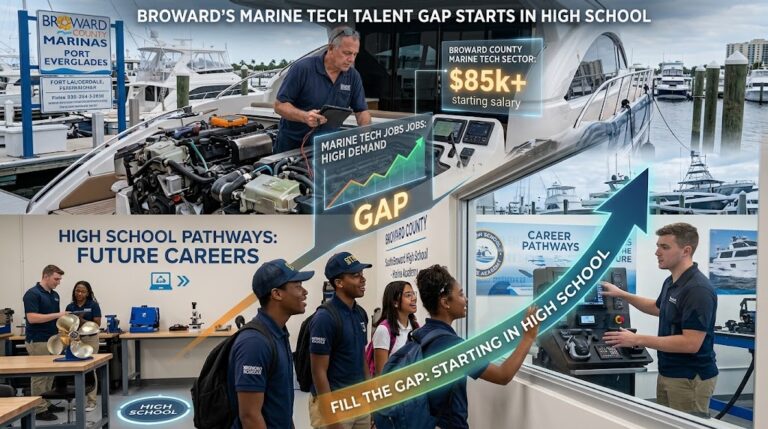
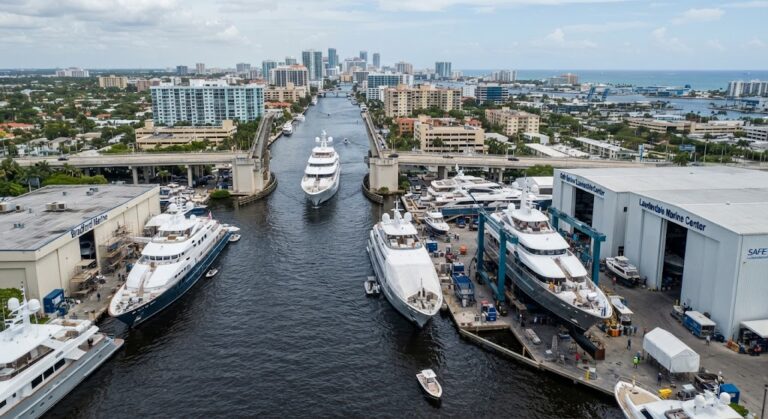
Furthermore, Fort Lauderdale’s world-renowned $7+ billion marine industry acts as a powerful economic multiplier for industrial real estate. The thousands of marine service firms, yacht refit businesses, specialized parts manufacturers, and electronics distributors that anchor the city’s maritime trade require accessible industrial footprints close to the waterways.
This robust maritime ecosystem, combined with global shipping container traffic moving through Port Everglades, ensures that industrial assets command premium capital values, frequently trading at impressive pricing metrics ranging from $250 to over $500 per square foot.
7. The Outlook: Navigating the Next Growth Cycle
The Fort Lauderdale commercial real estate marketplace has officially graduated from a highly speculative, momentum-driven market into a mature, institutional business ecosystem. The continuous influx of out-of-state corporate capital and structural space requirements from professional service firms are providing a dependable foundation for the local economy, even amidst broader macroeconomic headwinds.
For real estate developers, investors, and operators navigating this environment, the playbook has changed:
- Underwriting for Reality: Deals must be structured around conservative long-term hold parameters, focusing heavily on solid property fundamentals and operational efficiency rather than counting on rapid rent inflation or immediate interest rate relief.
- Embracing Mixed-Use Density: Successful megaprojects like the Galleria redevelopment show that the path to high yields lies in creating integrated vertical ecosystems that efficiently match corporate, residential, and retail spaces.
- Leveraging Legislation: Smart developers will continue to utilize tools like the Live Local Act to optimize their capital layouts, tap into workforce housing demand, and bypass traditional zoning constraints.
Fort Lauderdale’s structural growth drivers—including geographic space constraints, vital maritime trade assets like Port Everglades, zero state income tax, and an expanding white-collar labor force—are long-term advantages that remain firmly intact. As the current inventory pipeline thins out and capital markets find their footing, Fort Lauderdale is exceptionally well-positioned to command a premier role in the next real estate growth cycle.
Analytical Resources and Market Documentation
The data, economic metrics, and transitional details compiled in this comprehensive marketplace analysis are drawn from the following institutional commercial real estate research filings, economic studies, and regional market reports:
- Marcus & Millichap Real Estate Investment Services: 2026 Miami/Fort Lauderdale Multifamily Investment Forecast & Market Reports (January/First Quarter 2026 update tracking localized delivery rollouts, effective rent levels, and structural white-collar hiring trends).
- CBRE Group Inc. (Fort Lauderdale Commercial Advisory Services): Broward County Commercial Leasing, Capital Markets, and Industrial Figures Research (Q1 2026 press releases detailing transactions at Broward Financial Centre, Sawgrass Concourse, and regional Class A office absorption rates).
- Florida Housing Finance Corporation (FHFC): Official Request for Applications (RFA 2026-205) Guidelines for SAIL Financing of Affordable Multifamily Housing Developments (Detailing 2026 capital criteria, tax-exempt bond allocations, and workforce housing metrics under the Live Local Act).
- Federal Aviation Administration (FAA) Obstruction Evaluation Group: Aeronautical Study Determinations for FLL Galleria Venture LLC / InSite Group (May 2026 official filings confirming structural high-rise clearances for towers B1 through B8 at the Galleria redevelopment site).
- Apartment Loan Store Financial Analysis: National Multifamily Capital Markets Report & Cap Rate Index (Q1 2026 data tracking fixed-rate debt pricing, commercial debt service coverage parameters, and asset class cap rate compressions/expansions for Broward County).
- Fannie Mae Multifamily Economics & Market Commentary: South Florida Multifamily Investment Profiles and Climate/Economic Resiliency Forecasts (Tracking long-term institutional investment patterns, national migration indicators, and vacancy expansions through late 2026).
For a visual breakdown of how these real estate dynamics play out on the ground, you can watch Fort Lauderdale’s New Ritz-Carlton: The Complete 2026 Update. This video offers a localized perspective on how premium branded residences are being positioned to capture inbound wealth in the current growth cycle.
About the Author