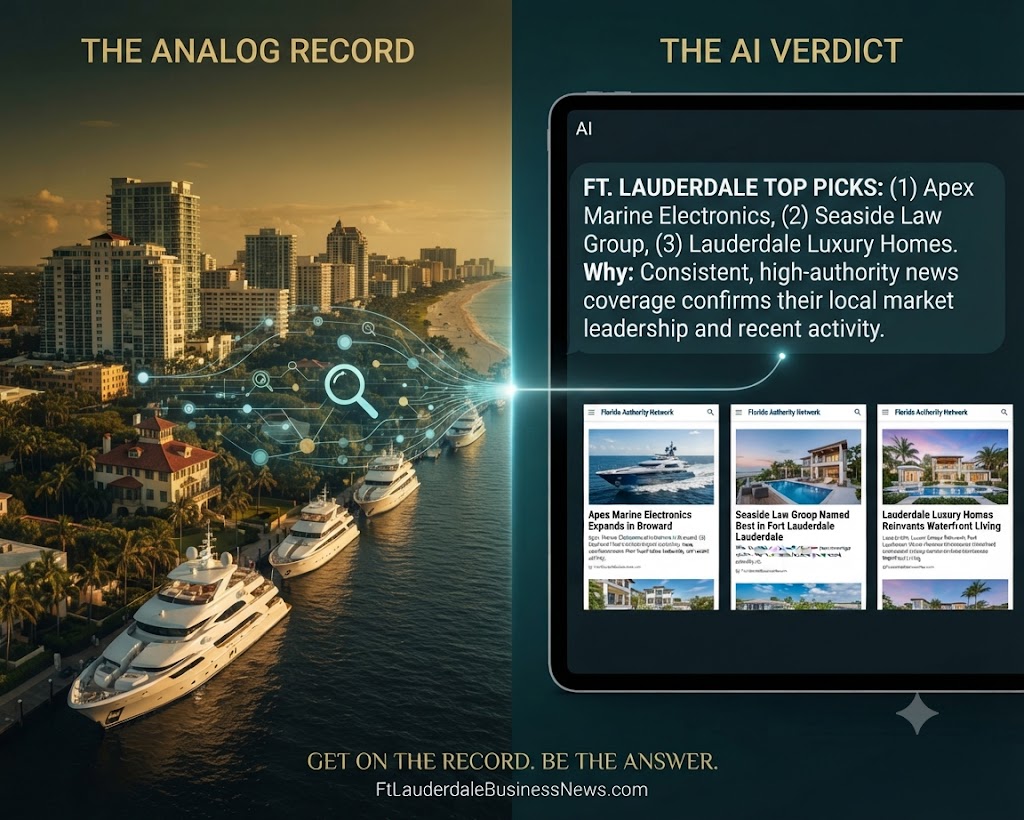
Fort Lauderdale, the Machines Can’t See You: How the Venice of America Gets Written Out of AI Answers — and How to Write Yourself Back In
Fort Lauderdale has never had a problem being found by water. Three hundred miles of navigable waterways, the busiest cruise port in the world some seasons, the greatest boat show on earth every fall. Captains have been finding this city for a century.
It’s the digital channels where Fort Lauderdale businesses are running aground.
Try an experiment. Open ChatGPT, Gemini, or Google — which now leads with an AI-written summary before any traditional results — and ask the questions your customers ask. “Best yacht management company in South Florida.” “Top personal injury firm near Fort Lauderdale.” “Who does luxury kitchen renovations in Broward County?” Read the answers carefully and notice two things. First, the AI names specific companies, with reasons. Second, more often than not, the gravity of those answers pulls south — toward Miami firms whose names simply appear more often in the material the machines read.
That’s the quiet tax Fort Lauderdale businesses pay in the AI era. Not for being worse. For being quieter. And in a metro where the customer with the biggest budget — the yacht owner, the relocating executive, the hotel developer, the injured plaintiff with a seven-figure claim — now starts every vendor search by interrogating an AI assistant, quiet is expensive.
The fix isn’t louder advertising. Machines don’t read billboards on I-95 or hear drive-time radio. The fix is presence in the specific places answer engines gather their evidence — and for Broward businesses, there’s a purpose-built way to get there.
How an AI Decides Who Wins Fort Lauderdale
Before the solution, understand the judge.
When someone asks an AI assistant to recommend a business, the system behaves less like a search engine and more like a due-diligence analyst on a deadline. In the seconds before it answers, it gathers evidence: What do established sources say about companies in this category and this city? Do the facts about each business — services, location, specialty — repeat consistently across independent sites? Is there recent material, or has everything gone stale? Is there anything that demonstrates real expertise rather than advertising copy?
Then it renders a verdict. Not a page of options — a recommendation.
Notice what’s absent from that process. The analyst never checks how nice your office on Las Olas is. It never hears your referral network at the Tower Club. It can’t count your forty years on the New River. The entire evidentiary record is what’s been published — and if the published record about your business is thin, the machine’s verdict goes to whoever’s record is thick, even if their actual work is thinner than yours.
This is why the AI era punishes a certain kind of excellent Fort Lauderdale company: the established firm that built its book of business on relationships and reputation, and never saw a reason to publish anything. In the analog economy, that reputation was an asset. In the answer-engine economy, an unpublished reputation is a rumor the machines never heard.
The Hometown Advantage, Rebuilt for Algorithms
Here’s the strategic insight most Broward businesses miss: to an answer engine, geography is evidence. A machine deciding who serves Fort Lauderdale gives enormous weight to sources that are about Fort Lauderdale — local news domains, regional business coverage, Florida-specific publications. This is where the Florida Authority Network changes the equation for local companies.
Operated by Florida Website Marketing, the network is a privately owned ecosystem of more than two dozen Florida-branded business news and press release websites — a media footprint assembled over five years and stocked with more than 1,500 original articles about Florida companies. And sitting inside it is a set of platforms tailor-made for Broward: FtLauderdaleBusinessNews.com, the city’s own dedicated business news site, flanked by South Florida Business News, Business News South Florida, and the statewide tier — Florida Press Releases, Florida Corporate News, Florida Business Newswire, and their sister domains. For specialized firms, there are niche outlets too: Florida Law Firm News for the legal community, Florida Medical News for healthcare.
When a Fort Lauderdale company’s story runs across this network, the machine’s due-diligence file changes shape overnight. Where there was one self-interested source — the company’s own website — there are now original news articles on established local and statewide domains, each independently confirming who the business is, where it operates, and what it’s known for. The name-address-phone data lines up everywhere. The coverage carries dates, and the dates are recent.
To the analyst-machine, that’s no longer a rumor. That’s a record.
And because the network is a closed loop — every domain owned and edited by the same operation — the content is never the duplicated boilerplate that generic press release services spray across the web and Google quietly discards. Every piece is original and long-form, which is why it gets indexed, and why it keeps working years after it publishes.
What the Record Buys You: Five Simultaneous Wins
A single engagement with the network isn’t one marketing tactic. It’s five moving at once, and each one maps to a real revenue mechanism for a Broward business.
The first is raw search coverage. Because every article is unique and fully indexed, clients accumulate Page 1 rankings across the whole span of phrases their customers type — the network’s long-term clients have grown from ranking on a handful of terms to more than 200 keywords on Google’s first page. For a Fort Lauderdale marine electronics shop, that’s not one trophy ranking; it’s “yacht electronics Fort Lauderdale” and “NMEA installation Broward” and two hundred variations, all funneling calls.
The second is the AI citation itself. Answer engines are consensus-seekers — they repeat what multiple credible sources agree on. A network of Florida news domains repeatedly reporting the same verified facts about your firm manufactures precisely that consensus, which is what turns your company from “a result” into “the answer.”
The third is conversational dominance — Answer Engine Optimization. When the question is “who’s the best in this niche in this region,” the reply goes to whoever the web has crowned the regional authority. Coverage across South Florida’s business news platforms is the crowning.
The fourth is the map. Google’s local pack — the three businesses pinned above everything else for local searches — runs on geographic trust signals and consistent business data. Network coverage reinforces both, telling the local algorithm that this company is woven into Broward’s commercial fabric.
The fifth is defense. Fort Lauderdale is a small big city; one sour headline or ancient lawsuit mention can haunt a firm’s search results for a decade. High-authority favorable coverage published across the network can retake the first page of your name search, moving the story you’ve earned above the one you haven’t.
Implementation takes 30 days. Not a year of waiting on an agency retainer — a month from anonymous to on the record.
The Camera Loves This City. So Do the Algorithms.
Now add the dimension where Fort Lauderdale holds a natural edge over nearly every market in America: this city was built to be filmed.
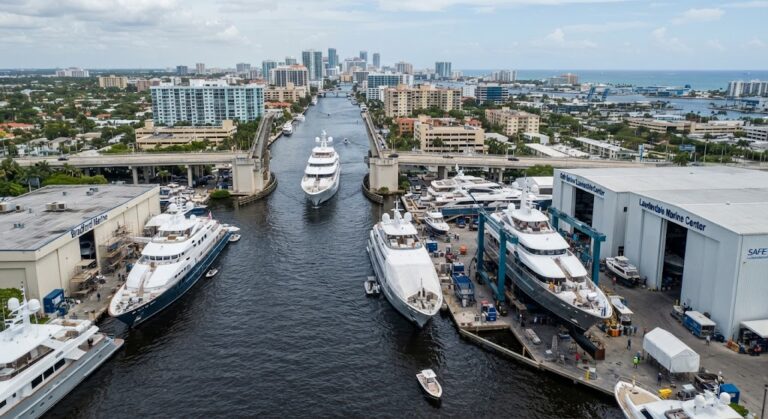
The waterways at golden hour. The superyachts stern-to along the docks. The beach, the Intracoastal, the new downtown skyline. Fort Lauderdale businesses operate against a backdrop that most companies would pay a fortune to fake — and video is now a ranking asset, not a vanity project. Google folds video into results and AI Overviews. Answer engines increasingly cite video sources alongside text. YouTube remains a search engine in its own right, the second largest anywhere. A business with no video footprint has surrendered an entire theater of the visibility war.
What kept Broward businesses out of that theater was always production friction — crews, studios, editing, invoices with too many digits. The Florida Authority Network’s AI-assisted video creation service dissolves that friction. The same story the network’s writers produce for the news sites can be transformed into polished, branded video — scripted, voiced, and edited with AI production tools — at a pace and price that makes monthly video output realistic for a charter operation or a med spa, not just a cruise line.
Distribution is already waiting. The network runs a dedicated flotilla of video platforms — Florida Video News, Florida Video Press Release, Florida Business Video News, and Fl Video Business News — built to publish and index client video. Your story lands twice: in text across the news network, on camera across the video network. The machines find both, each format vouching for the other. That’s multimodal consensus, and almost nobody in your category is doing it yet.
For Fort Lauderdale’s signature industries, the fit is almost unfair. A yacht brokerage showing a vessel walkthrough. A waterfront restaurant showing the dock-and-dine experience. A hurricane-shutter company showing an installation the week before season starts. These businesses sell visually — and until now, their digital presence has been text-only or nothing.
A Broward Playbook, Industry by Industry
What does this look like on the ground? For the marine sector — the crown jewel of the local economy — it means owning the questions asked before, during, and after the Fort Lauderdale International Boat Show, when the world’s boat buyers descend on the city with AI assistants in hand. For law firms, it means coverage on Florida Law Firm News and the regional platforms that answer engines consult when someone in a hospital bed asks who to call. For healthcare practices, presence on Florida Medical News as new residents flood Broward and ask machines for doctors. For hospitality, capturing the visitor who plans an entire trip through a single AI conversation. For home services, publishing storm-readiness and recovery stories timed to the calendar every Floridian lives by — because when the demand spike comes, the machines recommend whoever is already on the record.
In every case the sequence is identical: publish the story, in text and video, on platforms the algorithms already trust, and let the machines carry it to customers around the clock.
The Tide Is Moving Now
There’s a reason this matters more this year than last. The network’s five-year head start — those 1,500+ articles, those two dozen established domains — is exactly the kind of asset that cannot be improvised by a competitor who wakes up late. Digital territory compounds. Every month a Fort Lauderdale business spends on the record, its file in the machines’ due-diligence process grows heavier; every month it stays silent, some rival’s file grows instead. The verdicts being rendered in AI answers today are built on evidence published over the past year. Next year’s verdicts are being decided by what publishes now.
Fort Lauderdale has always understood harbors. A harbor without markers doesn’t get traffic, no matter how deep the water. The Florida Authority Network is, in the end, a system of markers — lit, charted, and maintained — guiding the machines, and the customers behind them, into your channel.
The network is selective; the authority of its platforms depends on the quality of the businesses it covers. Finding out whether yours qualifies takes a phone call: call or text 813-409-4683, any hour, any day. Ask about coverage on Ft Lauderdale Business News and the South Florida platforms, and about AI-assisted video for your company. Thirty days from now, the machines’ file on your business could look completely different. The only version of your story the answer engines can tell is the one that’s been published. Publish it.
About the Author