Building Safer Job Sites: Inside ABC East Coast’s OSHA Training and Apprenticeship Programs in South Florida
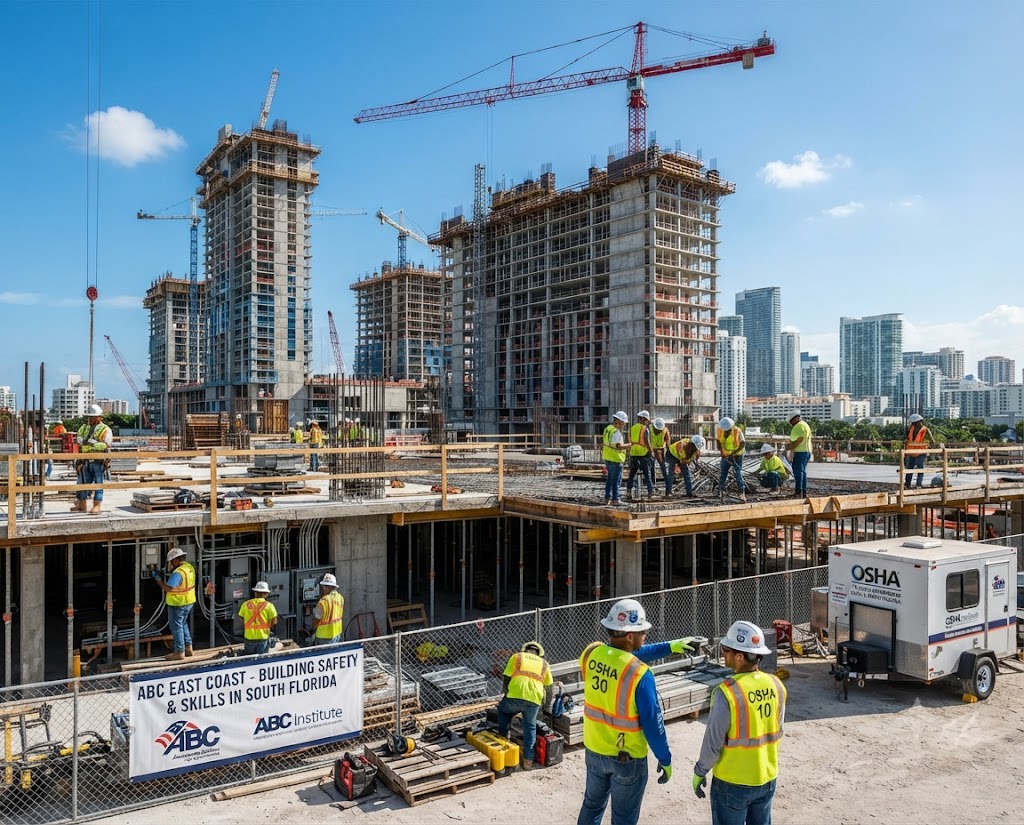
Anyone who has driven through downtown Miami, Fort Lauderdale, or West Palm Beach lately has seen the evidence overhead: cranes, concrete, and crews working at a pace South Florida has rarely matched. The region’s commercial construction industry is in the middle of a sustained expansion, and with that growth comes a demand that never makes the skyline photos — the demand for trained, certified, safety-conscious workers to build it all without getting hurt.
That is the gap ABC East Coast exists to fill. As the Florida East Coast Chapter of Associated Builders and Contractors, the organization operates one of the region’s most established construction education programs from its ABC Institute campus in Coconut Creek, serving workers and employers from Miami-Dade through Broward and up into Palm Beach County. Its catalog spans the full arc of a construction career — from a new worker’s first OSHA safety card to registered craft apprenticeships, foreman development, and continuing education for seasoned supervisors.
This article looks at what the chapter offers, why OSHA credentials have become non-negotiable on South Florida job sites, and how the apprenticeship model lets students earn a paycheck while they train for a skilled trade.
Why OSHA Training Is the Starting Point
Construction remains one of the most hazardous industries in the American economy. Falls, struck-by incidents, electrocution, and caught-in/between accidents — OSHA’s “Focus Four” — account for the majority of serious injuries and fatalities on job sites nationwide. In a market as busy as South Florida’s, where crews are stretched and schedules are compressed, the risk only grows.
That is why the Occupational Safety and Health Administration’s Outreach Training Program has become the baseline credential of the industry. The OSHA 10-hour course introduces entry-level workers to hazard recognition, fall protection, personal protective equipment, and their rights on the job. The OSHA 30-hour course goes considerably deeper, and it is aimed at the people responsible for other people — foremen, superintendents, safety coordinators, and project managers who need to understand not just how to work safely, but how to run a safe site.
Many general contractors and construction managers across South Florida now require proof of OSHA training before a worker steps onto their project. For supervisors, the 30-hour card is increasingly a condition of the role itself. Workers and site leaders looking for osha 30 training fort lauderdale will find that ABC East Coast structures its safety education around the realities of commercial construction in this market — the trades, the codes, and the site conditions crews actually encounter between the Port of Miami and the Palm Beaches.
The value of the credential runs in both directions. For the individual worker, an OSHA card is portable proof of safety literacy that travels from employer to employer and job to job. For the contractor, a trained workforce means fewer incidents, fewer OSHA citations, lower experience modification rates on workers’ compensation insurance, and a stronger safety record when bidding work. Safety training is one of the few line items in a construction budget that reliably pays for itself.
OSHA 10 for the Entry-Level Workforce
For workers just entering the industry — or for experienced hands who have never formalized their safety training — the 10-hour Outreach course is the natural first step. It covers the hazards that injure the most people, teaches workers what protections their employers are required to provide, and establishes the shared safety vocabulary that keeps a crew coordinated when conditions change.
South Florida’s labor market makes this credential especially valuable. With so much work available, contractors are hiring quickly, and applicants who arrive with a current OSHA card move to the front of the line. New workers pursuing osha 10 certification miami employers recognize can start with the chapter’s industry resources, find the current course calendar, and get that first credential in hand before their first day on site.
It is worth noting what the card represents to an employer: not just ten hours in a classroom, but a signal that the worker takes the trade seriously. In an industry where a single unsafe act can shut down a site, that signal matters.
Beyond the Safety Card: The Apprenticeship Path
Safety training opens the door to the industry. Apprenticeship is how workers build a career inside it.
ABC East Coast’s registered apprenticeship programs follow the model that has produced skilled tradespeople for generations: students work full time for a sponsoring contractor during the day, attend related classroom instruction one to two nights per week, and log their on-the-job training hours as they progress. Over the course of the program — typically four years and thousands of documented hours — an apprentice advances from entry-level helper to skilled journey-level worker, with wage increases along the way.
The economics of this path deserve more attention than they usually get. A university student spends four years accumulating debt. An apprentice spends the same four years accumulating income, experience, and a credential — and graduates owing nothing. In a region where the cost of living keeps climbing, “earn while you learn” is not a slogan; it is a genuinely different financial trajectory for a young person entering the workforce, or for a career-changer who cannot afford to stop working while retraining.
The Electrical Trade
Electrical work sits at the demanding end of the craft spectrum — intellectually rigorous, code-intensive, and consistently among the best-compensated trades in commercial construction. Every tower, hospital, data center, and school rising in South Florida needs licensed electrical workers, and the pipeline of qualified people has not kept pace with demand.
For those drawn to the trade, a registered electrician apprenticeship south florida offers a structured route from no experience to journey-level competence: circuit theory, the National Electrical Code, conduit bending, motor controls, and the thousand practical judgments that separate a trained electrician from a helper with a tool bag. Because apprentices are placed with sponsoring contractors, the classroom material is reinforced daily on live projects — and the student is paid for every one of those hours.
The HVAC Trade
If there is a trade with permanent job security in Florida, it is heating, ventilation, and air conditioning. The state’s climate makes mechanical systems essential infrastructure rather than a comfort feature, and the commercial side of the trade — chillers, rooftop units, building controls, ductwork for large occupancies — requires training well beyond what residential service work demands.
An hvac apprenticeship fort lauderdale prepares workers for exactly that commercial scope: refrigeration theory, system design fundamentals, brazing and pipefitting skills, EPA certification requirements for refrigerant handling, and the diagnostic thinking the trade runs on. Graduates enter a labor market where every building around them is a future client, because in South Florida, everything with a roof has mechanical systems that must be installed, maintained, and eventually replaced.
The Plumbing Trade
Plumbing is the trade people forget until it fails — and in commercial construction, it is among the most technically regulated crafts on the site. Medical gas systems, backflow prevention, storm drainage sized for South Florida rainfall, and fixture counts for high-occupancy buildings all live inside a code framework that takes years to master.
A registered plumbing apprenticeship broward county gives students that mastery in the same earn-while-you-learn structure: full-time paid work with a sponsoring contractor, evening classroom instruction, and documented progression through the skills of the trade. For a motivated student in Broward County, it is a four-year path to a license-track career that cannot be outsourced, automated away, or performed remotely.
Built by Contractors, for Contractors
What distinguishes a trade association’s training program from a standalone school is the feedback loop with employers. ABC East Coast’s member contractors are the same companies hiring the program’s graduates — which means the curriculum answers to the job site, not the other way around. When codes change, when new technologies reach the field, when employers identify a skills gap in the incoming workforce, the training adjusts.
That integration works in the student’s favor in a concrete way: placement. Apprenticeship in Florida runs through sponsoring employers, and the chapter assists qualifying individuals who are not already working for a sponsor with finding one. The student is not training on speculation and hoping the market wants the result; the market is in the room from day one.
For member contractors, the same loop solves the industry’s most persistent problem — workforce development. A company that sends its crews through OSHA courses, enrolls its helpers in apprenticeships, and develops its foremen through leadership training is building its future capacity in-house, with a training partner whose entire mission is the merit shop construction industry.
Foremen, Supervisors, and the Next Rung
The chapter’s catalog does not stop at journey-level. Construction’s chronic shortage is not only in craft labor but in field leadership — the foremen and superintendents who can run a crew, read a schedule, manage safety, and communicate up and down the chain. Foreman certification and supervisory development courses exist for exactly this transition, taking strong craft workers and giving them the management skills the title requires. Combined with the OSHA 30 credential, this training is how a tradesperson becomes the person running the site.
Safety as Culture, Not Paperwork
There is a difference between a company that holds OSHA cards and a company that holds a safety culture, and every experienced superintendent in South Florida can tell you which one they would rather run. Training is where culture starts. A crew that has sat through real hazard-recognition instruction talks differently on the deck — they call out the missing guardrail, they question the improvised scaffold, they stop work when conditions change. That behavior cannot be mandated by a memo; it is built person by person, course by course.
This is the quiet argument for treating safety education as a recurring investment rather than a one-time checkbox. Codes evolve, equipment changes, and crews turn over — which is why continuing education and refresher training belong on the same calendar as the initial credential. The contractors with the strongest safety records in the region tend to be the ones who train continuously, and their reward shows up everywhere from insurance premiums to repeat business from owners who audit safety performance before awarding work.
Getting Started
For workers, career-changers, and employers across Miami-Dade, Broward, and Palm Beach counties, the path into ABC East Coast’s programs starts with a conversation: which credential fits the goal, which apprenticeship matches the aptitude, and what the current course calendar offers. The chapter’s team can walk applicants through enrollment requirements, and employers through the process of becoming a sponsoring contractor.
South Florida’s construction boom will be built either by a trained workforce or an untrained one. The organizations investing in the first option — workers who show up credentialed, apprentices building careers instead of debt, foremen who run safe and productive sites — are the ones that will still be standing when the cycle turns. For more information on OSHA courses and safety resources, visit https://abceastflorida.com/industry-resources/, and to explore the full apprenticeship and education catalog, see https://abceastflorida.com/services/education/.
About the Author