Sun, Sand, and Serious Money: Inside Fort Lauderdale’s Tourism Economy
Fort Lauderdale has spent decades shedding its old “Spring Break capital” reputation, and the transformation has paid off in a way the numbers make impossible to ignore. Tourism is no longer just an industry in Greater Fort Lauderdale — it is the economic engine of Broward County, touching everything from hotel housekeeping jobs to convention-center construction to the property-tax bills of residents who never set foot on a tour boat. This article looks at the size and shape of that business today, the destinations driving it, and the dollars and jobs it generates across the region.
A Record-Setting Visitor Economy
The headline figure tells the story: in 2025, Greater Fort Lauderdale welcomed more than 20.9 million travelers, according to Visit Lauderdale, the official destination marketing organization for Broward County. That visitor volume is roughly three times the county’s entire resident population, and it places Fort Lauderdale firmly among Florida’s most important tourism markets, behind only the Orlando and Miami metros in overall scale.
Those visitors generated $124 million in Tourist Development Tax (TDT) revenue in 2025, a slight year-over-year increase of about 0.3 percent. The TDT is a 6 percent surcharge collected on hotel and short-term lodging bookings throughout Broward County, and it is the single clearest barometer of how much money is flowing through the destination’s accommodations sector. The 2025 figure came on the heels of 2024’s roughly $125.4 million in tax revenue — the second-highest total in the county’s recorded history. The fact that collections have plateaued at record-adjacent levels for two consecutive years signals a destination that has matured into sustained, high-volume demand rather than boom-and-bust swings.
It is worth placing this in statewide context. Florida’s tourism industry as a whole delivered a record $133.6 billion in economic impact in 2024, with out-of-state visitors spending nearly $135 billion, according to Visit Florida’s annual study produced by Rockport Analytics. Travel and tourism accounted for 7.8 percent of Florida’s gross state product, supported 1.8 million jobs, and generated $33.6 billion in state, local, and federal taxes. Greater Fort Lauderdale is one of the most significant contributors to that statewide total, and the local data mirror the state’s upward trajectory.
Tourism by the Numbers
| Metric | Figure | Period / Source |
|---|---|---|
| Annual visitors to Greater Fort Lauderdale | 20.9 million+ | 2025, Visit Lauderdale |
| Tourist Development Tax revenue | $124 million | 2025, Visit Lauderdale |
| Tourism-supported jobs (direct + indirect) | ~101,700 | Visit Lauderdale |
| March 2026 hotel occupancy | 85% (+6% YoY) | Visit Lauderdale |
| March 2026 average daily rate (ADR) | $240.49 | Visit Lauderdale |
| Port Everglades total economic impact | $48.3 billion | FY2025, Martin Associates |
| Port Everglades cruise guests | 4.7 million (record) | FY2025 |
| Fort Lauderdale Int’l Boat Show impact | $1.79 billion | 2024, statewide |
| Florida statewide tourism economic impact | $133.6 billion | 2024, Visit Florida |
What Tourism Means for Jobs and Residents
Behind the abstract numbers are paychecks. Tourism in Broward County directly and indirectly supports approximately 101,700 jobs every year — hotel staff, restaurant workers, charter-boat captains, museum employees, rideshare drivers, retail clerks, and the thousands of small-business owners whose livelihoods depend on a steady stream of visitors. In a county of roughly two million residents, that means a meaningful share of the local workforce is connected, directly or indirectly, to the visitor economy.
The benefits extend beyond those who work in hospitality. Tourist Development Tax revenue funds destination marketing, beach maintenance and renourishment projects, and operations and capital improvements at the Broward County Convention Center, among other initiatives written into the county’s adopted budget. In other words, a tax paid almost entirely by out-of-town visitors underwrites public assets — clean beaches, a world-class convention facility, promotional campaigns — that residents also enjoy. Statewide, Visit Florida estimates that tourism saves the average Florida household nearly $2,000 per year in taxes they would otherwise have to pay to maintain current service levels. Broward residents share in that dividend.
The momentum carried into 2026. Hotels across Greater Fort Lauderdale posted 85 percent occupancy in March 2026, a 6 percent jump over the same month a year earlier, while hotel demand rose 9 percent year over year and the average daily rate climbed to $240.49. Rising occupancy and rising room rates simultaneously is the combination hoteliers dream about — it indicates demand strong enough to fill rooms without discounting, which flows directly to the bottom line and to the TDT collections that fund public projects.
The Top Tourist Destinations Driving the Economy
Fort Lauderdale’s appeal rests on a handful of marquee assets, each of which functions as its own economic sub-engine. Understanding the tourism business means understanding where the visitors actually go.
Fort Lauderdale Beach and the Beachfront Promenade
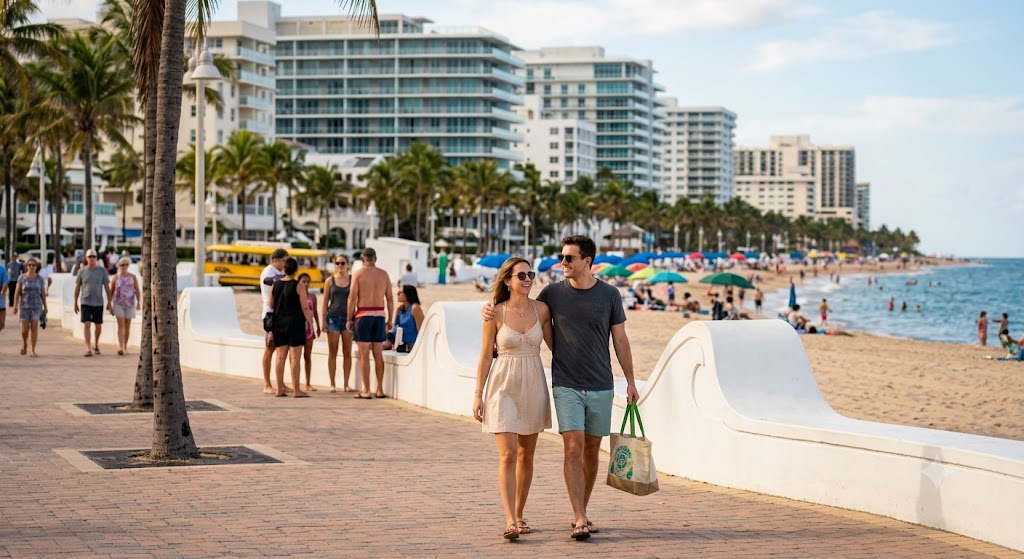
The two-plus-mile stretch of Atlantic coastline anchored by its signature white wave wall and brick-paved promenade is the destination’s calling card. Free and open to the public — as are all eight of the area’s beaches — the beachfront draws sunbathers, swimmers, paddleboarders, and joggers year-round, and the luxury hotels and restaurants lining State Road A1A capture the spending that follows. The beach is the reason most leisure travelers choose Fort Lauderdale in the first place, and the hotel district built around it is where the bulk of TDT revenue originates.
Las Olas Boulevard
If the beach is the destination’s heart, Las Olas Boulevard is its wallet. This walkable corridor of boutiques, art galleries, sidewalk cafés, and nightlife venues is where visitors convert a beach vacation into retail and restaurant spending. The adjacent Las Olas Oceanside Park (part of a green-space network locally branded “The LOOP”) hosts farmers markets, fitness classes, and live music, extending the area’s appeal beyond shopping. For the local economy, Las Olas represents high-margin discretionary spending concentrated in a compact, easily marketed district.
Port Everglades: The Cruise and Cargo Powerhouse
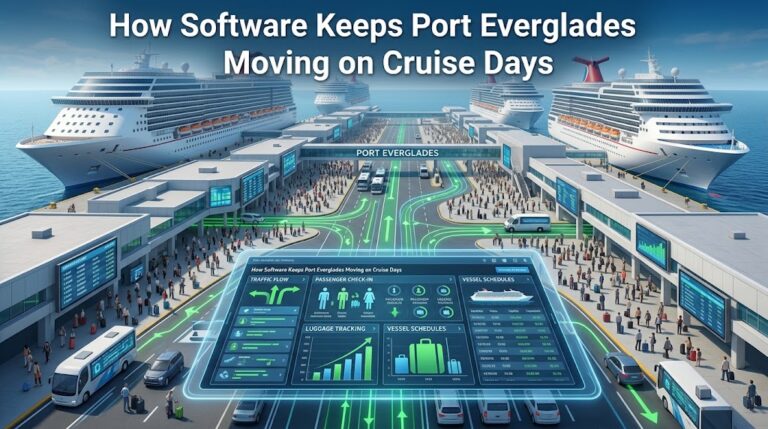
No single asset moves the economic needle like Port Everglades. Consistently ranked among the three busiest cruise homeports on the planet, the port set a record in fiscal year 2025 by handling 4.7 million cruise guests, a 21.7 percent increase over the prior year, while also moving record container-cargo volumes. Its total economic impact reached a staggering $48.3 billion in FY2025 — a figure that, for the first time, fully accounted for the port’s petroleum and energy distribution alongside cruise and cargo. That activity supports roughly 300,000 jobs statewide and generates nearly $1.9 billion in state and local taxes.
Even setting aside cargo and fuel, the cruise dimension alone is a tourism juggernaut. Port Everglades sits less than two miles from Fort Lauderdale-Hollywood International Airport, making it the closest cruise port to a major airport in the United States — a logistical advantage that funnels embarking and disembarking passengers into local hotels, restaurants, and shops before and after their voyages. Visit Lauderdale reported that the port welcomed more than four million cruise passengers in calendar-year 2025, up 16.2 percent from 2024, and every one of those travelers is a potential pre-cruise hotel night and restaurant tab.
The “Venice of America” Waterways
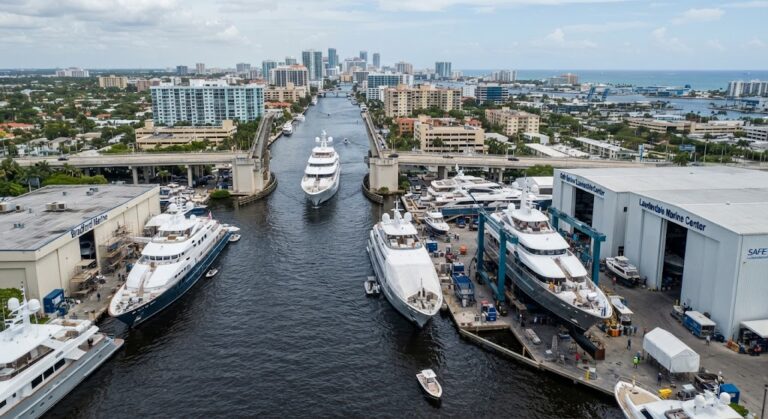
Fort Lauderdale’s more than 300 miles of navigable canals and waterways give it the “Venice of America” nickname and a tourism product no inland city can replicate. Water taxis, sightseeing cruises, gondola rides, and the long-running Jungle Queen Riverboat — a local institution for more than six decades — turn the Intracoastal Waterway and New River into revenue-generating attractions. The waterways also showcase “Millionaires Row,” the waterfront mansions and mega-yachts that reinforce the region’s luxury positioning and feed the yachting and marine-services industry that is so central to the local economy.
Hollywood Beach Broadwalk
Just south of Fort Lauderdale proper, the Hollywood Beach Broadwalk stretches more than two miles along the ocean, lined with hotels, casual restaurants, bars, and shops. Known for its laid-back, “Old Florida” character, it draws a steady flow of cyclists, skaters, and beachgoers, and complements the Fort Lauderdale beach experience with a different, more nostalgic flavor. Nearby attractions like ArtsPark at Young Circle and the Seminole Hard Rock Hotel & Casino broaden Hollywood’s draw.
Riverwalk, the Arts District, and Cultural Attractions
Downtown’s Riverwalk — a landscaped boardwalk along the New River — connects a cluster of cultural anchors including the Broward Center for the Performing Arts, the NSU Art Museum Fort Lauderdale, and the Museum of Discovery and Science. Historic sites such as the Stranahan House (the city’s oldest surviving structure) and the Bonnet House Museum & Gardens, along with the natural escape of Hugh Taylor Birch State Park, give the destination cultural and historical depth that helps extend visitor stays and attract a broader demographic than sun-seekers alone.
Sawgrass Mills and the Everglades
Two attractions just beyond the beachfront round out the visitor map. Sawgrass Mills, one of the largest outlet and retail destinations in the country with hundreds of stores, is a major shopping draw that pulls both tourists and regional day-trippers. And roughly half an hour inland, the Everglades — accessible via airboat tours at Sawgrass Recreation Park and Everglades National Park — offers the kind of wildlife-and-wilderness experience that international visitors in particular seek out, often as a half-day excursion bookended by Fort Lauderdale hotel stays.
Conventions and Big Events: The MICE Strategy
Leisure travel is the foundation, but Greater Fort Lauderdale has deliberately invested in the higher-yield meetings, incentives, conventions, and exhibitions (MICE) segment. The newly expanded Broward County Convention Center is the centerpiece of that strategy. In 2025, Visit Lauderdale booked 48 conventions at the facility, representing an estimated 265,000 hotel room nights and roughly $801 million in economic impact. Convention attendees are especially valuable because they typically book multiple hotel nights, dine out repeatedly, and spend during off-peak periods that leisure travelers tend to avoid — smoothing out the seasonality that challenges every beach destination.
The convention center expansion is paired with a wave of hotel development, headlined by the 29-story Omni Fort Lauderdale Hotel adjacent to the center, one of four major hotel properties that came online around 2025. That added room capacity is precisely what allows the destination to compete for the largest national and international conventions.
The region’s event calendar amplifies the MICE push. In a major coup, Greater Fort Lauderdale hosted IPW, the U.S. Travel Association’s largest and most influential international travel trade show, in May 2026 — an event that brings thousands of travel buyers, journalists, and tourism professionals from more than 60 countries and showcases the destination to the global travel trade.
The Marine Industry and the World’s Largest Boat Show
Few events illustrate the intersection of tourism and a specialized local industry better than the Fort Lauderdale International Boat Show (FLIBS). Held annually since 1961 and billed as the largest in-water boat show in the world, FLIBS sprawls across seven waterfront locations — including the convention center, Bahia Mar, Las Olas Marina, and the Superyacht Village at Pier Sixty-Six — connected by water taxis and shuttles.
The economics are extraordinary. The 2024 edition drew more than 100,000 attendees, displayed roughly 1,300 boats, and featured about 1,000 exhibitors from 52 countries, generating an estimated $1.79 billion in statewide economic impact, including more than $700 million in sales by Florida companies and tens of millions in state and local taxes (with roughly $24.5 million staying in Broward County). Organizers estimate that about half of attendees travel from out of state, filling hotels and restaurants during the show’s run each fall.
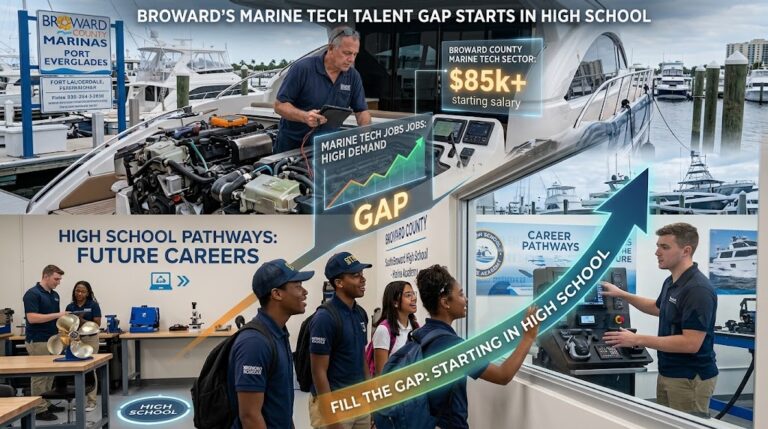
FLIBS is the public face of a much larger marine economy. Greater Fort Lauderdale is a global hub for yacht building, repair, brokerage, and crewing, with Port Everglades anchoring the logistics. The marine sector supports tens of thousands of skilled jobs and feeds a workforce pipeline that runs through local schools and technical colleges — a reminder that “tourism” in Fort Lauderdale blends seamlessly into high-value industrial activity.
Strengths, Challenges, and the Road Ahead
Fort Lauderdale’s tourism business enters the second half of the 2020s from a position of strength: record visitation, record-adjacent tax revenue, a record cruise season, rising hotel rates, and a deliberate, well-funded push into conventions and international markets. The destination has successfully diversified away from a single demographic and a single season, building a portfolio that spans budget beachgoers, luxury yacht owners, cruise passengers, convention delegates, and cultural travelers.
That said, the industry faces real headwinds worth watching. Hotel demand growth has cooled to the low single digits, suggesting the explosive post-pandemic rebound has normalized into steadier, more modest expansion. A softer consumer-spending environment could pressure discretionary travel. Climate and insurance costs — perennial concerns for coastal Florida — add long-term risk to both infrastructure and the affordability of operating hospitality businesses. And the destination competes directly with Miami to the south and Palm Beach to the north for the same pool of visitors and conventions.
Still, the structural advantages are formidable: an international airport minutes from the beach and the cruise port, 300 miles of waterways, an expanded convention center, a marquee global boat show, and a marketing organization that has clearly sharpened its strategy. For Broward County, tourism is not a sideline. It is the foundation of the local economy — generating the jobs, the tax revenue, and the public investment that shape daily life for residents and visitors alike. As long as the beaches stay clean and the cruise ships keep sailing, that foundation looks built to last.
Sources and Further Reading
- “Tourism Fuels Broward County’s Economy with Strong Start to 2026,” Visit Lauderdale — visitlauderdale.com
- “Tourism drives strong economic performance in Broward County in early 2026,” TravelDailyNews
- “Visitor Spending in Greater Fort Lauderdale Continues to Drive Broward Economy,” South Florida Business & Wealth — sfbwmag.com
- “Greater Fort Lauderdale Celebrates National Travel and Tourism Week,” Travel And Tour World
- “Tourism in Florida Delivers $133.6 Billion in Economic Impact,” Executive Office of the Governor / Visit Florida (Rockport Analytics study)
- “Port Everglades Contributes $48.3 Billion in Economic Impact” (FY2025, Martin Associates), Maritime Executive and Port Everglades — porteverglades.net
- “Port Everglades’ Economic Impact Exceeds $28 Billion” (FY2024), Port Everglades
- “FLIBS Show Overview” and economic-impact figures, Fort Lauderdale International Boat Show — flibs.com
- “Fort Lauderdale International Boat Show touts $1.8 billion of economic impact,” WLRN
- “Top 10 Things to Do in Fort Lauderdale” and attractions listings, Visit Lauderdale and Visit Florida
- Greater Fort Lauderdale Alliance, Marine Industries overview — gflalliance.org
Figures reflect the most recent publicly available data as of mid-2026 and are subject to revision. Economic-impact estimates from different organizations use different methodologies and reporting periods (calendar year vs. fiscal year), so totals should be compared with that in mind. This article is informational and not intended as investment or business advice.
About the Author